
Compile the evidence file
The examination from the target criterion to the final stage is documented.
SAMPLE
APPROVAL
From target criterion to repeatable test
Imagine another subject receiving the updated inventory, two test reports and a release. From the dossier it must immediately identify which service was checked, what condition applied and to what state of the decision relates.
The memory change of the fictitious port bank is based on two separate test criteria. Payment processing can be reached while alarming continues to fail. For both statements, the appropriate documents must be found.
Select a checkpoint and guide a second person through the file. This should find the expected alarm, the checked status and location of the observation and derive the clearance decision from it. Such a reading test makes evidence that is present in the file visible but belongs to the wrong version.
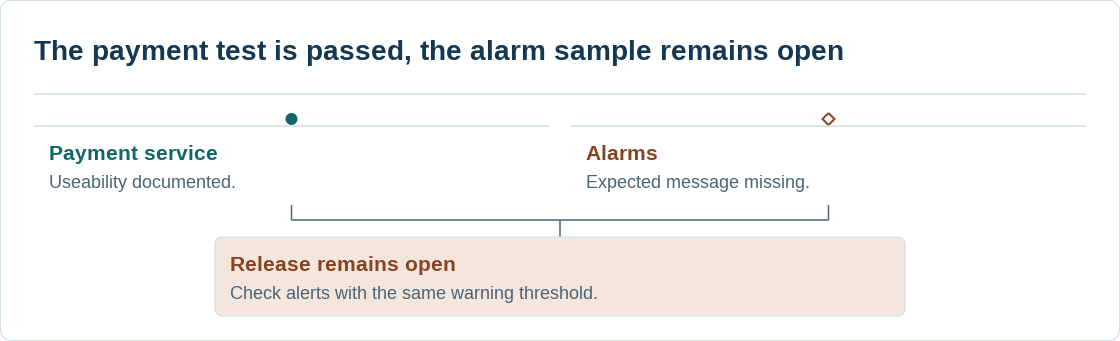

Read the test track from the target criteria to the documents. In the fictitious memory example only a documented follow-up test bears the release of the alarm.
Establish the test file from target criterion to completion
Start with a controllable test job and use the same reference throughout the dossier. The following steps show which documents are in the release.
Set the test task and baseline
Describe the payment processing, the memory change and the checked time window. Take over from the change order the exact system status. Arrange prior to the sample separate target criteria for recovery and for receipt of the alarm at call readiness.
Testable supporting evidence A dated audit task with affected function, scope, version, target criteria and responsible role.
Document the sample in such a way that it is repeatable
For each setpoint criterion, specify which source is the actual value. When alerting, keep the relevant time window of the logs together, the expected alert threshold and the observation of call readiness. Hold on to why this sample was selected.
Testable supporting evidence A clear assignment of target, source and is. In the first sample the service is available, the expected alarm is missing.
Connect findings, corrections and release
Name cause, changed assignment of monitoring, responsibility and appointment. Repeat the sample after correction with the same warning threshold and receiver. Do not vote for the test conditions, justify the deviation and note which statement the new test is carrying.
Testable supporting evidence A follow-up test with an alarm observed and a release that refers to exactly this verified version.
A missing alarm keeps the release open
The fictitious port bank switches back on the payment processing after a memory change. The first payments can be processed. However, the alarm agreed for the test does not respond to the call readiness.
What the first test proves
The restored service is available. Event log and call readiness protocol together prove that the alarm path in this version does not work.
What the release carries
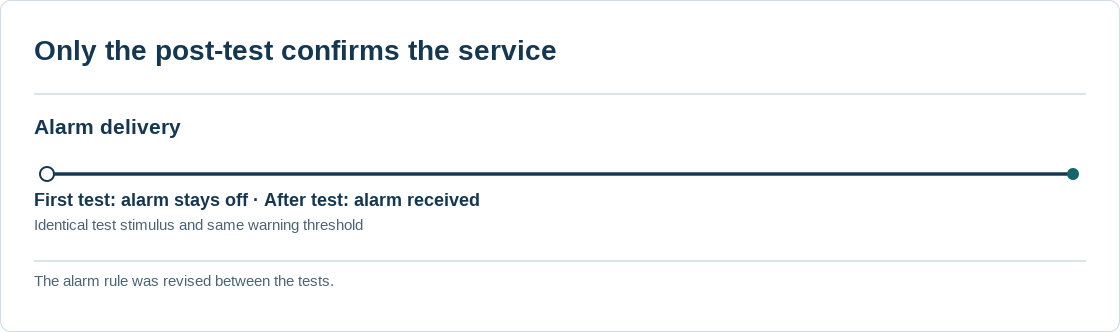
The test is performed using the same warning threshold, the same reporting path and a confirmed system level. The test file identifies triggers, received alarm and checking person. Only after that the result is closed.
- What you are examining
- In the test file, separate the technical proof of re-access to payment from the report. In both cases, refer to the identical test bench and to the respective approved criterion.
- What the post-test decides
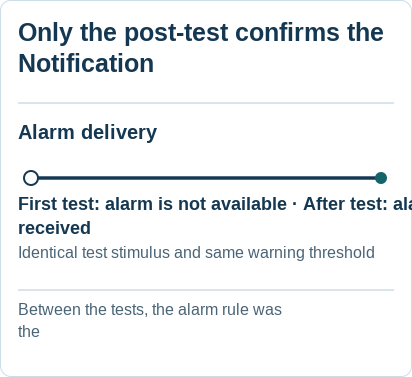
- Compare the alarm delivery in the post-test with the same warning threshold. The final receipt contains time, receiver and confirmation of the corrected version tested.
The target criterion remains the same for the post-test
The original warning threshold is re-used after correction. The alarm receipt and the time are documented in the test file.
From the blog
Test documents for a comprehensible revision
Deepen as documents are named, assigned to each other and kept for a later test to be found.
Templates and worksheets
The filler tool is directly under the task. Download the template for editing or open the Quick View.
Support index for repeatable test
Create a repeatable index that holds together target criterion, sample, source and responsible rating.
Outcome A second person may re-examine the examination without additional knowledge using the same referenced files.
Read the instructions
Fictional example A test protocol refers to a log extract whose file name remained unchanged after filing while the version was updated. The log proof shows the status instead of during the checked time window.
- Evidence of decision Capture observation, scope and evidence per test step. Clear each open result before release.
- Linking Evidence For relevant checkpoints, deposit the specific source, the verified version and the proof ID.
- Treatment of deviation Secure the original version and keep the results up to approved release.
Assign DORA to the German examination report
Compare the examination order of the respective institute type with the DORA work steps. The test view leads from the German location to the appropriate detection sample.
Legal basis for this task
The regulations answer two questions of the test example. When does the risk framework come to the test bench? How can we understand the correction of a test result?
DORA Article 6(5) · Review risk framework
Paragraph 5 describes when the ICT risk management framework is documented and reviewed, including findings from relevant resilience tests and audits.
For your exam Check whether the alarm results give reason to check the control concept. Link the decision note with the test protocol.
DORA Art. 24 para. 5 · Track test results
Paragraph 5 requires a procedure for the assessment and correction of test results and internal validation for the financial undertakings covered outside micro-enterprises.
For your exam In the subsequent test, document the receipt of the alarm using the same target criterion as in the first test. This allows us to understand how the correction can be done in the test file.

List DORA sources of law
Official acts, technical standards, register templates and references of EBA and Bundesbank are available after work. For internal evaluation, assessments on EUGRC.AI are available.

