
Cyber Resilience Act
Determine which requirements apply to your digital product and what to verify before and after release.
CONFORMITY
MAINTENANCE
Which product and what decision are to be taken?
The Cyber Resilience Act concerns products with digital elements which is made available on the Union market and has a intended or reasonably foreseeable connection relationship. Check the exact scope, exceptions and market role of each product.
Start with a specific version. Capture the necessary remote function, actual delivery and intended use environment. For release you combine protection effect, component list and explanation. After delivery, update maintenance, product safety and reporting check remain your own tasks.
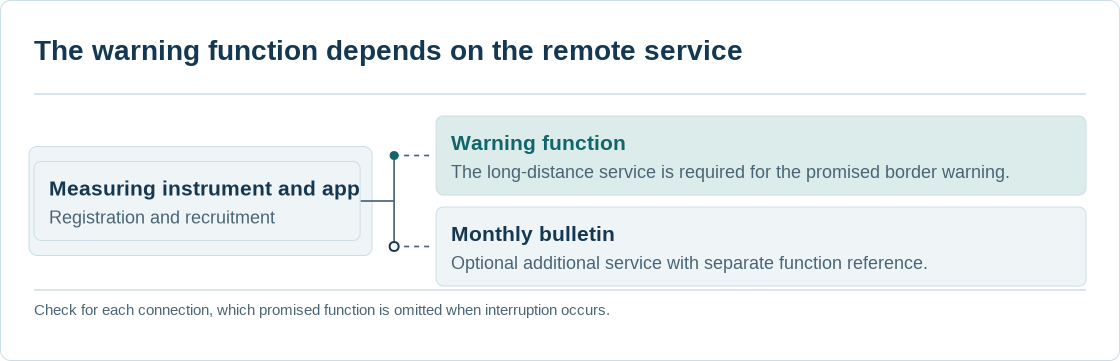
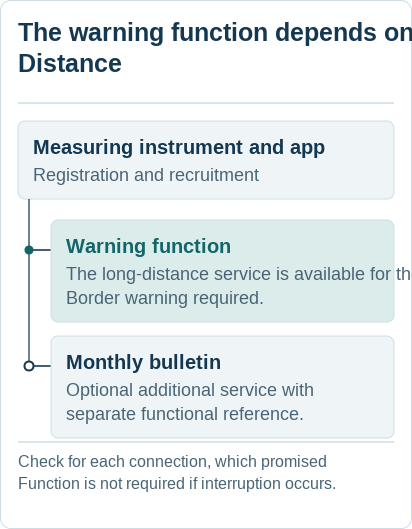
The decisive factor is which promised function is omitted in the separation sample. Check also the development responsibility.
When will the task be fulfilled?
Manufacturers' reporting obligations have to be checked since 11 September 2026. The general requirements are generally subject to 11 December 2027. For products previously placed on the market, the transition and a substantial change are also important.
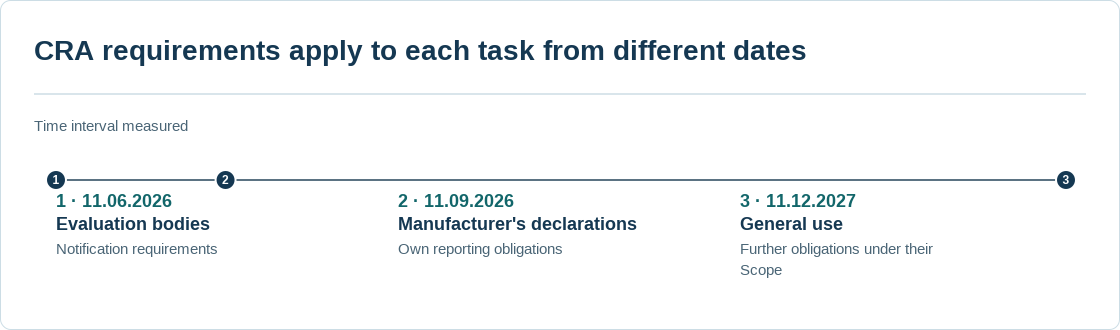
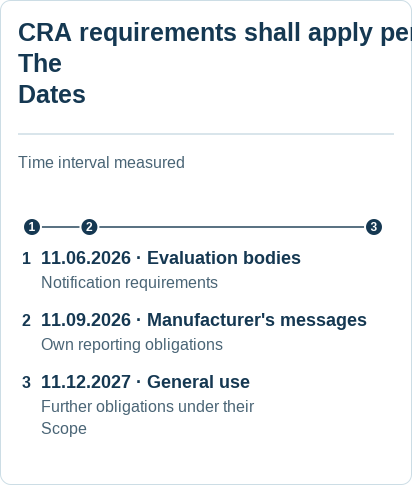
First, you must set the right date. In case of existing products, you also check the transitional rule.
Choose the appropriate CRA work path
Start with the product limit if scope or roll are still unexplained. If there is a reliable indication of a safety incident, select the reporting path directly.
Case studies
Edit a specific case and check how a modified observation postpones the decision.
Select Case studiesArticle index
Find the relevant obligation and a comprehensible checkpoint.
Open tabTemplates and worksheets
Document a product version, delivery decision or message with your own data.
Viewing work aidsReporting training
Practice which observation triggers the CRA reporting process.
Start exercise
Organize product and responsibility
First, clarify product scope, market role and deadline. The classification determines who needs which tests.
Product scope and remote processing
Detect hardware and software, Union market and data connection. Check necessary remote processing and optional additional services separately
View the guideApplication data and inventory products
The existing products are classified according to documented initial provision and subsequent modification.
View the guideProduct category and test procedures
Arrange the core function as set out in Annex III or IV and link it to the actual conformity procedure.
View the guideProducers, importers and distributors
Assign manufacturer, importer and distributor roles per sales model and examine the change in the case of a self-brand or substantial change.
View the guide
Release the specific delivery level
Match protection effect, parts list, test procedures and technical documentation to the same delivered version.
Safety requirements and risk
From cyber risk assessment to sample of the delivered product. Document protection effect, findings and counter-sample version-related.
View the guideComponents, SBOM and suppliers
Match dependencies in the delivery stand, machine-readable SBOM and supplier documents. Hints and remedy lead to the affected version.
View the guideConformity, declaration and release
Conformity procedures, technical documentation, product status and EU declaration of conformity prior to placing on the market
View the guide
Organize product safety after delivery
Secure maintenance and update access. When observing, check promptly whether a mandatory message is triggered.
Support period and security updates
Expected useful life and support. Check security updates, download availability and visible consumer information in concrete terms.
Check support and updatesVulnerabilities and knowledge
Check raw evidence from a weak point against product versions and record the time of confirmed active use.
Identifying the time of knowledgeReporting route and deadlines
record early warning, follow-up notification and completion for the appropriate CRA reporting mode with time basis and transmission document.
Check the reporting route and deadlines
Continue working after the first product release
If the purpose, delivery stock or responsibility is established, choose the appropriate follow-up or follow-up decision.
Change, care and supervision
Choose the way to work for care, substantial change, supervision or multiple duties.
Open OverviewRelease laboratory
Change the observed condition of a release and check the effect on your decision.
Start exercise
Secure a release with original documents
If a test report is available, check its reference to the version delivered. If there is a deviation, secure the original scale for the next attempt.
Test files and evidence
Select the test that supports your decision. Connect product capture, observed effect and release in the same review file.
Select Test TaskCRA file check
Check in three short situations which original documents actually carry a decision. Each document receives its own justification.
Practice the selection of documents
Check product protection, market access and procurement in detail
Select the test matrix for a complete examination of Annex I. For concrete approval or procurement, start with the result that needs to be decided.
Test matrix Annex I
Arrange product characteristics and vulnerability treatment per location. Each line leads to detection, counter-testing and work help.
Use the test matrixCheck Module H and job size
Determine product class, confirmed scope of a notified body and approved quality system prior to process approval.
Examine the scope of proceedingsProcuring with product proof
Compare the product version offered, practical manufacturer proofs and promised care with the specific requirements.
Checking evidence of procurement
Working from product scope to proof of conformity
Put product description, variant list, software levels and the assignment of economic operators side by side.
Delimiting the product family
Capture variants, software levels, intended use and the responsible economic player role. Document differences that can change the classification.
Preparing for conformity
Arrange cybersecurity requirements, risk assessment, evidence and technical documentation for the respective product variant. Set the relevant procedure.
Organise maintenance and reporting
Determine responsibility for the treatment of vulnerabilities, security updates and, if necessary, notifications. Use the applicable type and application data.
Secure the statement with a sample
Select a released variant and check whether risk assessment, technical documentation and care process indicate the same status.

From the blog
Components, Security Updates and Disclosure
The blog post shows how parts list, patch procedures and hints on vulnerabilities over the product lifecycle interact.
Example of networked device
A device and its accompanying software form a sold product family. Check which digital components are part of the scope and how additional variants are documented.
Product status verification Software status, evaluation, technical documentation, release and maintenance process belong to the same product variant.
- What you are examining
- Arrange the device, support software and released variants to each other. Name the valid stand per component as well as the document that bears this assignment.
- What the post-test decides
- Choose a variant from a later release. The documentation and verified documents must relate to the same status and make the effects of the change comprehensible.
Tasks in this thematic area
Technical documentation
Connect the recorded product stand with risk assessment and protection requirements. Determine where test reports, software item list and release can be found.
Templates and worksheets
The filler tool is directly under the task. Download the template for editing or open the Quick View.
Processing sheet for product findings after release
Find out about the product version concerned on the decision to use the verified remedy.
Outcome Completed product files with comprehensible version and effect control.
Read the instructions
Fictional example Feedback only concerns one product variant. The team confirms the affected version, sets a targeted correction and rechecks the same variant after deployment.
- Findings and receipt Document the source, date of receipt and variants concerned.
- Impact and scope Check version reference, technical evaluation and possible other variants.
- Decision on processing Record the responsible role, priority and planned customer information.
- Verification Determine the corrected version, test result and proof of availability.
Legal basis for this task
Compare the decision from the test example with the relevant rule.
Cyber Resilience Act · Regulation (EU) 2024/2847
Legal entry into the role, scope and obligations of the product life cycle.
For your exam Software status, evaluation, technical documentation, release and maintenance process belong to the same product variant.

Building up technical documentation
Connect product status, risk assessment, cybersecurity requirements and evidence for a specific product variant. The assessments on EUGRC.AI are available for internal evaluation.

