
Maintain and restore operations
The results of the study are based on a number of studies.
RECOVERY
RETEST
What can be used after a disturbance?
The recovery of an application is only completed when the supported business function works again. Set together which core performance, data quality and time targets the test must cover.
Before testing, determine which business performance must be usable in the first step. Determine the re-start time and data level separately. The decision to return to regular operations should be clearly based on both results and a technical acceptance.
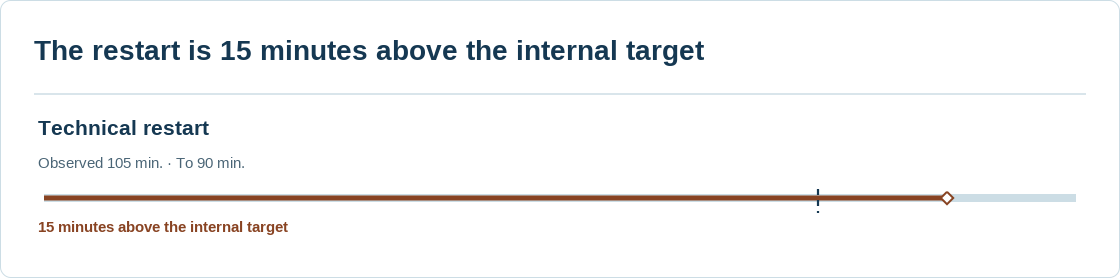
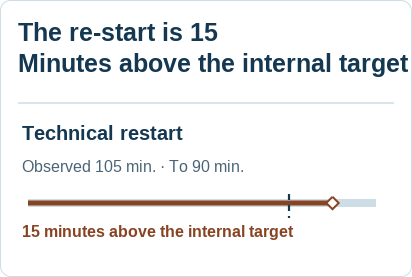
Fictional test example. The time values are internal exercise assumptions.
Prepare to restart a business function
Provide impact analysis, restart plan and the last backup for the same business process.
Defining time targets
Set restart target and maximum acceptable data loss per function. Match the responsible, start point and end of time measurement.
Run Recovery
Log test environment, backup, data check and technical acceptance. Capture interruptions and the time of release.
Checking deviations
Arrange causes, measures and responsibilities. The review test uses the same success criteria and shows whether the gap is closed.
Secure the statement with a sample
Ask when the department can provide the first reliable service. Compare this time and the required data level with the technical protocol.
Example with missed time target
In a fictitious recovery test, payment processing is technically usable after 105 minutes. The internal target is 90 minutes. The deviation of 15 minutes is documented with cause and new test date.
Restarting plan tested Time measurement, data matching, acceptance decision and post-test are assigned to the same function identifier.
- What you are examining
- Separately record the start, technical provision and the first professionally usable payment processing. Compare data status and completeness for the specialist company with the previously approved acceptance criteria.
- What the post-test decides
- Repeat the measurement in the agreed scenario. The test file specifies the cause of the 15 minutes time deviation, the tested solution level and the judgement for time and data.
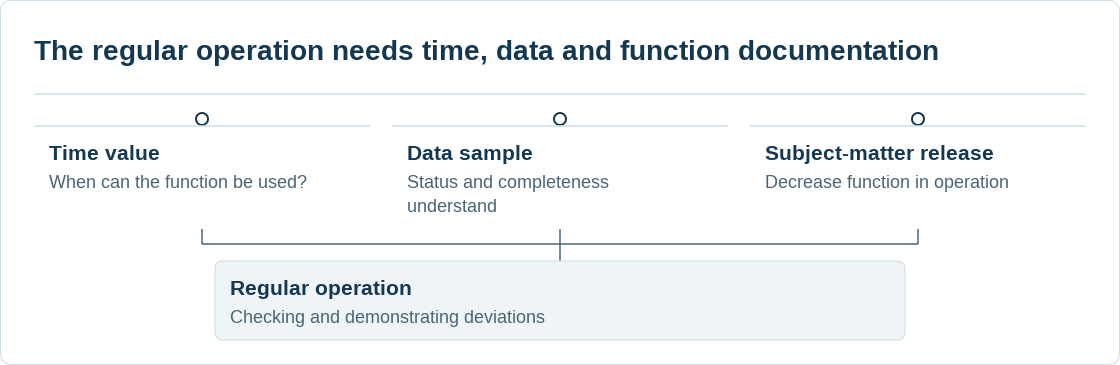
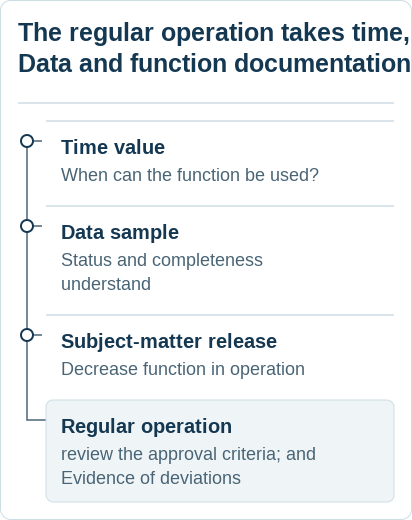
The operation release takes time and data quality
After the run, determine whether the service will start again in the time window and if the data sample confirms the expected status.

From the blog
Operational resilience in everyday life
The paper deepens how organisations prioritize critical performance, make dependencies visible and prepare for disruption.
Tasks in this thematic area
Select the work page for your role, next check point or corresponding proof.
Evaluate business impact
Evaluate the consequences of a business interruption and derive the re-start priority along technical and technical dependencies.
Release the operation
Arrange escalation, technical restoration and professional release of the same business function. Check which observations will carry the return to regular operation.
Planning backup and recovery
Merge backup scope, allowable data loss and professional acceptance for a recovery test. Check backup scope and data status in the test.
Restart test
Edit a restart protocol with time measurement, data reconciliation and release request. Measure time, data level and technical acceptance.
Prepare for a crisis communication for an operational disruption
A communication sample shows how situation information comes to internal or external approval from the professional bodies. It takes into account achievable representatives, recipients, documented statements and updates according to new findings.
Your result Communication file with recipients, released statements, channel, time and receipt.
Effectively follow findings from incidents and tests
Execute a verifiable improvement task from a fault or test. The conclusion shows separately which cause has been fixed and which rule, control or exercise needs to be adjusted.
Your result Documented change of control and exercise plan with proof of re-examination.
Practice examination decisions in the case
Edit the initial data and compare your result with the well-founded solution.
Case D11
Evaluate a back-up with target deviation
The fictitious port bank checks a backup for its payment service. They compare duration, data level and technical usability and derive from it an after-test.
Your result Acceptance note with separately evaluated time and data targets, open findings and planned follow-up.
Legal basis for this task
Compare the decision from the test example with the relevant rule.
DORA Art. 11 · Reaction and restoration
The rule covers ICT business continuity, response and recovery plans as well as appropriate testing.
For your exam Compare approved test acceptance, actually observed business flow and professional approval.
DORA Art. 12 · Backup and Recovery
In the case of data backup and recovery, the underlying procedures, checks and restoration goals are relevant.
For your exam In the case of a data recovery, assess the time to usability and the status of the recovered data based on your own evidence.
DORA Art. 13 · Learning and further development
Findings from relevant incidents and risk management are incorporated into the development.
For your exam Apply the findings for delayed technical release to the operating plan and prove his treatment with a follow-up test.

Perform a re-starting test
Edit a restart protocol with time measurement, data reconciliation and release request. The assessments on EUGRC.AI are available for internal evaluation.

