
Test detection and alerting
Track the path of a signal until it is processed.
APPLY
DOCUMENT
Track a deviation until confirmed processing
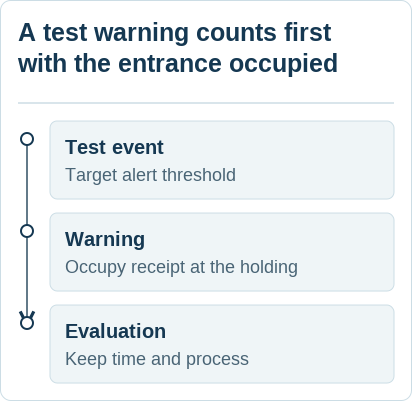
Select an approved sample in a controlled operating or test environment. Track the expected signal from the triggering system, through logging and alarm to confirmed processing. Define what is considered successful detection beforehand.
A recorded event shows what the system has observed. The efficacy test also includes whether the intended warning path works and if the relevant role can initiate the response. Arrange the signal, receiver, expected time and treatment of a missing warning before the sample.
Track a warning message until it is processed
Set the initial event, the expected alarm and the achievable call readiness for an approved sample.
Pre-determine triggers and results
For example, select a scheduled interruption of a test service. Write down expected event, time limit, receiver and procedure if the alarm is not available.
Testable supporting evidence A freed test job with abortion rule.
Match protocol, alarm and processing
Compare timestamps, cancellation of service name and ticket acceptance. Check whether the serviced entity can see which business function would be affected.
Testable supporting evidence A comprehensible documented sequence of event, notification and editing.
Fix and test deviation with the same scale
If the event is in the log, but no alarm, clarify responsibility and cause. Repeat the approved sample after correction under the same conditions.
Testable supporting evidence Two comparable test protocols with a clear prior-after assessment.
Secure the statement with a sample
Repeat the same sample after correction. The time stamps show triggering, receipt and responsible handling of the warning message.
When changing memory the expected alarm is missing
The test service interrupts the connection as planned. The time stamp is present in the operating protocol. The alarm overview shows the service under its previous name. After correctly assigned monitoring, the repetition reaches the responsible call readiness.
Measurable detection Source, availability of the farm, maximum period and receipt by the competent authority are documented.
- What you are examining
- Set the test time, service name in the operating protocol and monitored entry side by side. The expected recipient checks whether a message has arrived in the defined time window.
- What the post-test decides
- After updating the assignment, check whether the same approved sample is visible and evenable under the new service name of the intended recipient. Hold both timestamps.
An alarm is only detected after its delivery
Create an agreed test report. Follow it from the generating system to the person who evaluates it.

Templates and worksheets
The filler tool is directly under the task. Download the template for editing or open the Quick View.
Alarm delivery test protocol
Check alarm, transmission route and processing with specifically triggered test signals.
Outcome The time and delivery sample shows alarm cause, receiver, escalation and proven fix.
Read the instructions
Fictional example During a controlled test, a memory error creates an event. The primary channel is silent unplanned. In the event system there is an alarm, with the receiver no confirmation is available.
- Evaluate measurement Enter the same unit for target and is. Set the direction of assessment and complete the professional sample.
- Linking Evidence For relevant checkpoints, deposit the specific source, the verified version and the proof ID.
- Treatment of deviation Follow delivery and escalation after correction with unchanged test signal and independent time source.
Legal basis for this task
Compare the decision from the test example with the relevant rule.
Article 10 DORA and Delegated Regulation (EU) 2024/1774 · Detection
The references specify the specifications for the detection of anomalies and the organisational and technical framework for logging and monitoring.
For your exam Source, availability of the farm, maximum period and receipt by the competent authority are documented.

Recognizing the impact of an incident
Merge affected services, materiality thresholds and new insights into a comprehensible classification decision. For internal evaluation, assessments on EUGRC.AI are available.

