
AI in university admissions
Check whether the AI only sort documents or influence the allocation of places.
DEPLOYMENT
OVERSIGHT
Starting position and test order
The fictitious Akademie Nord introduces an AI service for application to the study place. Variant A indicates the completeness of the files. The notice does not change the order of priority or deadline. The department opens each application and can request documents. In Variant B, the system uses applications with missing suspected attachments at the end of the waiting list without prior examination.
Both variants run with the same surface. For comparison, the Academy uses twelve fictitious applications with confirmed initial state. In three cases, installations are available in different order. The system initially reports them as missing. Decisive is what consequence of the memo actually has in the procedure.
Edit the case independently
Properly use per variant
Track the output to the waiting list. First check whether the specific purpose is specified in Annex III, point 3(a).
Testable evidence Confirmed purpose with observed effect on the procedure.
Evaluate conditions separately
In a case covered, you will examine significant risks, the actual influence of decision-making, a case of Article 6(3) and profiling separately.
Testable evidence Justification with evidence per condition and open question.
Secure exception as your own result
If the exception is applicable, document the provider verification before provision and registration separately.
Testable evidence Versioned Art. 6 para. 4-Note with jurisdiction and subsequent date.
What the test results
Situation The fictitious academy Nord introduces an AI service for application to the study place. Variant A indicates the completeness of the files. The notice does not change the order of priority or deadline. The department opens each application and can request documents.
Model decision and justification
In A, the wrong indication is intercepted three times by the independent examination. First, check whether this function is to be classified as an Annex III application at all. If so, the narrowly limited procedure task can only be considered with proven conditions. In B, the same error changes the processing for three persons. The exception does not bear under the circumstances described above.
Counter-sample and impact
In A, you can test an automatic shift at the end of the list. This refutes the reason for the lack of decision-making effect. If an Annex III system is further profiled, the exception classification will be omitted anyway.
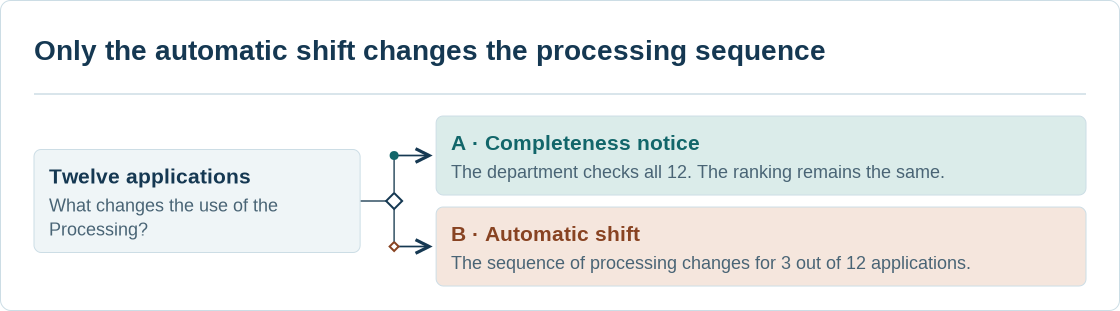
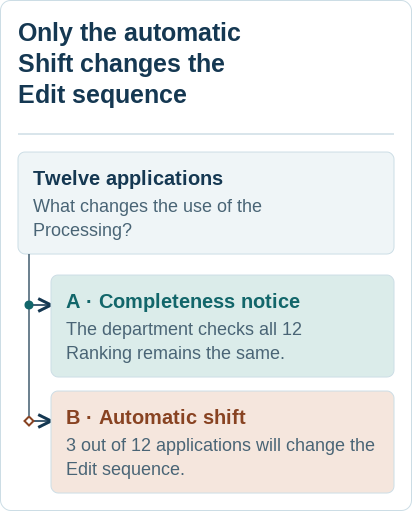
The surface is the same, and the effect on the process changes.
Templates and worksheets
Use the workbook for your own data and calculations. The fillable quick view contains a sample sample and a protocol for your own process.
System inventory and risk classification
Determine the purpose, role, legal reference, prohibition, product path, Annex III and the separate transparency issue.
Outcome A work stock with a reasoned classification proposal, pre-sorted clarification cases and independent decision by system.
Read the instructions
Fictional example KI02 · The automatic shift of a study place application changes the documented decision influence. The documented exception reason does not bear then.
- The starting position Prove purpose, function and role
- Editing the Process Tracking unresolved prohibition and risk issues
- Secure Decision Release the decision to release the version
Official sources
Regulation (EU) 2024/1689 as amended on 27 July 2026
Readable version with the changes made by Digital Omnibus on AI. The application rules are to be read for your own deadline.

Transfer the result to your own use
First, take the decisive observation from the case. Then, based on your open question, choose whether you want to check your own process or play a comparable case.
Risk classification
The prohibition, product-related high risk path, Annex III and transparency are independently assessed.
Starting point Documented purpose, process observations, applicable plant position and tests to influence the decision.
Work result A reasoned classification note with proven conditions, independent transparency check and clearance.
View the guideOther cases
You want to practice with fictitious data first or understand a similar decision from another role.
Select a case by task and available sample.
Work result The cases provide initial data, a test order and a reasoned sample decision. Change a concrete condition and check the impact.
Select Case studies

