
Fundamental rights in credit scoring
An observed risk leads to concrete remedy and evidenced release.
DEPLOYMENT
OVERSIGHT
Starting position and test order
In 2028, the fictitious Hafenbank introduced an AI-based credit rating for natural persons. The issue is incorporated into the professional decision. A sample set-up uses forty synthetic processes that are subject to approval according to common technical standards. The audit order compares twenty online applications with twenty applications from the branch.
Six of the twenty online cases are unnecessarily postponed, in the branch one of twenty. The provider suspects a difference in the format of uploaded documents. The department checks the originals of all seven cases. The internal audit requirement allows up to ten percent unnecessary provisions per observed channel. It also requires a reasoned individual case examination and an approach to appeal.
Edit the case independently
Create obligation and reach
Arrange the purpose of the appropriate point in Annex III. Decide which information the impact assessment already covers and what additional information needs to be considered.
Testable evidence Dated Scope sheet on fundamental rights and data protection.
- Acceptance criterion
- Justify applicability using evidenced activity or intended use, role and date. Assign an owner and due date to any unresolved assumption.
- Evidence
- Reasoned applicability assessment recording facts, reference, role, date and open assumptions.
Evaluate risk per channel
Calculate the quotas for the cases that have actually been checked. Check the original documents and mark open suspicions of causes as open.
Testable evidence Quotas with denominator, case list and cause check.
- Acceptance criterion
- Use the same metric, population and unit for expected and observed results. Record the measurement point at which the business service is achieved.
- Evidence
- Measurement record with baseline population, source, expected and observed values, unit and timestamp.
Remedy and notification
If you are responsible for a correction in the input format, check complaints and link the post-test to the conclusion for release.
Testable evidence Decision-making file with responsible residual decision and notification path.
- Acceptance criterion
- Trace the submission by time, version sent and acknowledgement. Resolve missing or changed information for each reporting stage.
- Evidence
- Copy of the submitted version with version reference, dispatch evidence, acknowledgement and outstanding items.
What the test results
Situation In 2028, the fictitious Hafenbank introduced an AI-based credit rating for natural persons. The issue is incorporated into the professional decision. A sample set-up uses forty synthetic processes that are allowable according to common technical standards.
Model decision and justification
The starting rates are 30 and 5 percent. Their difference is 25 percentage points. In the scenario, the online channel fails. After the format correction two out of twenty online and one out of twenty in the branch are available. This corresponds to ten or five percent respectively. The sample proves the tested condition and determines the next test requirement.
Counter-sample and impact
Reduce the online number from twenty to eight, with two provisions still in place. The value now stands at 25 percent and the release has to be re-examined.
- Audit record
- Comparison of the original finding and retest showing the changed condition, observed effect and closure decision.
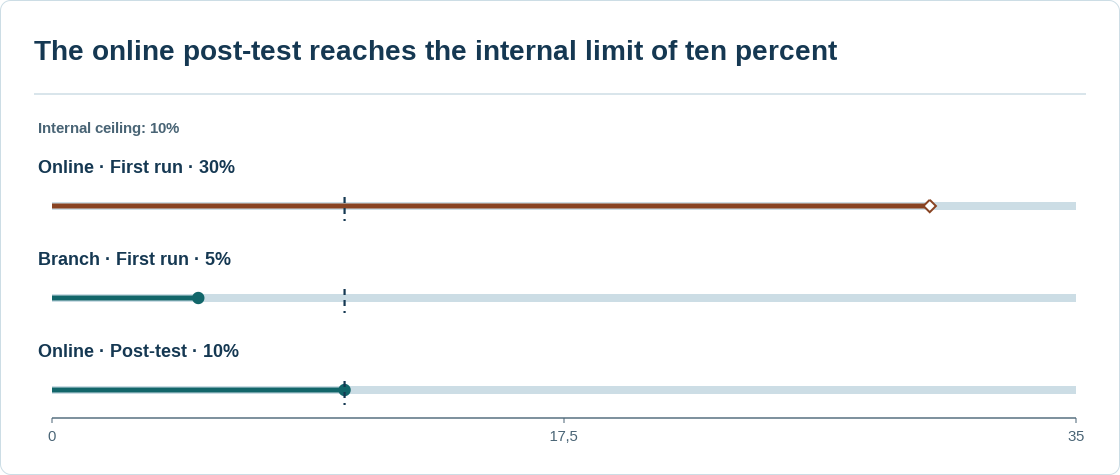
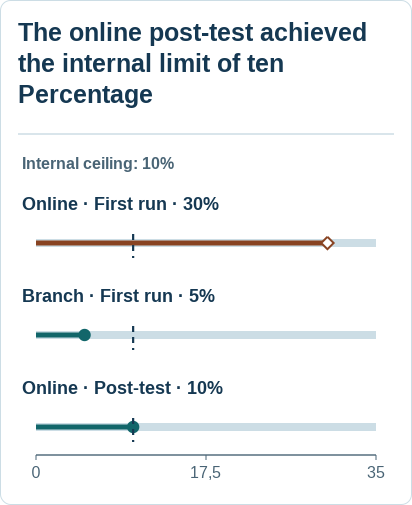
The quota is calculated per channel on the confirmed denominator. The dashed line shows the internal target of the exercise.
Templates and worksheets
Use the workbook for your own data and calculations. The fillable quick view contains a sample sample and a protocol for your own process.
fundamental rights impact assessment and sample
Determine the fundamental rights per use. Evaluate risks based on comprehensible case groups and track remedy and residual risk.
Outcome A documented impact assessment with group quotas, protective measures, jurisdiction, complaint procedure and post-test.
Read the instructions
Fictional example KI04 · 6 of 20 unnecessary provisions online correspond to 30 percent, 1 of 20 in the branch 5 percent. The scenario uses as internal target a maximum of 10 percent per channel.
- The starting position Determine the use and persons concerned
- Editing the Process Document risk, case group and observed effect
- Secure Decision Complete action, complaint procedure and communication
Official sources
Regulation (EU) 2024/1689 as amended on 27 July 2026
Readable version with the changes made by Digital Omnibus on AI. The application rules are to be read for your own deadline.
Art. 35 GDPR · Data protection impact assessment
Check data protection impact assessment and fundamental rights impact assessment based on the relevant requirements.

Transfer the result to your own use
First, take the decisive observation from the case. Then, based on your open question, choose whether you want to check your own process or play a comparable case.
Fundamental rights and data protection
Limit Art. 27 and the data protection impact assessment and combine them with concrete measures.
Starting point Purpose, affected groups, process monitoring, provider information and existing data protection impact assessment.
Work result An impact assessment with comprehensible risks, effective measures, residual decision and evidenced follow-up of changes.
View the guideOther cases
You want to practice with fictitious data first or understand a similar decision from another role.
Select a case by task and available sample.
Work result The cases provide initial data, a test order and a reasoned sample decision. Change a concrete condition and check the impact.
Select Case studies

