
Test AI literacy in operations
Distinguishing participation from an actual controlled decision.
DEPLOYMENT
OVERSIGHT
Starting position and test order
The fictitious WeserService GmbH introduces AI-based response assistance. Four service personnel are supposed to match sources and withhold false expenditures. Four authorized persons must additionally suspend the process if they have unsure information and be able to use the intended replacement route. All eight people have passed the instruction.
In the first run, all four service personnel and three out of four authorized users perform the exercise. A person cannot trigger the replacement route in time after a major contact is not reached. The internal clearance rule requires a pass of his own per person in the assigned role.
Edit the case independently
Deriving learning goal from the role
Describe the observable action and limits of permitted AI use. Clearly assign responsibility and representation.
Testable evidence Role-based learning goal with verifiable tasks.
Participation and observed action count
Run participant list and passed samples separately. Use the same target for comparison and retest.
Testable evidence Protocol with 8 participations, 7 passed tasks and own findings.
Check replacement route under the same condition
Let the failed release role re-edit the process without the main contact and actually achieve the responsible replacement.
Testable evidence Documented role release or further open findings.
What the test results
Situation The fictitious WeserService GmbH introduces AI-supported response assistance. Four service forces are supposed to match sources and withhold false expenditures.
Model decision and justification
The participation rate in the case is 100 percent, and the observed fulfilment at 87.5%. The unconfirmed person does not receive independent clearance for the audited role until the passed post-test. The next change of the workflow is an opportunity to look again at the exercise cases.
Counter-sample and impact
In the post-test, change the main contact from unreachable to reachable. This does not check the original gap. The follow-up must have the relevant replacement path observed.
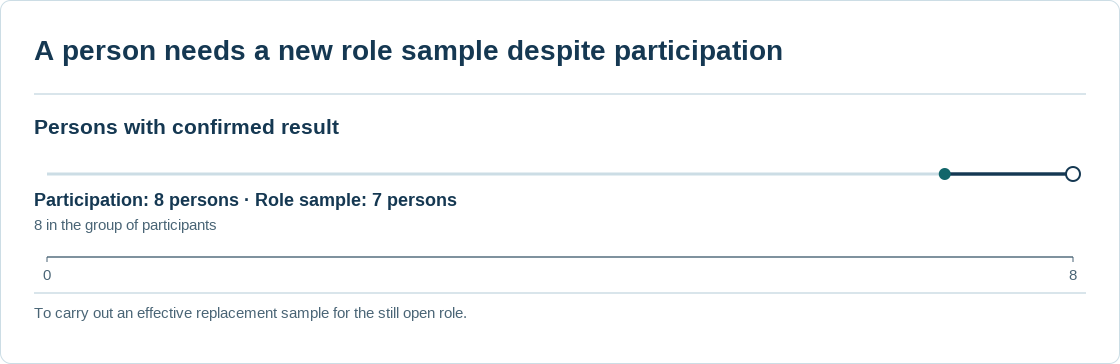
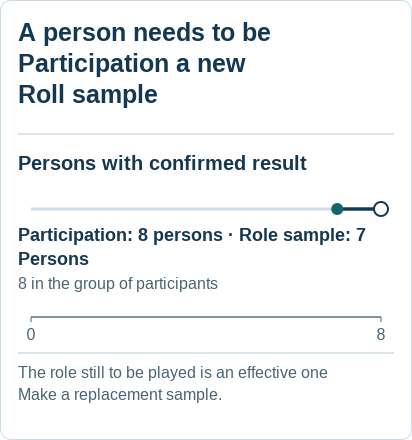
The open roller sample receives its own order for the replacement path.
Templates and worksheets
Use the workbook for your own data and calculations. The fillable quick view contains a sample sample and a protocol for your own process.
AI competence and role sample
Plan exercises according to role. Calculate documented participation and passed roll samples separately and track gaps until repetition.
Outcome A clear decision as to which tasks a person or role can perform after the observed sample.
Read the instructions
Fictional example KI08 · Eight participants correspond to 100 percent. Seven completed roll samples correspond to 87.5%. The replacement path remains open in one roll.
- The starting position Determine expected action and authorised role
- Editing the Process Documenting participation and observed action separately
- Secure Decision Check repeat under the same critical condition
Official sources
Regulation (EU) 2024/1689 as amended on 27 July 2026
Readable version with the changes made by Digital Omnibus on AI. The application rules are to be read for your own deadline.

Transfer the result to your own use
First, take the decisive observation from the case. Then, based on your open question, choose whether you want to check your own process or play a comparable case.
AI literacy
Practice and prove the decisions that people have to make in the concrete AI deployment.
Starting point Role list, permitted interventions, guidance, relevant use cases and criteria for observation.
Work result A role overview with exercise, measured action, open gap of competence and the date of the re-examination.
View the guideOther cases
You want to practice with fictitious data first or understand a similar decision from another role.
Select a case by task and available sample.
Work result The cases provide initial data, a test order and a reasoned sample decision. Change a concrete condition and check the impact.
Select Case studies

