
CRA and AI after an update
Check the delivery level, remote processing, follow-up testing and explanations per version.
DEPLOYMENT
OVERSIGHT
Check CRA and AI after an update on your own system
Determine the product limit, actual dependencies, the manufacturer's role and the evidence for the version state concerned. After an update, check whether all the delivered and actually used versions are recorded.
Check the requirements of the CRA bridge individually in accordance with Art. 42 para. 3 of the AI Regulation and Art. 12 para. 1 of the CRA. The procedure for this bridge follows the relevant assignment in accordance with Article 12(2) CRA. Evaluate a significant change and any new conformity assessment separately for the specific situation.
Compare delivery and actual stand
Match active product levels after correction
Document delivery, actual remote capture, handled vulnerability and affected configuration. Check the responsible support stand.
Testable evidence Version inventory and repeated acceptance with the actually verified combinations.
- Acceptance criterion
- The item under review and the documents refer to the same approved version. Record obsolete evidence as a separate discrepancy.
- Evidence
- Versioned mapping of item, source and approved version with any discrepancy recorded.
Secure CRA bridge for active combination
Confirm the requirements for product, processes and appropriate explanation as well as the assignment of the procedure.
Testable evidence Evidence of product and process requirements with appropriate explanation of cybersecurity level.
- Acceptance criterion
- A second reviewer can follow the statement to the original evidence and the version checked. Record the evidence identifier or file reference with the decision.
- Evidence
- Evidence list recording original source, version, documented mapping and owner.
Limit the range of cybersecurity bridge
Document which version and cybersecurity requirements of the appropriate CRA detection are related to.
Testable evidence Proven scope and separate AI-specific documents for accuracy and robustness.
- Acceptance criterion
- Justify applicability using evidenced activity or intended use, role and date. Assign an owner and due date to any unresolved assumption.
- Evidence
- Reasoned applicability assessment recording facts, reference, role, date and open assumptions.
Check the materiality of the AI amendment
Document whether the amendment affects the intended purpose or compliance with the relevant requirements and what consequences for conformity assessment.
Testable evidence Reasoned change decision separated from product release.
- Acceptance criterion
- The item under review and the documents refer to the same approved version. Record obsolete evidence as a separate discrepancy.
- Evidence
- Versioned mapping of item, source and approved version with any discrepancy recorded.
Delivery is in line with the declaration that the operating status is missing
The fictitious product Learning Rating 5.5.3 is provided with remote processing, which is responsible for the manufacturer. In case of this function, it is part of the product. CRA and high risk classification are confirmed. The new product status has been tested with the remote version R18.
Check a product stand and the actual AI processing used together.
A reasoned decision for each configuration to the CRA bridge and the technical test as well as a separate order for unconfirmed stands.
Edit case · Delivery fits the explanation, the operating status is missing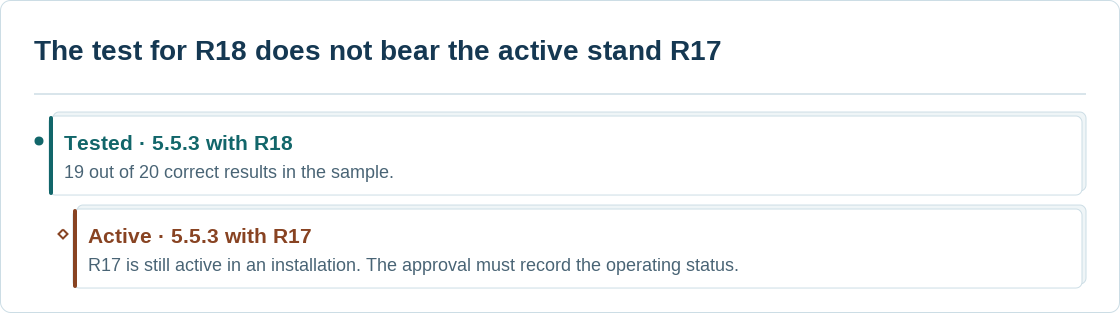
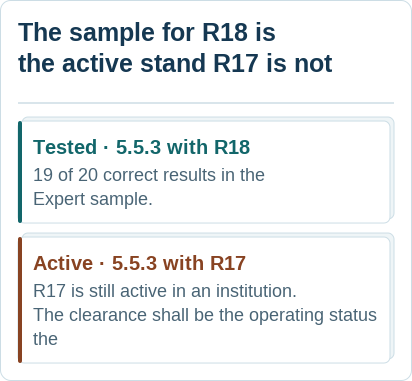
The test and declaration documents shall be valid for the version examined. The actual operating status shall be compared with its own.
Documenting your own test
A release file with version matching, independent CRA-files and confirmed AI performance.
Compare Product Update and AI Operating Stand
Check tested, explained and active combination of product and remote processing. Calculate the sample and evaluate the evidence separately.
Outcome A release file with version matching, independent CRA-files and confirmed AI performance.
Read the instructions
Fictional example KI24 · Tested is R18, still used at a site R17. 19 out of 20 correct results apply to the tested combination.
- The starting position Confirm product limit and actual distance
- Editing the Process Evaluate CRA evidence and sample separately
- Secure Decision Remedial, robustness and compliance
Release the digital product stand according to CRA
Technical documentation
For the product stand, build a comprehensible technical file with its own test and approval track.
View the guide
Connection check for this product stand or incident
Connect CRA and AI conformity
The high-risk system is part of an important or critical digital product. Check Art. 12 CRA and the required process combination.
View the guide
Check the product decision on the original document
CRA and Machinery Regulation jointly
If the AI system belongs to a machine, assign originals of the same version and secure your own tests per set of rules.
View the guide
Connect product protection and AI detection at the same stand
Test matrix Annex I
Determine the relevant CRA requirements for the digital product and link matching originals with your own AI test.
Use the test matrix
Official sources
First check for this task
Regulation (EU) 2024/1689 as amended on 27 July 2026
Readable version with the changes made by Digital Omnibus on AI. The application rules are to be read for your own deadline.
Regulation (EU) 2026/1744 · Digital Omnibus on AI
Officially published changes, including AI competence, high risk periods and transitional rules.
Art. 12 CRA · High risk AI systems
Check the three requirements of the cybersecurity bridge per product version.

Other official references2
- Article 13 CRA · Manufacturer's obligations (opens in new tab)
EUR-Lex · CRA 2024/2847
Arrange risk files, version documents, accompanying information and management of vulnerabilities to the recorded product stands.
- Article 14 CRA · Manufacturers' reporting obligations (opens in new tab)
EUR-Lex · CRA 2024/2847
Distinguishing actively exploited vulnerabilities and serious security incidents. Evidence and completion reference must be given for the confirmed path.
What is the next decision?
Choose the work path that fits your open decision. The descriptions show what you start with and which proof you then hold.
Technical documentation
If the product scope is still unclear, first build up the technical documentation with confirmed dependencies.
Starting point Product and version level, component overview, risk assessment and actually appropriate test protocols.
Work result The product file shows the tested stand and identifies open inspections per release document.
View the guideConformity and market access
If purpose or relevant evidence changes, clarify the further way of conformity.
Starting point The intended purpose, the position in Annex I or III and the conformity documentation prepared for this version.
Work result A reasoned procedure with a reliable assessment, declaration, identification and registration, where appropriate.
View the guide

