
Identify entities and services
Merge activity, contractual partner and operational responsibility per company.
IMPLEMENTATION
EVIDENCE
Find out who is actually doing the service
Common brands, group-wide IT and a central purchasing often conceal which institution offers a service legally and who actually operates it. Start with accountants, service descriptions and operational contact person. The approval or actual activity may differ from the group assignment.
Select an order with multiple services. Mark contractors, operating team and change release for each service.
Making the decision on the allocation of benefits
Perform the test
Select three orders from the same product family. Read the contract and service description, identify operators and recipients and agree to the assignment with billing and business directory. Hold the viewing period, change of supplier and, if necessary, a standalone group performance.
Result and further processing
A coordinated portfolio of services with legal entities, investment position, period and evidence or open decision per performance. If the operator remains open, the purchase receives a clarification order. The still unfilled performance receives a separate resubmission.
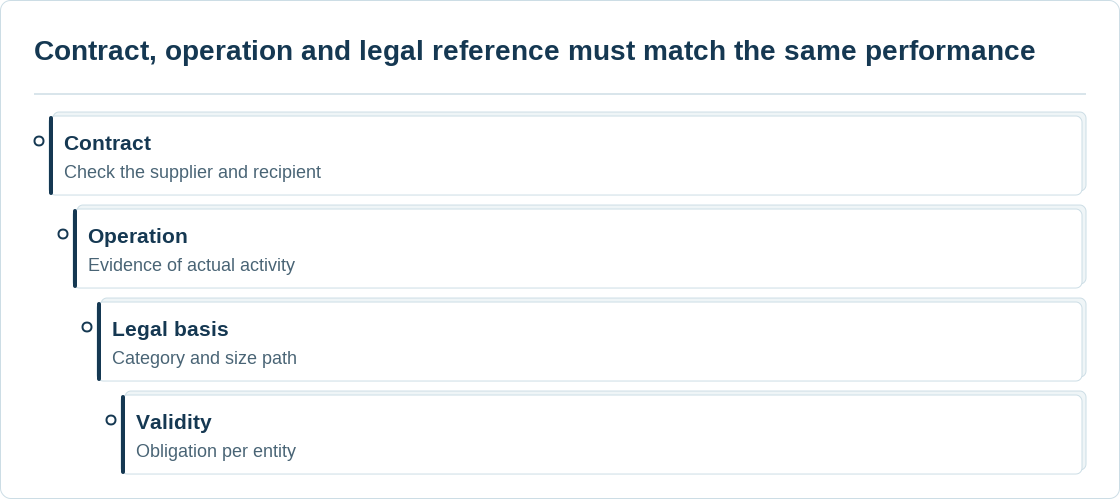
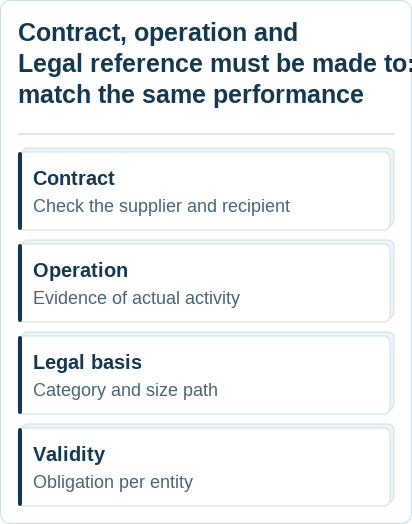
Actual performance, contractual partners and regulation form the basis for classification.
Decision and counter-test
Situation Common brands, group-wide IT and a central purchasing often conceal which institution offers a service legally and who actually operates it. Start with accountants, service descriptions and operational contact persons.
Initial situation and observed findings
The fictitious HanseWerk Group sells under a common brand. Connect invoices the public network connection. Service provides the current administration separately. An order contains both services and refers to a joint operating service. The service attachment confirms two obliged parties and two demarcations. The joint service receives its own proof reference.
Negative test
Remove the service attachment. Move the second assignment to an open clarification order on purchase and operation until the actual activity is documented.
The own test bench
Arrange activities per entity, calculate confirmed size values and record special cases and supporting documents.
Affectedness and size values
Arrange activities per entity, calculate confirmed size values and record special cases and supporting documents.
Outcome The test method to be used for the calculation of the installation, size path and provisional category per activity.
Read the instructions
Fictional example HanseWerk achieves 62 annual work units with the confirmed group values. Another case with 249, 60 million. EUR turnover and exactly 43 million EUR balance sheet total remains below the main financial path.
- Legal entities and activities Enter the name, assignment, verifiable numbers and a stable reference.
- Group reference Check the partner share or full allocation and already consolidated values.
- Technically confirm decision The test shall be carried out in accordance with the following conditions:
Obligation and detection matrix
Document legal decisions per institution and performance. Check each proof whether the scope, status, access and statement support the assigned obligation.
Outcome Reasoned obligations and comprehensible decisions on the use of common evidence.
Read the instructions
Fictional example N10 · Bank and ICT service providers use the same technical protocol. A bank position remains open until their own business sample. Case N12 shows the separate assignment of common systems.
- Legal decision per obligation Capture confirmed entities, activity, exact reference, decision, role and deadline.
- Check the proof under the same identifier Link position and document form. Confirm evidenced depth of information and actual retrievability.
- Release your own evaluation Keep in mind who has released the use and what proof is missing.
Legal basis for this task
§ 28 BSIG · Particularly important and important institutions
Check legal form, actual paid activity, type of facility, size values and special cases. § 28 para. 5–8 alters the scope of obligations for certain activities or institutions.
Appendix 1 BSIG · Sectors and types of equipment according to Appendix 1
Compare the real service with the specific type of facility and its legal definition. Check size level and special rules for basically relevant activities.
Appendix 2 BSIG · Sectors and types of equipment according to Appendix 2
For technical terms such as industrial production, research or marketplace operation, document the actual service. The size alone does not postpone an activity exclusively covered by Appendix 2 in Annex 1.

Deriving the next order from the result
First, take the decisive observation from the case. Then, based on your open question, choose whether you want to check your own process or play a comparable case.
Deriving size values in the group of companies
The responsibility is clear and the size values of several companies are still to be combined.
Starting point The list of participations, annual work units, turnover and balance sheet totals at the same level.
It is clear that own, proportionate and fully inclusive corporate values are calculated.
Work result A repeatable calculation path shows own, proportional and full values without double counting.
View the guideCheck NIS2 concern per device
The legal entity, activity or category are still unclear.
Starting point Performance description, commercial register, investment overview and confirmed size values.
To merge activity, size and grouping up to the justified classification.
Work result A valid endorsement for each institution with actual performance, type of device, calculation method and clarification requirements.
View the guide

