
Assess suppliers against needs
Connect security requirements, evidence and selection decision for a direct supplier.
IMPLEMENTATION
EVIDENCE
Concreteize the required delivery before selecting
Before selecting the service, describe the required operational service and its consequences. Check security practices, dependencies and the ability to demonstrate observable protection requirements in the relevant scope. Requirements and evidence must match for the specific service.
Write a verifiable performance criterion and determine which evidence the supplier provides in case of emergency.
Compare provider commitment and observed performance
Perform the test
Combine three selection features with concrete test data. For the performance concerned, request the current scope of a proof, the measured response path and documented treatment of deviations. Reason for exceptions and their maturity.
Result and further processing
Reasoned supplier selection with performance, order-specific supporting documents and open conditions before release. If there is no supporting supporting evidence, the procurement receives a verifiable condition or checks an alternative.
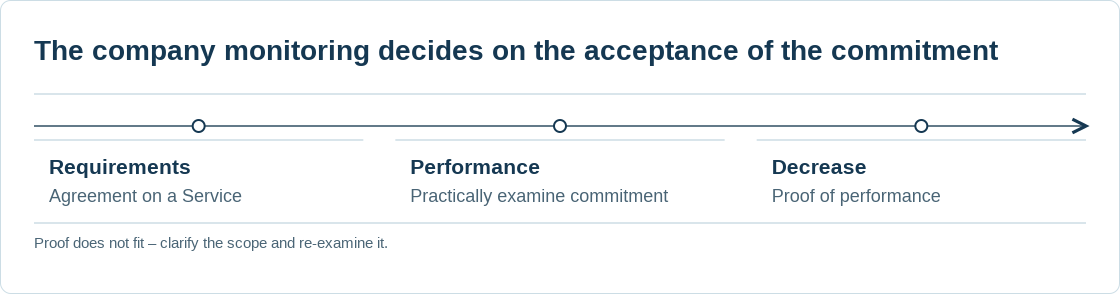

Contract, performance and current observation form a chain of evidence for the service actually used.
Decision and counter-test
Situation Before selecting the service, describe the required operational service and its consequences. Check security practices, dependencies and ability to demonstrate observable protection requirements in the relevant scope.
Initial situation and observed findings
The provider fulfils the agreed response time according to the report. However, in the sample data set it only applies to another type of contract. The evaluation remains open until the booked performance and the actual contact person are confirmed in a common sample.
Negative test
Replace the report with a formal certificate with different scope. Check which statement to the specific service must be supported in addition.
The own test bench
Compare promised and observed provider services. Determine common dependencies, evidence and approvals.
Supplier testing with quality limits
Compare promised and observed provider services. Determine common dependencies, evidence and approvals.
Outcome Decision on remedy or release per direct provider and service.
Read the instructions
Fictional example The primary service quickly reports, but the replacement route requires the same failed identity service. The technical alternative remains open.
- Connect service and contract Record direct provider, function and concrete contract finder
- Measure Report and Restore Compare own time limits and actual values from the same sample.
- Supporting alternative Evaluate the common dependence, plan and document correction.
Detection coverage and evidence gaps
Check for each service and obligation whether the proof is available, fits the status and is currently released. Track the reliable denominator.
Outcome The following table shows the results of the assessment carried out by each test group:
Read the instructions
Fictional example N22 · Six positions are expected. Four documents are current and relevant, one has expired, one is missing.
- Determine target size Provide unique identifiers for the verified obligations and demonstrate their scope.
- Matching Evidence Confirm receipt date, validity, coverage and release separately.
- Solve gaps Arrange responsibility, appointment and professional standard for any open document.
Check supplier statements on product records
Procuring with product proof
Use confirmed product data for supplier testing. Determine the own performance requirement and obligations of the NIS2 facility separately.
Checking evidence of procurement
Legal basis for this task
§ 30 BSIG · Risk management measures
For each relevant service, combine risks, ten fields of action, evidence and effectively verified effect. § 30 para. 3 gives priority to the technical requirements of the DVO for the providers covered there.
Art. 21 NIS2 · Risk management in cybersecurity
Determine verifiable criteria from the risk analysis for all ten policy areas. Consider applicability, proportionality and additional technical regulations.
Annex 5 · (EU) 2024/2690 · Supply chain security
Select a direct service provider and follow the selection, safety requirement and ongoing monitoring up to your own specialist service.

Deriving the next order from the result
First, take the decisive observation from the case. Then, based on your open question, choose whether you want to check your own process or play a comparable case.
Practically prepare change of service provider
The performance and its dependencies are recorded. Check the takeover by an alternative.
Starting point Replacement or self-operation, data format, transition windows and a certified minimum performance.
Demonstrate replacement performance, data transfer and time limits using a controlled takeover sample
Work result An audited takeover decision with data matching, remaining deviations and possibly return.
View the guideCheck security requirements along the supply chain
The effective performance of an immediate provider is still unclear.
Starting point Contract and performance installation to a direct provider, observed performance and possible failure sequence.
Track a direct provider from selection to proven replacement solution.
Work result A decision on release, restitution or replacement with a sample at the service concerned.
View the guide

