
Review shared supplier dependencies
Dependency card with clear and open relationships.
IMPLEMENTATION
EVIDENCE
Uncovering common dependencies of direct suppliers
Two contracts can have the same operational requirements. It is crucial whether an alternative will provide the promised service even if a jointly required service fails.
Perform the verification task
Tracking the critical service at both providers
Capture operators, platform, identity, storage and support as relevant to the performance of the alternate. Confirm the information by signing contracts, proof of service or a suitable check.
Work result Dependency card with clear and open relationships.
Simulate the joint failure approved
In a controlled scenario, check the promised alternative and the specialized function. Increase time, data reconciliation and application in the same sample.
Work result Auxiliary evidence of confirmed baseline.
Meeting the Supplier Decision Risk-Based
Document the observed dependence and consistency for the protection measure. Set an independent alternative or controlled follow-up order if there is any risk remaining.
Work result Released supplier decision and follow-up date.
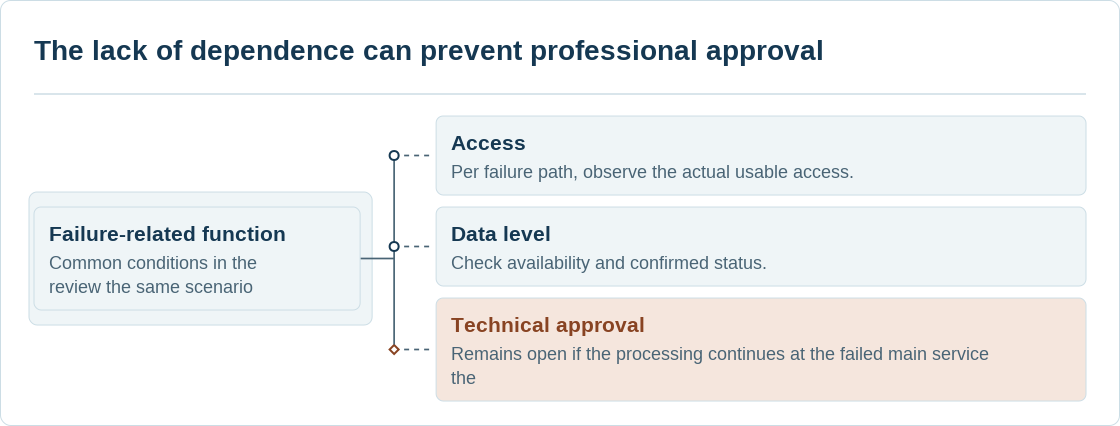
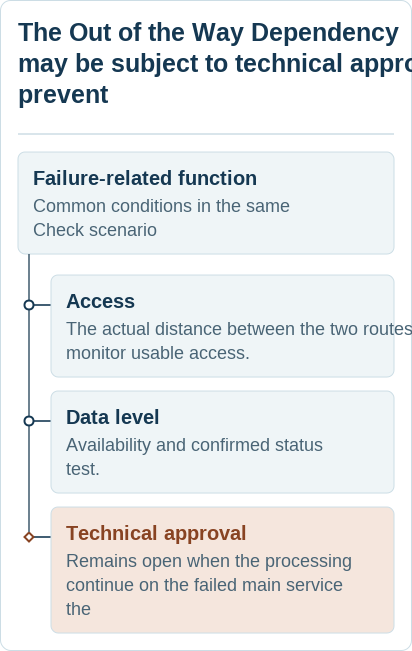
The performance sample records access, data and technical processing as separate dependencies. In the example, the professional approval remains open as long as it needs the failed main service.
Starting position, assessment and counter-test
Situation Two contracts can have the same operational requirements. It is crucial whether an alternative will provide the promised service even if a jointly required service fails.
Situation
Two direct providers offer different applications. Both use the same identity for administrative restart. In case of exercise, the second provider can take over the data, but the willingness does not confirm professional approval.
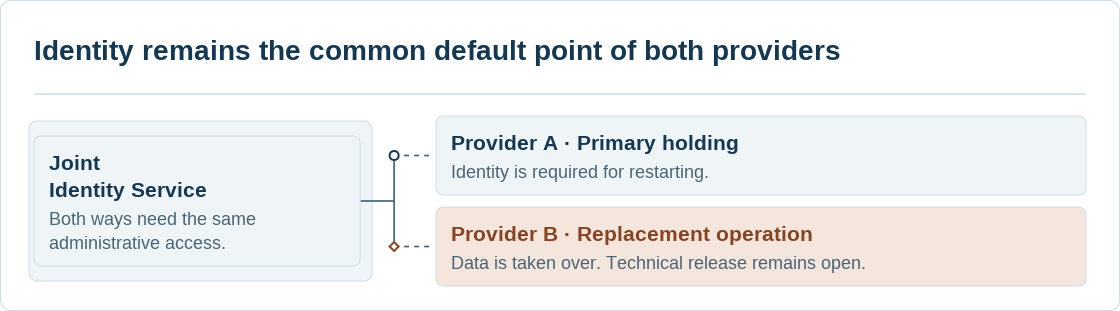
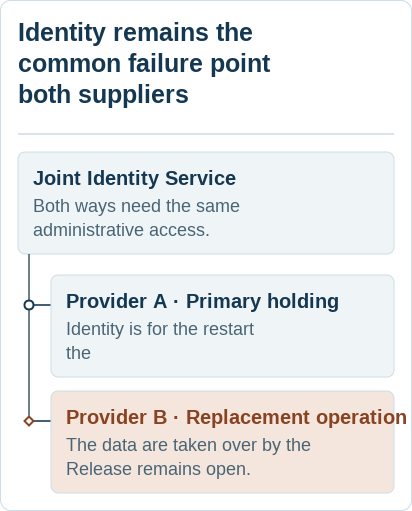
The two power paths meet with administrative access. The next sample must prove an independently usable release path.
Evaluation and decision
The power of the evasive system is not fully documented for this failure. The next order combines an independent release with the same data and function sample.
Negative test for your own operation
Just change the administrative release in a confirmed independent way. In addition, check whether the operation and return of data actually work independently.
Help for your decision
Compare promised and observed provider services. Determine common dependencies, evidence and approvals.
Supplier testing with quality limits
Compare promised and observed provider services. Determine common dependencies, evidence and approvals.
Outcome Decision on remedy or release per direct provider and service.
Read the instructions
Fictional example The primary service quickly reports, but the replacement route requires the same failed identity service. The technical alternative remains open.
- Connect service and contract Record direct provider, function and concrete contract finder
- Measure Report and Restore Compare own time limits and actual values from the same sample.
- Supporting alternative Evaluate the common dependence, plan and document correction.
Operating effects and restart order
Arrange operational consequences and restart targets per performance. Calculate necessary parallel and subsequent steps against the internal target
Outcome Prioritized performance with comprehensible restart chain and visible target deviations.
Read the instructions
Fictional example N18 · The target of the order service is 90 minutes. The operational dependence takes 70 minutes, the subsequent handover 35 minutes.
- Coordinating objectives Set tolerable interruption, restart target and data loss.
- Count order Confirm the parallel requirements and the duration of the subsequent professional transfer.
- Sharing time and data Compare the calculated values and open evidence for the organizational decision.
Legal basis for the verification task
§ 30 BSIG · Risk management measures
For each relevant service, combine risks, ten fields of action, evidence and effectively verified effect. § 30 para. 3 gives priority to the technical requirements of the DVO for the providers covered there.
Annex 5 · (EU) 2024/2690 · Supply chain security
Select a direct service provider and follow the selection, safety requirement and ongoing monitoring up to your own specialist service.
Annex 4 · (EU) 2024/2690 · Management and crisis management
Link technical effects, restoration goals, safety test and release. Work ends with a proven business process.

Next step for your editing level
First, take the decisive observation from the case. Then, based on your open question, choose whether you want to check your own process or play a comparable case.
Practically prepare change of service provider
The existing alternative is not enough for a documented failure. You want to take on a different performance practically.
Starting point Replacement or self-operation, data format, transition windows and a certified minimum performance.
Demonstrate replacement performance, data transfer and time limits using a controlled takeover sample
Work result An audited takeover decision with data matching, remaining deviations and possibly return.
View the guideCheck security requirements along the supply chain
They work in parallel on tasks from the same department.
Starting point Contract and performance installation to a direct provider, observed performance and possible failure sequence.
The overview will classify further audit orders and aids.
Work result A decision on release, restitution or replacement with a sample at the service concerned.
View the guide

