
A connected machine lacks safety evidence
Remote access to a packaging machine is documented.
CONFORMITY
MAINTENANCE
Starting position and test order
A fictitious packaging machine is supplied with digital control and a designated remote service. In the case of instruction, the team has confirmed the scope of application of both Regulations for version 2.4. The independent test group monitors the correct access check and protection of the intended configuration.
A controlled simulation run for safe system function with a disconnected remote connection was planned. The test report only contains the confirmation that the service is separated for this run. The observation of the required safe condition of the machine is missing.
Compare test data and consequences
Version
- Scale
- 2.4 in both test files
- Observation
- Common version documentation available
- Follow
- Assigning evidence to it
Remote access
- Scale
- Access and configuration checked
- Observation
- Cybersecurity evidence available
- Follow
- Matching CRA criterion
Safe condition
- Scale
- Monitoring of machine performance
- Observation
- Only separation documented
- Follow
- Specialized sample missing
Joint documents and separate security samples
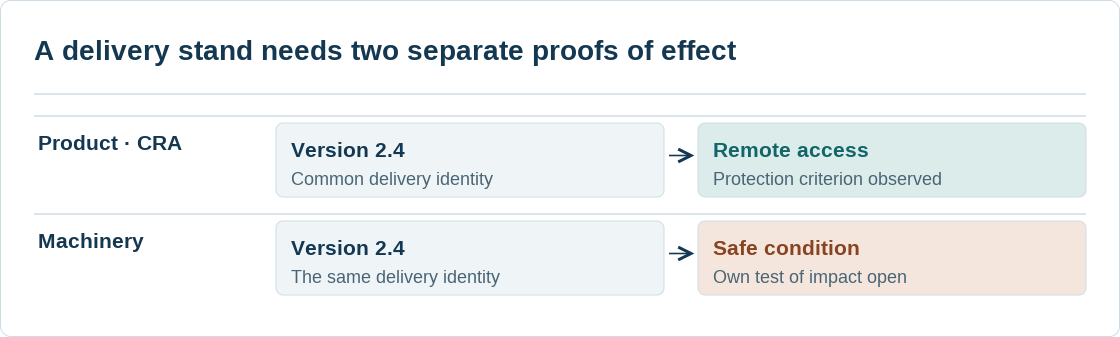
For the joint declaration, provide the appropriate evidence on both acts.
Edit the test step by step
Ensuring both applications
Arrange product, intended functions, deadline and applicable assessment methods to the respective legal acts.
Testable evidence Verification of the validity and procedural matrix of the same version.
Distinguishing common raw data and own impact
Link the remote access observation to the CRA. Check separately whether the secure system condition is occupied.
Testable evidence Separate statements on access testing and machine effect.
Confirm the joint statement reference after verification
Put the missing technical sample and check the draft declaration for both legal acts with their correct references.
Testable evidence The verifiable release of version 2.4 or further justified blocking.
Worked decision and negative test
Decision in case
The observed deregistration can support the intended remote access. For machine safety, the actual safe condition in the controlled simulation is also required.
The manufacturer shall keep both decisions in the same file and shall not confirm the joint declaration until the requirements of the specific delivery status are covered by the appropriate procedures.
Counter-sample and impact
Complete a valid machine test report for version 2.3. The safe condition is observed there. Check the transferability for 2.4 and decide whether a new observation is necessary.
Templates and worksheets
Product border and common proof of conformity
Compare legal reference, version and independently required documents per product range.
Outcome Classification and approval note with applicable basis and appropriate explanation.
Read the instructions
Fictional example The networked packaging machine has a confirmed access certificate. The machine effect is open.
- Identify the starting situation Justification of actual offer, purpose and possible exceptions
- Run the test to assign supporting documents per act and actual version.
- Secure decision and evidence Ensure the appropriate procedure, joint declaration and decision where appropriate.
Official sources
First check for this task
Cyberresilience Regulation in text
Use the article or attachment that regulates the task to be solved.
Regulation on machinery
Check the scope, procedure, Annex III and Art. 21 for the specific machine.
Machinery Regulation as amended on 27 July 2026
Use the version required by the deadline and the relevant amending acts.

Other official references1
- Guidelines for the application of CRA (opens in new tab)
EU-Kommission · Leitlinien C(2026) 5252
Check inter alia the remote processing, expected use and delimitation to other legal acts.
What depends on your result?
CRA and Machinery Regulation jointly
Transfer the same test criteria to your own product and save the different starting data.
View the guideConnect CRA and AI conformity
If a high-risk AI system is also involved, check its classification and special connection according to Art. 12 CRA.
View the guide

