
Dependencies and oversight
Identify shared risks and examine alternatives.
ALTERNATIVE
TRANSITION
When are two providers a common dependency?
Check location, subcontractors, platform and transition route separately. Two contracts can lead to the same technical or operational dependence. Document which function is affected in case of failure of this dependency.
Track two power paths up to the infrastructure that is actually needed for recovery in case of a malfunction. This allows you to see which contracts are affected by the same cause. For an exit, determine which alternative can be used by the function with what amount of time and data.
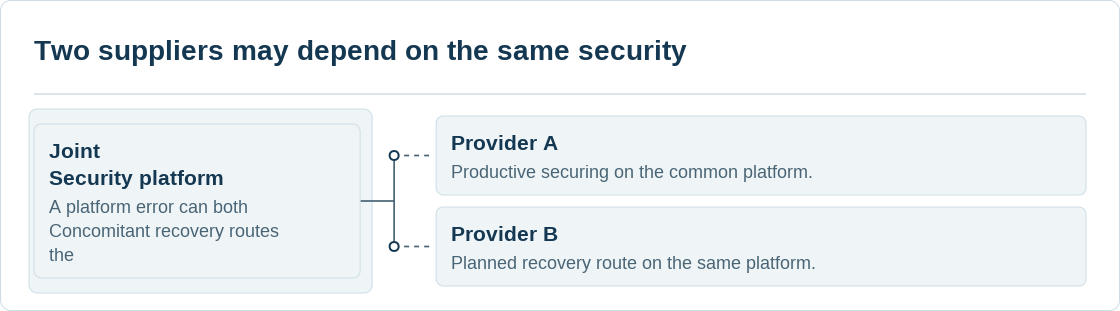
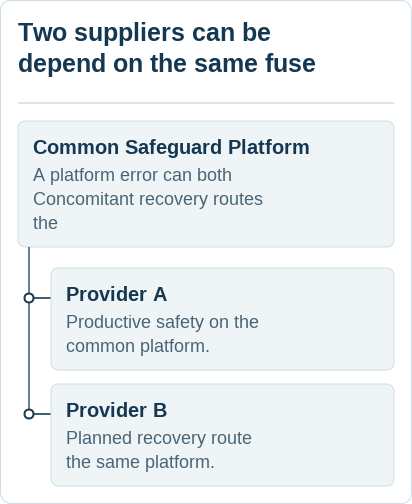
Fictional example of concentration in the service chain.
Checking common dependencies and alternatives
Capture providers, locations, subcontractors and available alternatives for critical business functions.
Reconstruct Chain
Use contract investments, supplier's statements and updated register data to substantiate the relevant chain for the function.
Check alternative
Determine which data, deadlines, technical requirements and roles determine a transition. Evaluate whether the alternative dissolves the relevant common dependence.
Test exit
Perform a documented exercise with transfer quantity, restart criterion and responsibilities. Hold obstacles and follow-up.
Secure the statement with a sample
Play through the failure of the common recovery platform. The chosen alternative must resolve this dependency or identify the remaining risk.
Example of two independent contracts
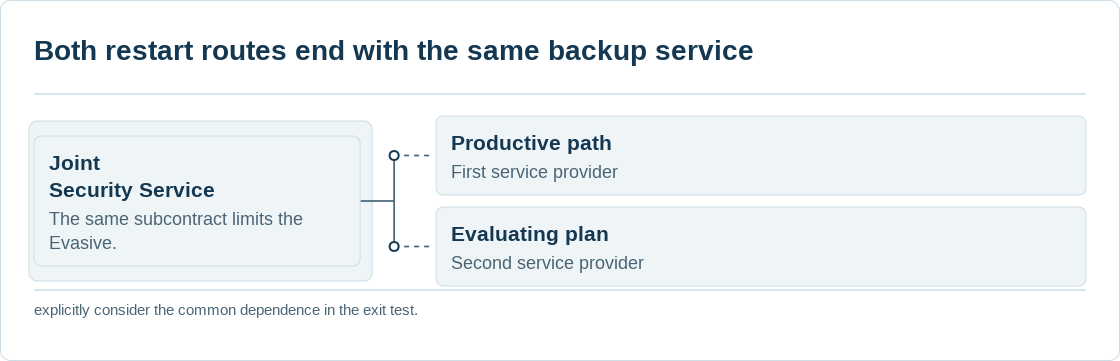
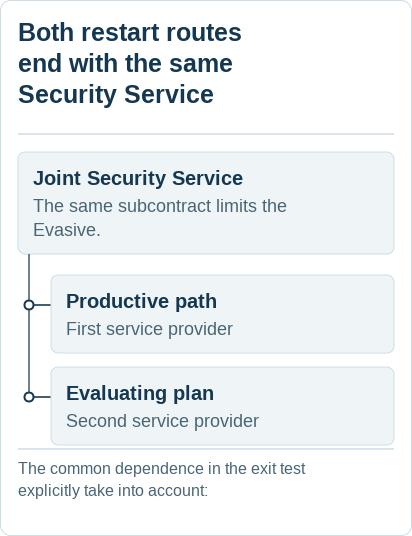
Two providers use the same subcontractor for collateral. A distinctive contract name is not sufficient for evaluation. The exit sample contains an alternative with a different security dependency.
Substantial transitional plan The plan identifies triggers, data return, responsible persons, technical requirements and the technical acceptance of the target operation.
- What you are examining
- Trace the recovery paths of both providers to the respective storage. From the contract documents and the operating documentation, document which technology would be affected jointly in case of a failure.
- What the post-test decides
- In the exercise, you can assume that the common backup service is out of order. The alternative environment must take over the agreed data. Document import, data reconciliation and partition sharing as your own steps.
A second provider may have the same vulnerability
Track both performance paths until recovery. This assumption checks the dependency in the exit test.
Tasks in this thematic area
Select the work page for your role, next check point or corresponding proof.
Evaluate changes in subcontracting
To examine the proposed major subcontracting change to function, risk situation, information route and contractual response.
Evaluate concentration risks in the performance chain
Evaluate contractors, shared infrastructure and realistic alternatives along a critical business function. Check common dependencies in the supply chain.
Checking out the exit plan for an ICT service
Check data return, transition services and technical resumption using a realistic exit scenario. Practically check data return and replacement operation.
Organize critical ICT third-party service provider supervision
Separate the internal meaning of a service from the European classification of its provider. The first results from the supported function. The second follows the formal procedure of the European supervisory authorities.
Your result Comparison of own functional evaluation and official designation status.
Responsible for voluntary exchange on cyber threats
Plan voluntary exchange only with a clear goal, a trusted circle of participants and shared information types. Document the boundaries of business secrets, personal data and confidentiality.
Your result The participation note with data criteria, notification path and evidence of a technical follow-up.
Maintain supervisory requirements and legal changes
Keep an understandable list of changed legal texts, official notices and specific supervisory requests. Each process includes the addressee, time, activity concerned and the responsible body for assessing the impact.
Your result Version proof with a well-founded responsibility and the appropriate edition.
Practice examination decisions in the case
Edit the initial data and compare your result with the well-founded solution.
Case D08
Identifying hidden concentration in two cloud services
Two contracts are to allow an independent restart in the fictitious port bank. The exercise checks service, platform and location dependence.
Your result Dependence card with common reference, assumed failure effect and an audited independent alternative.
Case D09
A substantial change in subcontracting
In the case of a service important for payment processing, the direct provider announces a change in the recovery chain. You process the contract notification until the reasoned decision.
Your result Reviewed prior-after comparison with queries, release conditions and competent bodies.
Case D10
Exit and restart with split fuse
Check a seemingly independent alternative solution for payment data and justify the transition based on measurable acceptance criteria. Check two default scenarios in the port bank.
Your result Decision per default scenario with selected performance path, measured duration, data reconciliation and justified residual risk.
Legal basis for this task
Compare the decision from the test example with the relevant rule.
Articles 28 to 30 DORA and Delegated Regulation (EU) 2025/532
For relevant subcontracts and changes, check the additional rules. The supervisory path for designated critical providers is regulated from Art. 31 DORA.
For your exam The plan identifies triggers, data return, responsible persons, technical requirements and the technical acceptance of the target operation.

For your own operation
DORA Dependencies and exit sample
Check actual independence from main and evasive service and plan a resilient sample.
Outcome Exit decision with proven infrastructure separation and measurable data transfer.
Read the instructions
Fictional example Two contract providers secure the payment data on the same recovery platform. The second contract uses the same default point as the first one.
- Identifying Common Dependency Use the same identifier for the same upstream service and verify controlled alternatives with a proof.
- Linking Evidence For relevant checkpoints, deposit the specific source, the verified version and the proof ID.
- Treatment of deviation Classify the common platform as a concentration risk and accept replacement only after independent acceptance.
List service providers and contracts
Evaluation of ICT providers, control contract content and document the performance of the DORA register of information. Assessments on EUGRC.AI are available for internal evaluation.

