
Fallback for payment data
Two default scenarios in the port bank are being checked.
APPLY
DOCUMENT
What alternative means are the payment processing?
The fictitious port bank is testing its exit from an ICT service. Provider A operates the primary payment service. Provider B is intended as a substitute for this. The bank only knows the promised services of the two providers so far.
You are responsible for the technical acceptance of the port bank. First check what remains available in case of failure of provider A. Repeat the evaluation for a failure of the shared backup platform. For both scenarios, you document time, data completeness and usability.
Initial data of the exercise
- 120 minutes
- Internal time limit for technically usable payment processing. Use the same start and end point for each sample.
- A common platform
- Providers A and B obtain their backups from the same recovery platform.
- 10.000 Test data sets
- A third party provider can take over the fictitious data from an independent source. The exercise checks the complete data reconciliation.
The exit decision for two default scenarios
Distinguishing the primary provider's failure from the failure of the common backup service. Use the same amount and time limit for both alternatives.
Check the starting position against the trigger
Consider separately a failure from Provider A and a failure of the common recovery platform. Note at which event Provider B continues to be a viable alternative.
Testable supporting evidence A decision matrix for primary service, provider B and independent alternative.
Measure failure in the transition test
The independent test import is technically completed after 90 minutes. First, the technical requirements are 9.980 of 10.000 test data sets. Check both criteria and document why a technical runtime alone does not prove any completion.
Testable supporting evidence A measurement with setpoint values, actual values and the 20 missing data sets.
Documenting the residual risk and follow-up
After adding to the export scope, all 10.000 records are technically available after 105 minutes. In the exercise, check again whether the common backup platform is needed for recovery.
Testable supporting evidence A releaseable test report and a condition for ongoing control.
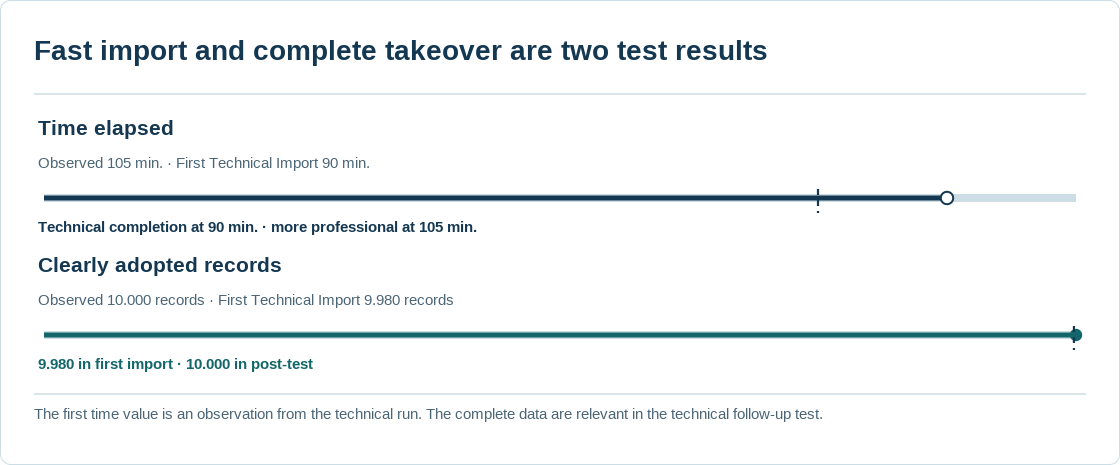
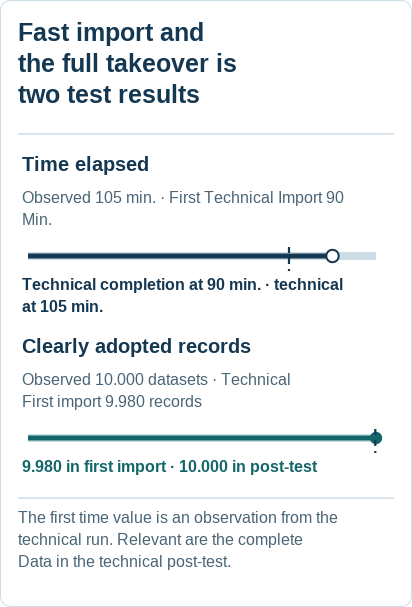
The time data indicate the work step taken. Only the post-test proves complete technical availability.
Secure the statement with a sample
The second import must deliver all 10.000 records completely. Note which dependency remains and which is eliminated by the new backup.
What is the alternative solution to the failure scenario?
Situation The fictitious port bank is testing its exit from an ICT service. Provider A operates the primary payment service. Provider B is intended as a substitute for this. The bank only knows the promised services of the two providers so far.
A failure of the shared platform interrupts both previous paths. In the test, independent recovery begins with a proven separate export. The repetition meets both the 120-minute target and the complete data reconciliation. The measured values apply to the described exercise scope.
Model decision with comprehensible alternative Provider B remains conceivable for the failure of the primary service. For the failure of the common platform, the independent exercise proves a usable alternative and a reserve of 15 minutes.
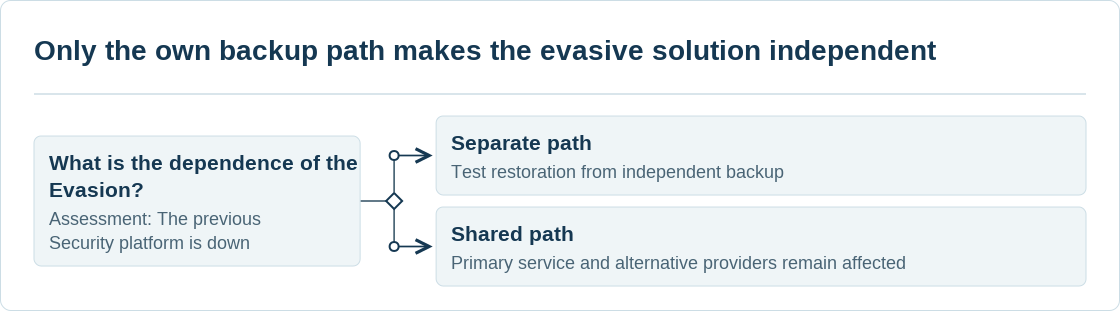
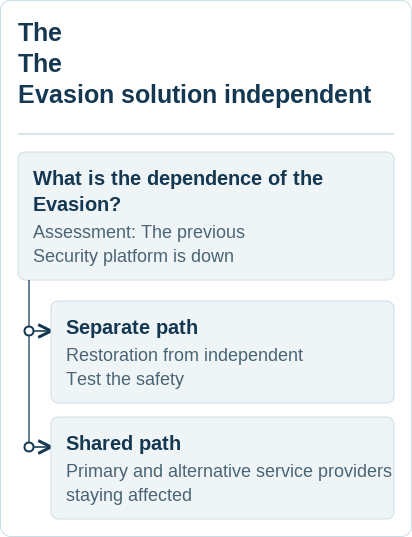
The graphic shows the failure effect in both performance paths.
Legal basis for this task
Compare the decision from the test example with the relevant rule.
Article 28(8) and Article 29 DORA · Discontinued and concentration
The case decision combines the assessment of a common dependence with the documented transition from a relevant service.
For your exam Provider B remains conceivable for the failure of the primary service. For the failure of the common platform, the independent exercise proves a usable alternative and a reserve of 15 minutes.

For your own operation
DORA Dependencies and exit sample
Check actual independence from main and evasive service and plan a resilient sample.
Outcome Exit decision with proven infrastructure separation and measurable data transfer.
Read the instructions
Fictional example Two contract providers secure the payment data on the same recovery platform. The second contract uses the same default point as the first one.
- Identifying Common Dependency Use the same identifier for the same upstream service and verify controlled alternatives with a proof.
- Linking Evidence For relevant checkpoints, deposit the specific source, the verified version and the proof ID.
- Treatment of deviation Classify the common platform as a concentration risk and accept replacement only after independent acceptance.
Prepare an exit procedure for your own service
Check data return, transition services and technical resumption using a realistic exit scenario. For internal evaluation, the assessments on EUGRC.AI are available.

