
Simplified framework in practice
Determine the status, design and responsibilities.
DECISION
RETEST
How is the confirmed status translated into a working framework?
A fictitious e-money institute examines a simplified framework. A proven legal classification controls the procedure and is translated into concrete roles and tests.
Support the department and the operation in the classification. Start with the status confirmation and use the service to assign responsibilities for control, restart and resubmission. Run register and report questions as your own tasks.
Initial data of the exercise
- Status
- In the exercise, the specialised body confirms that the institution as an exempt electronic money institution falls within the relevant category of Art. 16.
- Performance
- Payment triggering and balance of accounts are based on a central external service. In case of emergency, there is a documented replacement route.
- Test gap
- The company and management are registered. Owners for resubmission and test proof are missing.
Tasks for processing
Keep track of your decision, the original document used and still open information. Only open the sample solution once you have documented your justification.
- Arrange status records, simplified frameworks and the role of the external service each for themselves.
- Determine the responsibilities for risk control, re-start and re-submission.
- Create a compact overview of register and reporting receipts with the relevant audits.
Model solution with justification
Situation A fictitious e-money institute examines a simplified framework. A proven legal classification controls the procedure and is translated into concrete roles and tests.
- Derogation
- The classification follows the established category and the decision is re-examined when the regulatory status changes.
- Simplify audit trail
- In a single framework overview, service, risk, control, roles and test site are linked. External dependencies and representation remain visible.
- Decide on other obligations separately
- The registers and roles in the event of incidents are checked according to the respective regulations. The work sheet shows responsible persons and open information.
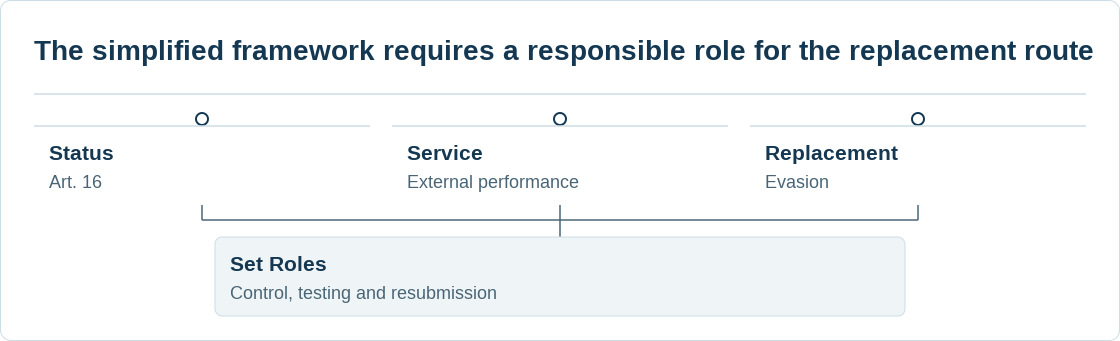
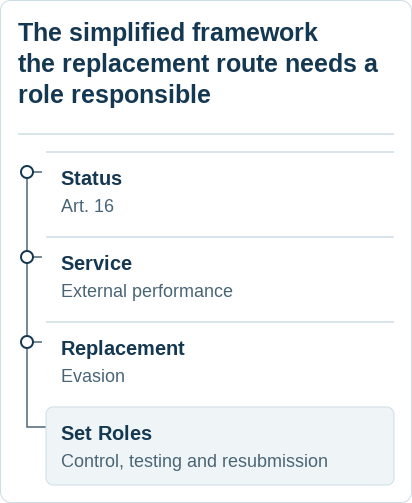
The role decision is based on three supporting documents:
Check the status confirmation, external dependency and existing restart receipt. Then set the tasks within the framework.
Secure the result in the post-test
Situation A fictitious e-money institute examines a simplified framework. A proven legal classification controls the procedure and is translated into concrete roles and tests.
Replace the status confirmation in a copy with an unchecked self-certification. The release must remain open until the request is received.
The legal assignment remains open until the competent authority provides sufficient evidence. At the open check points, determine which other tasks depend on this decision.
Legal basis for this task
DORA · Art. 16 · Application of the simplified framework
Article 16 lists the categories for the simplified framework.
For your exam Link the classification to the status document.
ICT risk management · (EU) 2024/1774 · Art. 28 · Management responsibility
Title III begins with governance and organisation of the simplified framework.
For your exam Check who is responsible for the replacement route and test.

What is the next decision?
Transfer the decision to your own process and set the checked criterion. Then, in the case directory, select an exercise with other source data or a different role.
Applying the simplified ICT risk management framework
The accreditation or status certificate, activity overview, key ICT dependencies and official reference documents.
First, create a proven business status. For the financial undertakings referred to in Article 16(1) the simplified framework is specified by Title III of Delegated Regulation (EU) 2024/1774.
Work result Tested assignment of the frame with representation of the roles and specially considered further duties.
Your result Released classification with separate statements on risk frameworks, reporting and third parties.
Edit DORA case studies
Edit a DORA case with fictitious initial data, for example to the information register or to a payment malfunction. Solution and counter-probe help in the transfer.
Your result Reasoned decisions with supporting evidence and a repeatable follow-up test.

