
Simplified ICT risk framework
Assess the entity's status and identify its obligations separately.
EVIDENCE
SAMPLE
Clear the occupied category before designing the framework
First, create a proven business status. For the financial undertakings referred to in Article 16(1) the simplified framework is specified by Title III of Delegated Regulation (EU) 2024/1774.
A small organizational size may be an opportunity to examine the applicable framework. For legal assignment, you work with the resilient status of the specific company. Then decide separately how the functions, responsibilities and evidence are organized within the chosen framework.
Work steps and verifiable documents
Determine legal status
Check the category using relevant approval and sectoral law. Decide with the competent legal entity. Separate open questions about the activity from practical issues.
Testable supporting evidence Document the scope decision with supporting evidence and references to the relevant articles.
Identifying roles and risks
Link responsibility for the framework with information security, service assignment and restoration. Visibly remove the few essential scenarios, controls and associated work instructions.
Testable supporting evidence Functional overview, risk list and role directory that refer to the same status.
Check further DORA requirements separately
Merge third-party registers and incident procedures with your own validity decision. Check the requirements of the respective regulations and keep track of inspection and update events.
Testable supporting evidence Short applicability matrix per area of obligation.
Decision in the test example
A fictitious small company expects a simplified framework because of its size. The department establishes an exempt electronic money institution under the relevant national law and provides the authorisation certificate.
- Compilation of documents
- From the classification note, keep track of the confirmed category until official proof. In addition, place a service related to the group and the corresponding own proof of performance.
- Keeping a decision
- The group decides on the basis of the category covered. It documents the roles of Title III and clarifies, independently of this, the receipt of external ICT services and register management.
- Complete the test file
- Released classification with separate statements on risk frameworks, reporting and third parties.
- Sample and acceptance
- Let the department document the individual legal category with the origin document. Check the decision again if an exception rule expires.
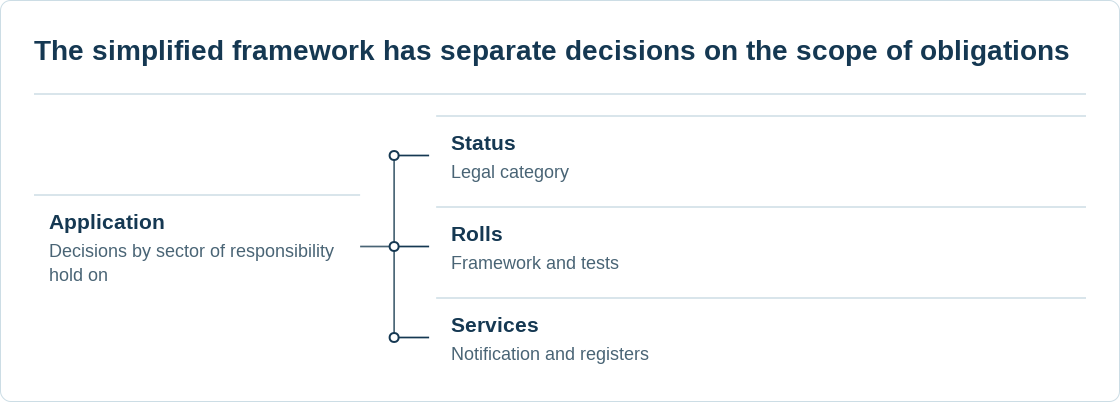
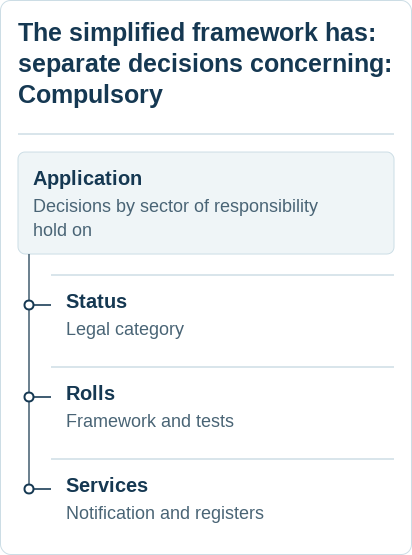
The status certificate shall bear three separate decisions
Use a common reference level for applicability. In practice, risk frameworks, incident obligations and register management are examined individually.
Legal basis for this task
DORA · Art. 16 · Simplified frame
The regulation describes the personal scope and the basic framework.
For your exam Use the status certificate for the assignment decision.
ICT risk management · (EU) 2024/1774 · Art. 28 · Responsibility in a simplified framework
Title III begins with requirements for management responsibility and clear tasks.
For your exam Check the roles and responsibility for risk management.

What is the next decision?
In the case of an institute, test which decisions follow from the confirmed status. Take over your documented role assignment and the open points into the audit file.
A fictitious e-money institute examines a simplified framework. A proven legal classification controls the procedure and is translated into concrete roles and tests.
Case D04
Your decision Compact framework overview with status receipt, service, risk, roles, test findings and open obligations.
Building a simplified ICT framework for an institution
A fictitious e-money institute examines a simplified framework. A proven legal classification controls the procedure and is translated into concrete roles and tests.
Your result Compact framework overview with status receipt, service, risk, roles, test findings and open obligations.
Detection dossier
Test job, original sample, version reference, correction and documented retest.
Link target criterion, drawn sample, findings and retest. The memory example shows which protocols prove the effectiveness of alarming to the checked status.
Work result A dossier in which a third party monitors expectations, observations, findings and conclusions per test criterion.
Your result A dossier from which another person can repeat the same sample.

