
Close an internal audit finding
To assess the correction and efficacy.
DECISION
RETEST
What observation allows the audit findings to be completed?
The revision examines a control in the fictitious port bank for the release of changes. The documented rule is complete. Proof of recurring execution has a gap.
You will check the remedy from the perspective of revision. Compare the original defect with a new, actually executed sample. Determine which version of the working document was used and whether the control has been passed through it until release.
Initial data of the exercise
- Expected result
- For relevant changes, the internal process requires test protocol, release and confirmation of the updated inventory.
- Sample
- Four completed changes from two teams are read. For two operations only the test is taken. The updated inventory position cannot be assigned time.
- Proposed remedy
- A new template adds a field for inventory documentation. Actual usage has not yet been checked.
Tasks for processing
Keep track of your decision, the original document used and still open information. Only open the sample solution once you have documented your justification.
- Formulate a finding with purpose, documented observation and effect on the traceability.
- Arrange the remedy with owner, appointment and verifiable target criterion.
- Determine a downstream independent sample of actual processed changes.
Model solution with justification
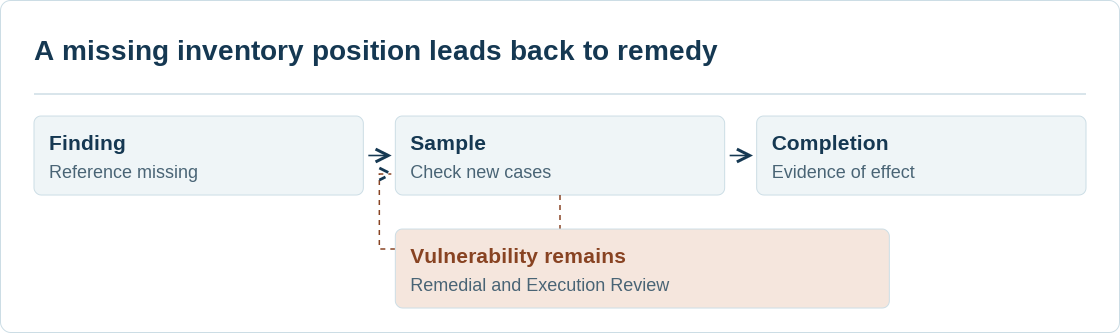
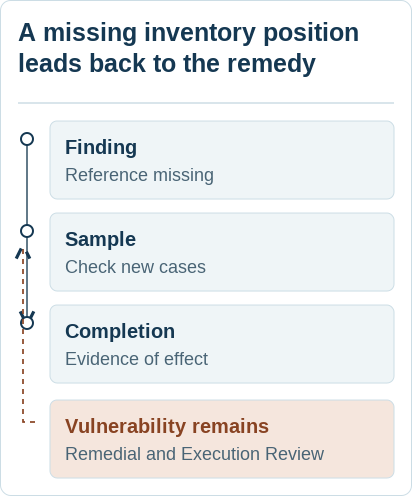
Situation The revision examines a control in the fictitious port bank for the release of changes. The documented rule is complete. Proof of recurring execution has a gap.
- Identifying the problem precisely
- The procedure already provides for inventory documentation. The sample shows missing execution or documentation in two cases and requires a check of the cause.
- Align remedy to execution
- The template supports traceability. The responsible role also checks whether the process completion captures the reference bindingly.
- Checking results from new cases
- The audit examines the actual use in suitable new cases. The conclusion refers to the supporting documents and the status of the case.
The effectiveness is shown in new processes
Compare the documented target rule with selected completed changes after correction.
Secure the result in the post-test
Situation The revision examines a control in the fictitious port bank for the release of changes. The documented rule is complete. Proof of recurring execution has a gap.
In a case with a completed form, check whether the inventory reference actually fits the deadline. A formal complete entry alone does not bear the conclusion.
Draw another final change after the implementation of the measure. Follow the confirmed reference up to the actual level used and have the test and findings documented again.
Legal basis for this task
DORA · Art. 6(6) and 7 · Internal audit and follow-up
The rule sets out internal audit and the timely follow-up of critical audit findings.
For your exam Support independence and effective remedy.
DORA · Art. 24 para. 5 · Tracking of test findings
The rule describes procedures for remedying and internal validation of the undertakings covered.
For your exam Link the sources to the extent that the facts are based on resilience tests.

What is the next decision?
Transfer the decision to your own process and set the checked criterion. Then, in the case directory, select an exercise with other source data or a different role.
Fix and test test results
First test with target and is, approved correction, version comparison and post-test with the same criterion.
Follow a failed test criterion until the rectification, re-examination and documented final decision.
Work result Final note with comprehensible remedy, observed effect and release date.
Edit DORA case studies
Edit a DORA case with fictitious initial data, for example to the information register or to a payment malfunction. Solution and counter-probe help in the transfer.
Your result Reasoned decisions with supporting evidence and a repeatable follow-up test.

