
Disruption to payment services
Decide on classification and initial notification.
APPLY
DOCUMENT
How do confirmed effects change the notification decision?
The fictitious port bank learns about a failure in the payment acceptance at 09:15 clock. The affected service supports the payment processing that is considered critical or important. At 11:30 clock confirmed values for classification are available.
You coordinate the classification of the fictitious payment failure. For each invoice, determine what is known at what time and on which user stock or downtime you rely. Prepare the initial notification with a verifiable time base.
Initial data of the exercise
- Failure to perform duties
- 135 minutes of downtime of the service concerned are confirmed for the exercise.
- Users concerned
- 12.000 affected users of 100.000 Users of the same service are the confirmed reference value.
- Dates
- Keep track of the information at 09:15 and confirmed information status at 11:30 separately.
Identifying the decision to first report
First, edit the case with the specified customer numbers, confirmed downtime and time points for knowledge and classification.
Deriving two criteria from the input data
Calculate the percentage of affected users. Document in parallel the period during which the service actually failed. Reason what time and which user base you are using.
Testable supporting evidence Two verifiable invoices with source and time stamp.
Identify the date of classification and reporting limit
Check Articles 6, 8 and 9 of Delegated Regulation (EU) 2024/1772. In the case of practice, use 11:30 as the time of classification. The first report is issued at 12:20.
Testable supporting evidence A timeline with knowledge, classification, the latest regular initial notification and actual transmission.
Complete the notification file and counter-probe
Change the user share to 8% for the counter-test. Leave the downtime at 135 minutes and do not require any more thresholds reached in the exercise scenario. Check which classification condition will be omitted.
Testable supporting evidence A statement of the amended decision and a presentation of the original reporting data.
Secure the statement with a sample
Calculate the alternative customer share. Reason on the same rules, which is why the classification changes in the actual case of exercise.
What is the classification of the initial stock?
Situation The fictitious port bank learns about a failure in the payment acceptance at 09:15 clock. The affected service supports the payment processing that is considered critical or important. At 11:30 clock confirmed values for classification are available.
12.000 of 100.000 is 12%. The failure takes 2 hours and 15 minutes. If the critical service is affected and two materiality thresholds are reached, the incident is considered serious in the example. The most recent regular first report is from 11:30 plus four hours and is at 15:30. Actual message at 12:20 is before.

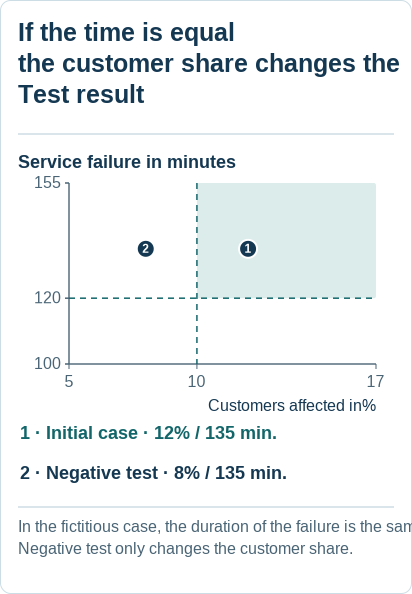
The counter-test only changes the customer's share. The duration provides the same test certificate in both runs.
Sample solution with own negative test The initial decision reaches the thresholds for customer share and service failure. If confirmed 8%, the remaining individual threshold is not sufficient on its own for the assumed case.
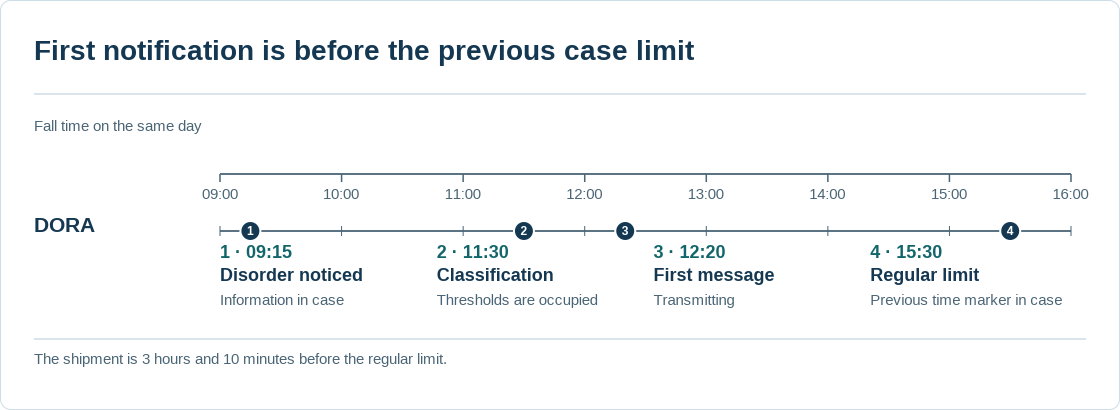
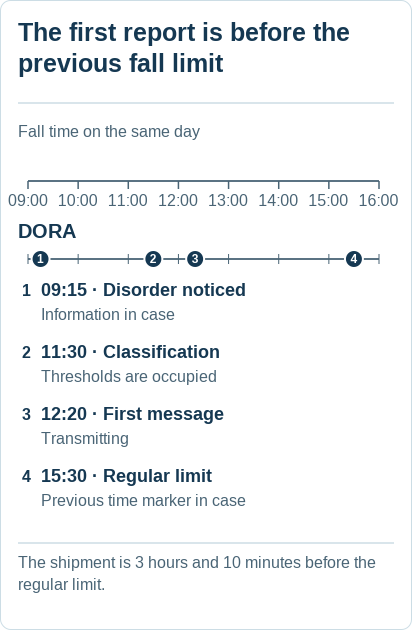
Fictional time data of the port bank. The chart shows the first report in the exercise scenario.
Legal basis for this task
Compare the decision from the test example with the relevant rule.
Articles 8 and 9 of Delegated Regulation (EU) 2024/1772 and Article 5 of Delegated Regulation 2025/301
In the case of training, customer share and downtime are relevant for classification.The deadlines for reporting levels are based on the separate reporting standard.
For your exam The initial decision reaches the thresholds for customer share and service failure. If confirmed 8%, the remaining individual threshold is not sufficient on its own for the assumed case.

For your own operation
DORA Incidental file and notification decision
Perform the evidence, classification and handover to the reporting officer in an incident file.
Outcome The classification can be calculated at each point of knowledge and repeated in the decision-making protocol.
Read the instructions
Fictional example A supervised financial service is affected. The downtime is 142 minutes, the geographical reference is initially open. A second cross-border affected state is initially only suspected.
- Check classification Support the Art. 6 alternatives and each relevant threshold criterion individually.
- Linking Evidence For relevant checkpoints, deposit the specific source, the verified version and the proof ID.
- Treatment of deviation Keep the review version, verify the new information and check the trigger for a new classification.
Assign deadlines and versions of notifications
Report a serious ICT incident with documented dates and keep track of reporting, recipients and transmission documents. For internal evaluation, assessments are available on EUGRC.AI.

