
Handle ICT incidents
Connect observations, decisions and handovers.
EVIDENCE
SAMPLE
Build the process of confirmed observations
Arrange technical observations immediately to a function concerned and the relevant role. The incident record records knowledge, assumptions, treatment and decisions in a common time sequence.
Keep track of, and decide on the same process, even if different teams provide information. Mark the time when the department confirms an impact. This allows coordination and responsible reporting unit to understand the same course with different work assignments.
Work steps and verifiable documents
Identify observation as an event
Capture time, source, service concerned and possible effects. Document when the organization gained knowledge of the incident and what information was resilient at that time.
Testable supporting evidence Chronicle with origin of any time indication and consistent reference to function.
Clearing responsibility and work packages
Determine the management of the incident, technical processing, professional situation assessment and reporting unit. Keep together who has taken which decision and which follow-up check is triggered.
Testable supporting evidence Incidental acts with jurisdiction, decision and resubmission.
Check handover and completion
Confirm with the department when the service is available again. Check open effects and transfer measures or a repeat test to follow-up.
Testable supporting evidence Final report with impact control and open orders.
Decision in the test example
Payments arrive late at the fictitious port bank. The company first finds a waiting period. Afterwards, the department reports double advertisements and a possible impairment of customers.
- Compilation of documents
- Put technical recognition, professional effect and transfer to the responsible role in a timeline. Check which information stand was loadable before the first decision.
- Keeping a decision
- The incident management links both observations with the payment function, secures the timing and re-examines the classification based on the newly confirmed effects.
- Complete the test file
- Continuous incident file with knowledge, effect and confirmed return to the plant.
- Sample and acceptance
- Compare the first technical alarm with the later professional confirmation. Both times must be from their own sources.
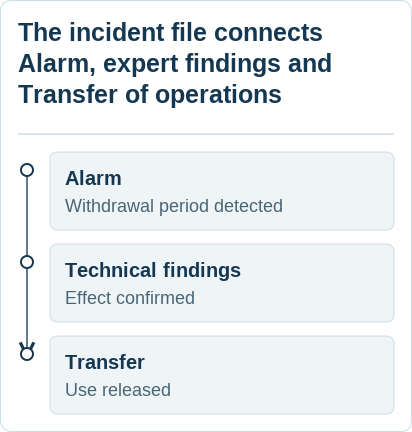
The professional confirmation complements the first alarm
Put together time, technical observation and technical impact in the same file. New facts trigger a reassessment if necessary.

Legal basis for this task
DORA · Art. 17 · Incident management
The rule covers the detection, treatment, recording and tracking of ICT-related incidents.
For your exam Use a file for technical and professional decisions.

What is the next decision?
Follow the example of the incident coordination when a new professional observation influences classification. Keep the same incident identification for chronology and evidence.
Incidents and notifications
Gather time, affected services and measurable impacts. In case of a payment failure, check how a new information affects the classification and reporting period.
Your result A reasoned decision with a time reference and reporting document.
Detection dossier
Test job, original sample, version reference, correction and documented retest.
Link target criterion, drawn sample, findings and retest. The memory example shows which protocols prove the effectiveness of alarming to the checked status.
Work result A dossier in which a third party monitors expectations, observations, findings and conclusions per test criterion.
Your result A dossier from which another person can repeat the same sample.

