
Work out DORA reporting deadlines
The data are used to calculate the reporting periods from established dates.
EVIDENCE
SAMPLE
To attach each time limit to the established trigger
Calculate deadlines from the actual documented triggers. The first message combines knowledge and classification. The intermediate message follows on from the dispatch of the initial message. The final report refers to the intermediate message or its last update.
Set the time when an event is noticed, its classification is confirmed and a message has actually been transmitted. An unclear time zone or a time stamp replaced subsequently can change the path of calculation. Keep the rule applied and the underlying documents separately visible.
Work steps and verifiable documents
Keep knowledge and classification separately
In the case of a standard, the first notification must be sent as early as possible within four hours from the date of classification and at least 24 hours from the date on which it is known.
Testable supporting evidence Time-limit sheet with two calculated maximum time points and the relevant result.
Checking specific constellations
If necessary, check the case of classification only after the 24 hours and the special rules for weekends and holidays. Determine the relevant rule and its conditions.
Testable supporting evidence Time-limit decision with reference to the article and release.
Deriving follow-up messages from dispatch records
Calculate the intermediate message at least 72 hours after transmission of the initial message. Use the relevant interim message for the final report and record updates.
Testable supporting evidence Reporting Chronicle with shipping reference, deadline and receipt.
Decision in the test example
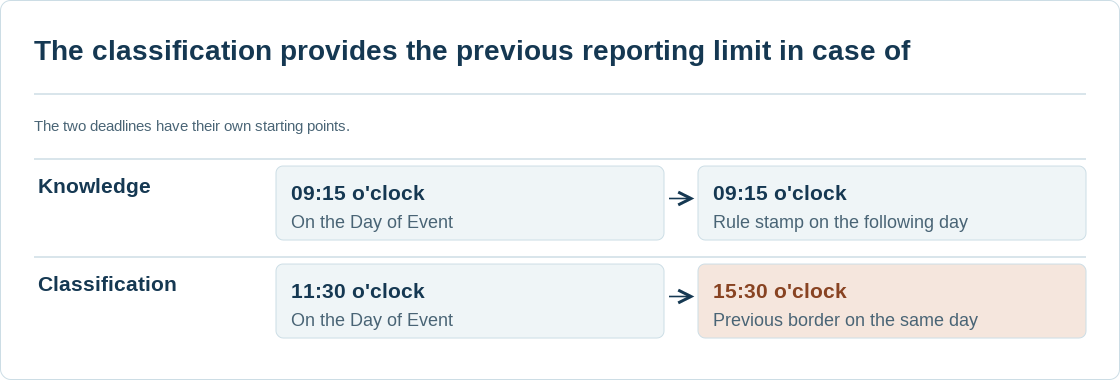
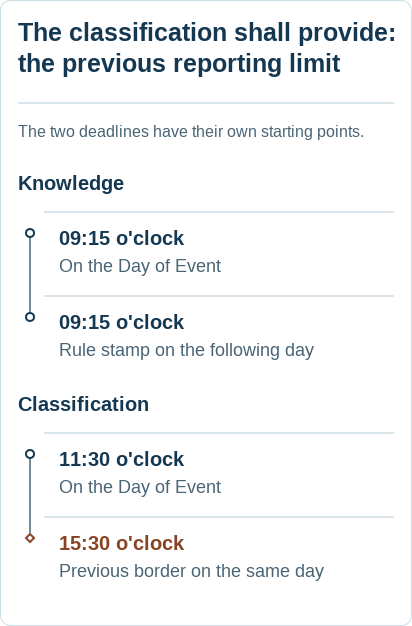
In the fictitious case, the bank becomes aware of 09:15 and ranks as serious at 11:30. Regular limits would be 15:30 on the same day and 09:15 on the following day.
- Compilation of documents
- In the case of exercise, use confirmed triggers, data and time zone for each period. Determine the actual previous limit with source and schedule possible later knowledge.
- Keeping a decision
- The previous regular limit is 15:30. The bank sends the available first message at 12:20. The dispatch of this report starts the deadline for the intermediate message.
- Complete the test file
- Time-limits sheet with reference dates, sources, rules used and actual transmissions.
- Sample and acceptance
- Let a second person only understand the three time-limits with the date of knowledge, the decision to classify and the proof of dispatch.
The previous regular limit applies to the initial notification
In the example, the four-hour limit falls to 15:30. Compare the time marks calculated in parallel and secure the shipping receipt.
Templates and worksheets
The filler tool is directly under the task. Download the template for editing or open the Quick View.
Timetable for DORA incident reports
Calculate rule limits from knowledge, classification and transmission and merge them with receipts.
Outcome The deadline check shows the basis of calculation, actual level sent and necessary special case check.
Read the instructions
Fictional example The incident is known around 08:00, classified to 11:30 and first reported around 14:30. If later knowledge is missing, an intermediate level to a restored service is missing.
- Recalculate deadlines Get knowledge, classification and actual transmissions in UTC. Check exceptions and immediate updates separately.
- Linking Evidence For relevant checkpoints, deposit the specific source, the verified version and the proof ID.
- Treatment of deviation Check immediate update and territorial special rules separately. Book shipment and receipt per level.
Legal basis for this task
Reporting periods · (EU) 2025/301 · Art. 5 · Time limits and special constellations
Article 5 defines the reporting dates and deals with specific time-limits.
For your exam Calculate with documented triggers and check the relevant exceptions.
DORA · Art. 19 · Reporting obligation
The basic act classifys the notifications of serious ICT incidents.
For your exam Determine which competent authority and the reporting level are available.

What is the next decision?
Select another reporting level from the exercise file and reconstruct the trigger. For the test, determine the confirmed time, legal reference used and actual receipt together.
Incidents and notifications
Gather time, affected services and measurable impacts. In case of a payment failure, check how a new information affects the classification and reporting period.
Your result A reasoned decision with a time reference and reporting document.
Detection dossier
Test job, original sample, version reference, correction and documented retest.
Link target criterion, drawn sample, findings and retest. The memory example shows which protocols prove the effectiveness of alarming to the checked status.
Work result A dossier in which a third party monitors expectations, observations, findings and conclusions per test criterion.
Your result A dossier from which another person can repeat the same sample.

