
Prioritise security patches
Evaluate findings by impact and exposure.
EVIDENCE
SAMPLE
Deriving an update strategy from impact, exposure and operational risk
Prioritize findings based on affected assets, their accessibility and their importance for business performance. The audit will follow a finding until the effective update or up to a well-founded, controlled exception.
Check the findings and actual use of the affected component in common. The same technical vulnerability can have different consequences in two environments. Set the planned update level, a possible temporary interim measure and the sample to confirm the effect.
Work steps and verifiable documents
An exception ends with a completed qualification
Check whether the released version status is actually used in operation. A temporary exception remains visible until its re-submission.
Matching findings with inventory
Check source, affected version levels and asset owners. Set how the result is confirmed, classified and assigned as a task.
Testable supporting evidence Findings list with version, function, justification and responsible role.
Treatment and exception decide
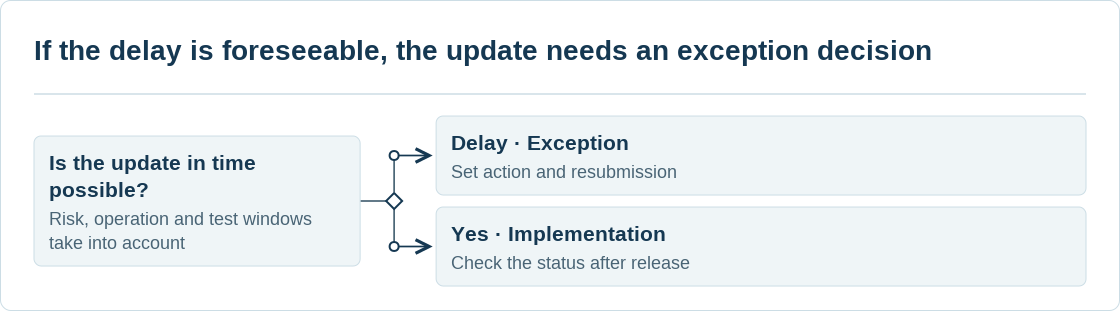
Arrange the update of the intended test and release route. If the next date fails to reach the target, you will be able to determine replacement control, decision-making authority, runtime and resubmission.
Testable supporting evidence Maintenance release or temporary exceptional file with controllable effect.
Verify completion on the basis of current status
Track the released version state into actual operation. Capture the rematch and the professional function sample.
Testable supporting evidence Test report with modified status and closing date.
Decision in the test example
A shared security update for a payment portal component clashes with a transaction tip. The technical role reports that the regular maintenance deadline is too late.
- Compilation of documents
- Arrange the results of the actual version and the performance concerned. Compare for remedy the approved date with the recorded record and the professional sample.
- Keeping a decision
- The responsible body decides on an early test and documents a short controlled intermediate phase. After the change, IT confirms the usability of the version and the department.
- Complete the test file
- The chain of findings from baseline, priority, treatment and effective technical change.
- Sample and acceptance
- Select a due exception and a marked result as done. In both cases, the date, responsible role and target must be valid.
Templates and worksheets
The filler tool is directly under the task. Download the template for editing or open the Quick View.
Findings and treatment decision for a safety update
Follow safety findings, maintenance-related deviation and correction until proven follow-up.
Outcome A reasoned patch or exception decision with a clear deadline and dependence.
Read the instructions
Fictional example A supplier patch cannot be recorded during billing. Replacement control is running for a limited time. The test is done, but the operating data shows an old version.
- Tax payable by Capture maturity and actual completion. Confirm the effect and follow overdue post-tests.
- Linking Evidence For relevant checkpoints, deposit the specific source, the verified version and the proof ID.
- Treatment of deviation Open the result again and secure version, risk decision and test on the same initial identifier.
Legal basis for this task
ICT risk management · (EU) 2024/1774 · Art. 10 · Vulnerabilities and patch management
The regulation makes clear documented processes for the detection, evaluation and treatment of vulnerabilities and for the introduction of updates.
For your exam Check the execution on a verifiable change.

What is the next decision?
Choose an open finding from the ICT business with confirmed business reference. Set the tested version, the decision until the update and the later effectiveness test together.
ICT operation and protection
Arrange applications, data and external services of a business function. Then select a specific sample, such as a controlled memory change or the withdrawal of an authorisation.
Your result Inventory status with technical reference and documented control test.
Detection dossier
Test job, original sample, version reference, correction and documented retest.
Link target criterion, drawn sample, findings and retest. The memory example shows which protocols prove the effectiveness of alarming to the checked status.
Work result A dossier in which a third party monitors expectations, observations, findings and conclusions per test criterion.
Your result A dossier from which another person can repeat the same sample.

