
Accuracy and fallback in an AI test
Decide whether the failure attempt will block otherwise successful release.
DEPLOYMENT
OVERSIGHT
Starting position and test order
The fictitious Nordhafen Technik GmbH is preparing the release of a camera evaluation to secure a test bench. The exercise is based on provider role and high risk classification. A secured test stand is tested. The approved order for version 3.1 requires at least 95 percent correct detection in 40 reference cases and an observed safety condition in each of the four failure attempts.
The first run provides 39 correct detections. In one of the four failure tests, the user interface continues to "already" although the subject cannot confirm the intended condition. The acceptance line stops the run. They have the reference cases, the time track and the hypothesis for display available.
| Sample | Internal | First run 3.1 | Aftertest 3.2 |
|---|---|---|---|
| Detection | 40 cases and at least 95% | 39 out of 40 | 40 of 40 |
| Safety status | All 4 failure tests observed | 3 out of 4 | 4 out of 4 |
Prepare the decision
Evaluate failures separately
Evaluate the 40 reference cases and the four failure samples independently. Secure the observed system reaction and display with the same test run identifier.
Testable evidence Two evaluated criteria and a proven deviation from the failure sample.
Prepare the post-test under the same condition
Release the modified version and repeat the four failure samples, including the failed case. Repeat the detection sample on the pre-set.
Testable evidence Post-test report with confirmed comparability, observed response and release note.
What the test results
Situation The fictitious Nordhafen Technik GmbH prepares the release of a camera evaluation for securing a test bench. For the exercise, provider role and high risk classification are determined.
Model decision and justification
39 out of 40 give 97.5 percent. The performance criterion is met. Three confirmed failure samples from four leave the safety certificate open and block the exercise release. Version 3.2 delivers 40 out of 40 correct detections and four observed safety states. The post-test carries a new decision when supervision and test conditions are confirmed.
Counter-sample and impact
Set the test to four expected and only three actual failed attempts. Even if all three tests are running show the safety condition, the release is open due to missing coverage.
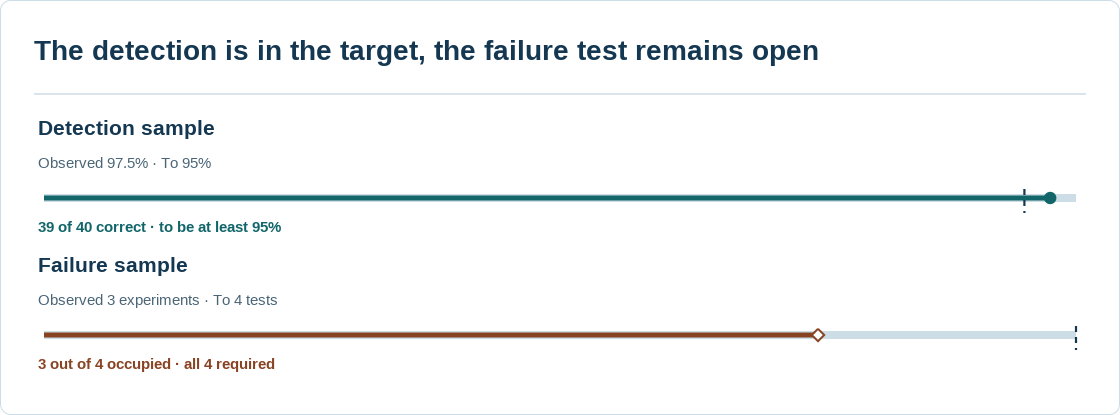
Security status and detection performance each have its own purpose.
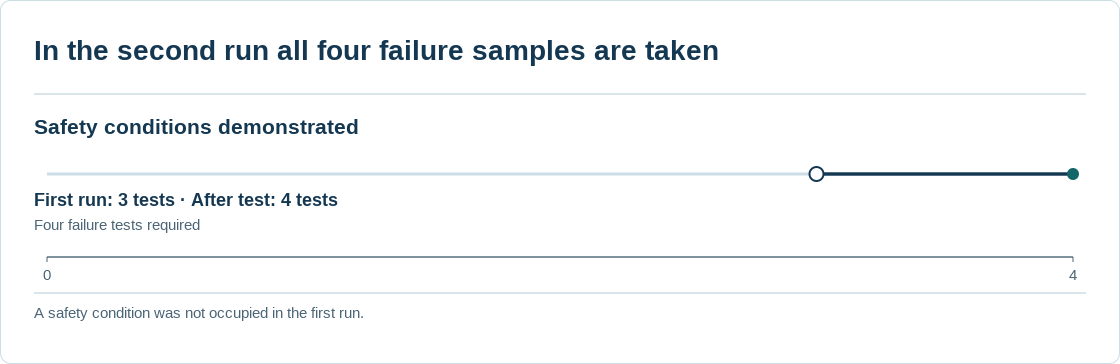
The repeat run takes over the original target circumference.
Repeat with your own data
A release protocol with separate findings per performance and safety criterion and a verified follow-up test
Risks and failure samples
Capture performance and safe relapse per test run. Consider the number of actual tests, confirmed reactions and original evidence.
Outcome A release protocol with separate findings per performance and safety criterion and a verified follow-up test
Read the instructions
Fictional example KI09 · 39 of 40 detections result in 97.5 percent. Three confirmed safety states from four tests block the release according to the scale of the exercise.
- The starting position Set the target, number and condition of intervention
- Editing the Process Detection and failure test separately
- Secure Decision Decrease new version with complete failure series
Official sources
Regulation (EU) 2024/1689 as amended on 27 July 2026
Readable version with the changes made by Digital Omnibus on AI. The application rules are to be read for your own deadline.
Regulation (EU) 2026/1744 · Digital Omnibus on AI
Officially published changes, including AI competence, high risk periods and transitional rules.

What is the next decision?
First, take the decisive observation from the case. Then, based on your open question, choose whether you want to check your own process or play a comparable case.
Risks and test limits
Transfer method and result to your own use.
Starting point Version, limit of purpose, specific error situation and already released target criterion.
Work result A decision per risk situation with original receipt, correction order and repeatable sample.
View the guideCase studies
You want to practice with fictitious data first or understand a similar decision from another role.
Compare how another decision needs to be taken.
Work result The cases provide initial data, a test order and a reasoned sample decision. Change a concrete condition and check the impact.
Select Case studies

