
Risks and limits of AI testing
Link hazard, test criterion, relapse path and documented release.
DEPLOYMENT
OVERSIGHT
Checking risks and test limits on your own system
A risk register becomes resilient when it describes the same situation as the later test. Keep in mind who or what would be affected, which system reaction can cause damage and what the department should observe at the same moment. Check the intended operation and realistically predictable misapplications separately.
Before running, determine which deviation will block the release. An average number helps in assessing performance. A failed protection mechanism needs a decision and a person responsible for remedying and post-testing.
Secure the test scale before running
Limit requirements at intended use
Arrange the obligation to protect and responsible persons for the intended system purpose.
Testable evidence Requirements covered by each function, on the basis of unexplained points.
- Acceptance criterion
- Trace execution, review and approval to named roles. Check handover and deputy arrangements in the exercise.
- Evidence
- Roles record naming responsibilities, deputies and documented approval or escalation.
Set test limits before run
Set realistic misuse, unique measurement size and pre-confirmed threshold.
Testable evidence Released order with reference, procedure, limit of blocking and expected evidence.
- Acceptance criterion
- Use the same metric, population and unit for expected and observed results. Record the measurement point at which the business service is achieved.
- Evidence
- Measurement record with baseline population, source, expected and observed values, unit and timestamp.
Detach detection and relapse separately
Check accuracy and robustness at independent setpoint values. Reason how the safe condition is observed.
Testable evidence Set-actual protocol for detection and relapse with a busy display and observed state.
- Acceptance criterion
- A second reviewer can follow the statement to the original evidence and the version checked. Record the evidence identifier or file reference with the decision.
- Evidence
- Evidence list recording original source, version, documented mapping and owner.
Watch the procedure to the condition
Check whether the authorized role notices a deviation, discards the output or safely interrupts operation.
Testable evidence Timely observation of warning, confirmed intervention and actual reaction.
- Acceptance criterion
- The responsible person performs the intended control in the approved workflow. Use the resulting transaction state to verify that the intervention worked.
- Evidence
- Evidence of the control showing role, time, affected transaction and observed effect.
A good score and a failure relapse
The fictitious Nordhafen Technik GmbH prepares the release of a camera evaluation for securing a test bench. For the exercise, provider role and high risk classification are determined.
Decide whether the failure attempt will block otherwise successful release.
The decision whether version 3.1 can be released and what the run must prove to be version 3.2.
Edit case · A good hit value and a failure relapse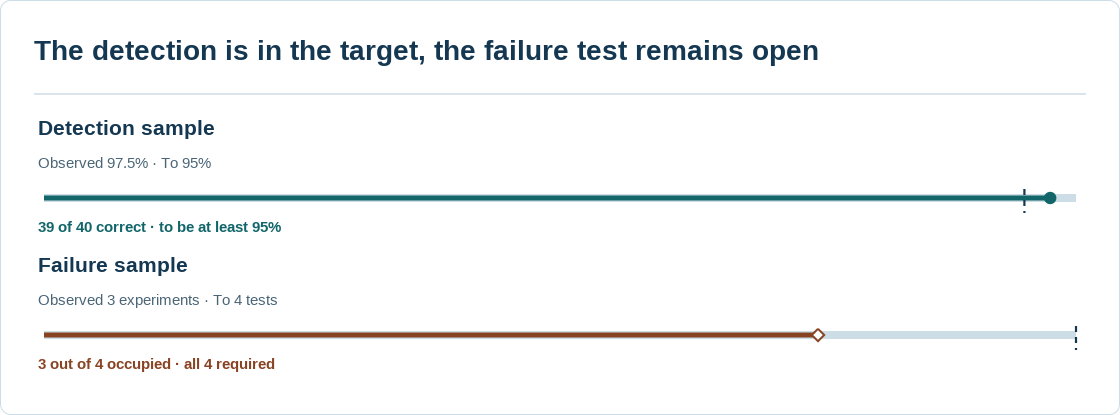
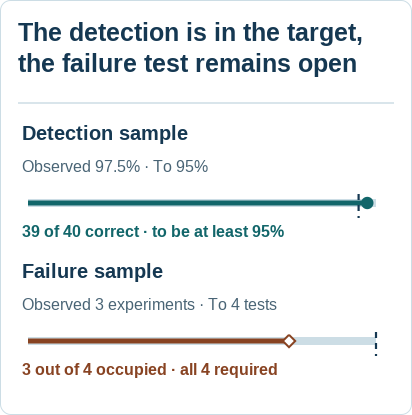
Security status and detection performance each have its own purpose.
Documenting your own test
A release protocol with separate findings per performance and safety criterion and a verified follow-up test
Risks and failure samples
Capture performance and safe relapse per test run. Consider the number of actual tests, confirmed reactions and original evidence.
Outcome A release protocol with separate findings per performance and safety criterion and a verified follow-up test
Read the instructions
Fictional example KI09 · 39 of 40 detections result in 97.5 percent. Three confirmed safety states from four tests block the release according to the scale of the exercise.
- The starting position Set the target, number and condition of intervention
- Editing the Process Detection and failure test separately
- Secure Decision Decrease new version with complete failure series
Official sources
Regulation (EU) 2024/1689 as amended on 27 July 2026
Readable version with the changes made by Digital Omnibus on AI. The application rules are to be read for your own deadline.
Regulation (EU) 2026/1744 · Digital Omnibus on AI
Officially published changes, including AI competence, high risk periods and transitional rules.

What is the next decision?
Choose the work path that fits your open decision. The descriptions show what you start with and which proof you then hold.
Data and case groups
If it is unclear which cases were represented in the test, check first whether the data fit the use.
Starting point Released reference, description of target population, sample size and observed errors per group.
Work result Decreased test coverage with separate detection for error rate, small sample and unexplained data origin.
View the guideTechnical evidence and amendments
If the criterion is established and the release file has gaps, assign any evidence of the actually tested version.
Starting point Manifestation of delivery, list of changes, technical documentation and results of the samples required for the modification.
Work result A clearly versioned file with evidence required and a reasoned decision on the further procedure.
View the guide

