
Review test data by case group
Evaluate coverage, error rate and unexplained data origin separately.
DEPLOYMENT
OVERSIGHT
Check data and case groups on your own system
Start with the bet for which the system is to be released. Select case groups from the actual environment and determine the type of error that would have consequences for those affected. Determine the denominator, the origin of the data and the independently confirmed reference per group.
Check the quality requirements for training, validation and test data used. For procedures without model training, the requirements set out in Article 10(6) refer to the test data sets. Art. 4a is to be examined separately for the processing of special categories of personal data in its own field of application. First, check whether synthetic or anonymised data are sufficient.
Set fall groups and test limits
Confirm coverage and faults separately
Check case groups and origin separately from performance. Set data usage, version and reference before execution.
Testable evidence Denominators and error values per group, reference released and declaration of excluded cases.
Evidence of need for specific data
Check the scope, less intervention-intensive data and all requirements of paragraph before processing.
Testable evidence Documented alternative testing and decision on necessity, access, purpose limitation and deletion.
Re-decrease sample after own correction
Track a confirmed data gap to the corrected and independently released sample.
Testable evidence Comparable first and second test data with errors per case group and indication of remaining limits.
Set the minimum sample as a release criterion
Define approved types of cases and a comprehensible lower limit before the test. Only evaluate confirmed test cases.
Testable evidence Sample order and reasoned decision on the scope of test release.
The mean conceals a fall group prone to error
The fictitious Weiden educational centre evaluates examination performance in accordance with Annex III, No. 3(b). A system issues assessment drafts which a specialist examines. An independent team has previously evaluated 100 synthetic responses for the sample. 40 contain tables, 60 pure text.
Check the range of a test release using the example of educational evaluation.
The decision as to which group of cases needs to be re-medied and which data the post-test may use.
Edit case · The mean conceals a fall group prone to error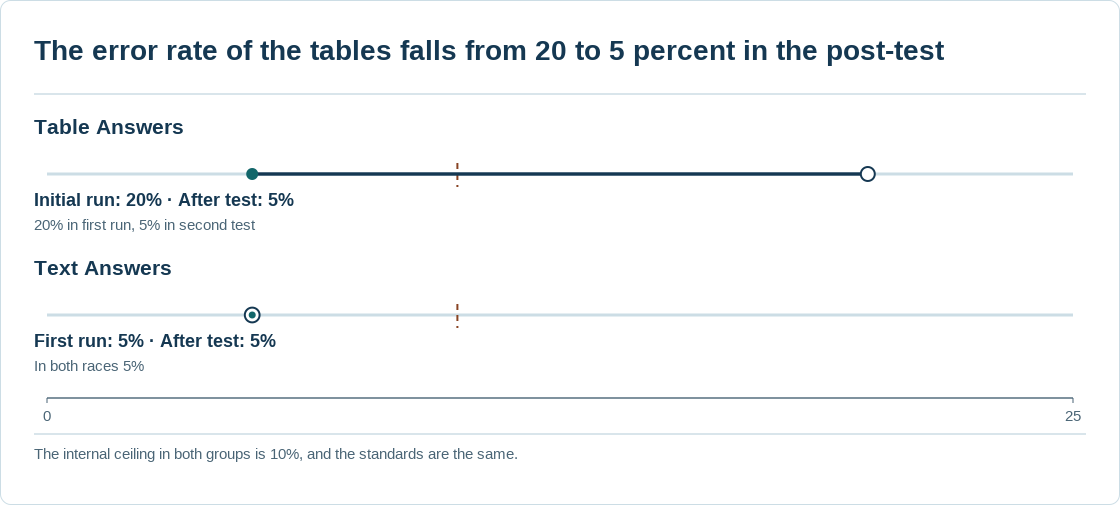
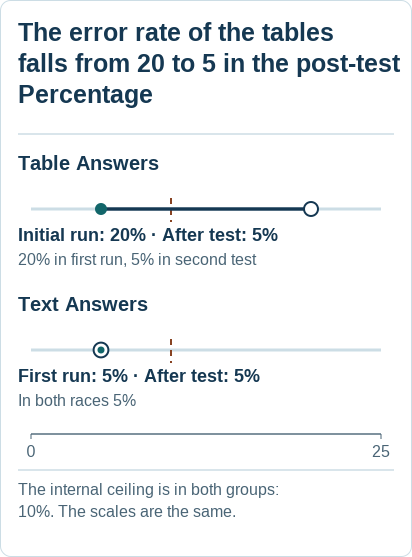
The reference values are 40 tables and 60 text responses. In the counter-sample, the minimum sample counts.
Documenting your own test
A comprehensible data collection with coverage limit, error per group and proven correction.
Data coverage and group errors
Measure the errors per case group. Determine tested origin, reference, scope and own threshold. The evaluation shows incomplete and too small samples.
Outcome A comprehensible data collection with coverage limit, error per group and proven correction.
Read the instructions
Fictional example KI10 · Table responses are 20 percent with 8 out of 40. Text answers are 5 percent. In the post-test, the rate for both groups is 5 percent.
- The starting position Confirm case group, source and reference
- Editing the Process Evaluate coverage and error rate separately
- Secure Decision Data correction and independent re-testing
Official sources
Regulation (EU) 2024/1689 as amended on 27 July 2026
Readable version with the changes made by Digital Omnibus on AI. The application rules are to be read for your own deadline.
Regulation (EU) 2026/1744 · Digital Omnibus on AI
Officially published changes, including AI competence, high risk periods and transitional rules.
Art. 35 GDPR · Data protection impact assessment
Check data protection impact assessment and fundamental rights impact assessment based on the relevant requirements.

What is the next decision?
Choose the work path that fits your open decision. The descriptions show what you start with and which proof you then hold.
Risks and test limits
If the deviations are known, determine which consequences block a release.
Starting point Version, limit of purpose, specific error situation and already released target criterion.
Work result A decision per risk situation with original receipt, correction order and repeatable sample.
View the guideMarket monitoring and corrections
If the error is only visible in operation, you can delimit the observation window and the affected version.
Starting point System and version identifier, reference window, number of evaluated operations, confirmed findings and feedback from operators.
Work result A documented response with responsibility, decision on continued operation or suspension and a secured retest.
View the guide

