
Critical infrastructure in hospitals
Determine hospital facilities and number of cases, check protection obligations separately and prove the safe care.
IMPLEMENTATION
EVIDENCE
The installation at the actual supply is delimited
Start with approval, provided care and system delimitation. Orient the number of cases at an approved hospital according to § 108 SGB V and Annex 5 Part 3 No. 1.1 BSI-KritisV. The relevant cases are 30.000 full-stationary cases per calendar year. For a joint installation, the spatial and operational context and the jointly supported critical service must be documented.
Check the operator of a critical facility, the NIS2 institution per legal entity and the hospital reference of § 391 SGB V on their own grounds. § 391 para. 5 determines how the obligation to protect already applicable KRITIS operators stands there. For pharmaceutical care, certain medical devices and laboratory diagnostics, separate categories and design sizes apply.
From the test order to the secured result
Clearly define the installation and calendar year
Secure approval, the demarcated case population and the responsible body. Compare medical controlling with the approved completion and remove cross-territorial duplications only on a documented basis.
- Acceptance criterion
- Use the same metric, population and unit for expected and observed results. Record the measurement point at which the business service is achieved.
- Evidence
Reproducible case count comparison with confirmed installation, unit, calendar year and source.
Deriving limit and date
Calculate with the confirmed number of cases. Check identification by 31 March of the following year, change of status by 1 April and transitional provisions for the applicable detection procedure
- Acceptance criterion
- The calculation and decision use the same substantiated trigger. Record actual events and planned timing separately, with a common time basis.
- Evidence
Reasoned category, documented deadline and time-control.
Sample supply effect at the technical process
For example, select the order, findings and feedback in the laboratory chain. Define time and completeness goals and confirm the technical release with safe exercise data. A technically available system alone does not yet release the process.
- Acceptance criterion
- Use the same metric, population and unit for expected and observed results. Record the measurement point at which the business service is achieved.
- Evidence
A technical resumption certificate with tested counter readings, deviations and post-test.
Secure the reporting route and official proof date
If there is a significant impairment, check the relevant BSIG-Report path and additional system information. Determine the date specified by the BSI in accordance with § 39, relevant transitional status and the supporting documents for corrections.
- Acceptance criterion
- Trace the decision to the agreed requirement and observed result. Assign an owner and review date to open conditions.
- Evidence
Detection plan with relevant maturity and comprehensible technical approval.
Read the official provisions on classification of services in the health sector and link your assessment to the relevant source.
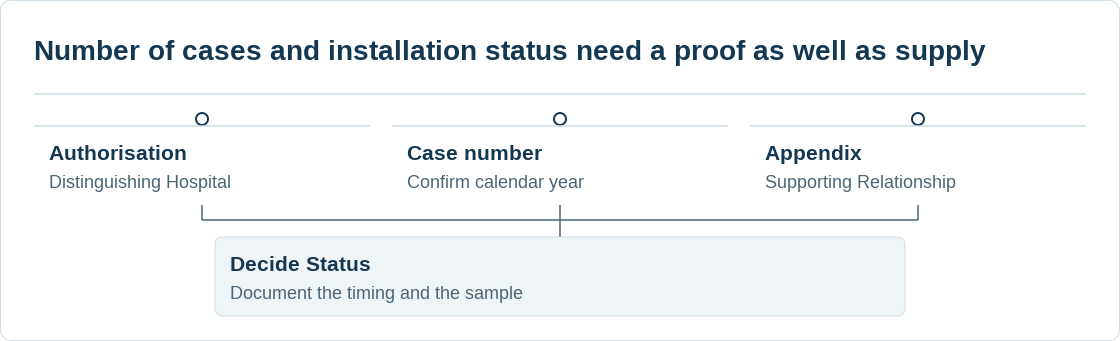

Approval, confirmed full-stationary case number and the installation reference lead to a justified status. A separate sample proves the supply.
Precisely 30.000 full-stationary cases
Situation Start with approval, provided care and system delimitation. Orient the number of cases at an approved hospital according to § 108 SGB V and Annex 5 Part 3 No. 1.1 BSI-KritisV. Relevant are 30.000 full-station cases per calendar year.
Situation
The fictitious HanseWerk Klinikum is admitted as a hospital according to § 108 SGB V. 29.999 was first identified as full-station cases for the plant in the calendar year 2025. Controlling shows a previously missing admissible case based on the released case population.
The limit is reached with exactly 30.000 cases for the first time after cleaning. For the exercise case, the KRITIS classification follows from 1 April 2026, under the accepted applicable reference date version. § 28 BSIG and § 391 SGB V must be documented separately.
Monitoring and evaluation
The resumption of the laboratory order chain uses 120 expected fictitious orders. The system is available after 65 minutes, but only 119 ready-to-order orders appear. At an agreed time limit of 75 minutes the sample meets the time value. The technical release remains open due to the lack of order assignment. In the post-test 120 assignments and the approval of the responsible body are to be documented.
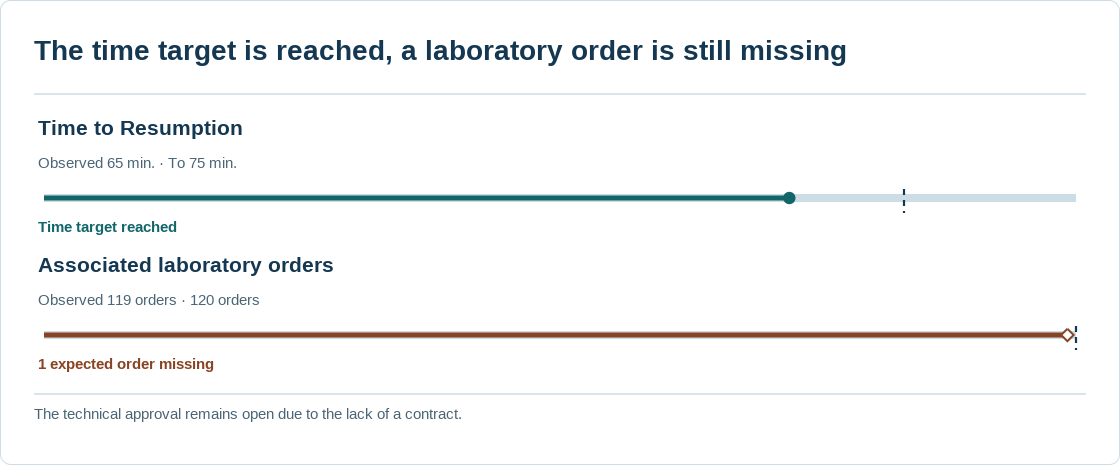
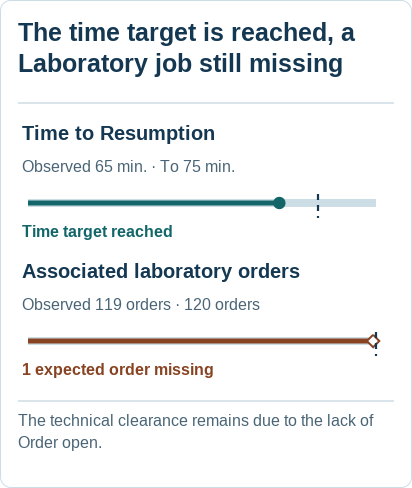
Each point stands for an expected order. The open individual document prevents the technical acceptance of the exercise.
Reasoned decision
The legal start of the status and the official time of inspection are independent data. Until a reliable date is available, the proof planning remains explicitly for clarification.
Negative test
Evaluate 29.999 cases without the documented correction. Then enter a second location. Without a confirmed joint investment and a delimitable case population, the aggregated number remains blocked for the status decision.
- Audit record
- Comparison of the original finding and retest showing the changed condition, observed effect and closure decision.
Work result
A comprehensible investment decision and documented proof of the complete technical resumption.
Working aid for your own operation
Recalculate the relevant number of cases of an approved hospital. Connect status date, relevant proof date and professional re-entry test.
CRITIS case number and secure supply
Recalculate the relevant number of cases of an approved hospital. Connect status date, relevant proof date and professional re-entry test.
Outcome Case number, evaluable threshold change and technical release with documented data quality.
Read the instructions
Fictional example N06 · A proven further full-station case increases the number of 29.999 to 30.000. The sample processes 119 out of 120 orders in 65 minutes. Despite the time taken, the professional approval remains open.
- Confirm calendar year and installation Compare case population, approval and, if necessary, joint plant operation. Document duplicates and exclusions.
- Evaluate threshold and timing Confirm the previous status and check the following date. Perform the detection date specified by BSI separately.
- Evidence of technical impact and release Compare time value, complete order assignment and documented release in the same run.
Legal basis and official information
First check for this task
Annex 5 BSI-KritisV · Thresholds and year change in the health sector
Confirm the system delimitation, design size and reference period. For a hospital approved, the threshold of 30.000 is valid for full-patient cases per calendar year. Determine the level of care by 31 March of the following year and check 1 April and any joint facilities if you change the threshold.
§ 391 SGB V · Information security in the hospital
Arrange the relevant systems for functional capacity and patient information. Check § 391 para. 5 for operators of critical equipment and § 28 BSIG separately. Check the suitability determination of a relevant industry-specific standard.
§ 28 BSIG · Particularly important and important institutions
Check legal form, actual paid activity, type of facility, size values and special cases. § 28 para. 5–8 alters the scope of obligations for certain activities or institutions.

Other official references9
- § 39 BSIG · Proof of critical installations (opens in new tab)
Deutsche Anwendung · BSIG
Determine the concrete BSI determination, classification as a new or existing operator and an appropriate exception. Plan scope of examination, handover and remedy open defects.
- § 6 BSI-KritisV · Critical services in the health sector (opens in new tab)
Sektorales Recht · Energie, Telekommunikation, Gesundheit und Wasser
First, determine the critical service provided and the appropriate equipment category. Evaluate the threshold with the unit relevant for this equipment category and the deadline.
- § 31 BSIG · Additional requirements for critical installations (opens in new tab)
Deutsche Anwendung · BSIG
Limit the systems that are relevant to the functioning of the affected installation. Check additional risk-appropriate precautions and the effectiveness of attack detection.
- § 32 BSIG · Reporting of significant incidents (opens in new tab)
Deutsche Anwendung · BSIG
The early first report and the incident report are linked to the knowledge of the significant incident. The monthly reference follows the actual reported incident report. In case of a continuous incident, the reporting level changes.
- § 66 BSIG · Transitional arrangements for CRITIS and registration (opens in new tab)
Deutsche Anwendung · BSIG
§ 66 links the application of certain recasts to the entry into force of the regulation referred to therein. Please provide evidence for the decision date, which version is therefore actually applicable.
- Installation delimitation and joint installation (opens in new tab)
§ 1 BSI-KritisV · Gesetze im Internet
Reason category, operational context and critical service provided together. In addition, check the sector-specific criteria of the relevant annex.
- Approved hospitals (opens in new tab)
§ 108 SGB V · Gesetze im Internet
Determine the basis of approval for the hospital facility considered, and in Annex 5 to the BSI-KritisV it is part of the definition.
- Information security at clinics (opens in new tab)
BSI · Handlungsempfehlungen für Kliniken
Use the recommendations for prioritizing care-relevant processes and preparing a professional resumption test.
- Register and choose the correct reporting path (opens in new tab)
BSI · Informationen für NIS-2 und MIP
The notice distinguishes NIS2 registration in the BSI portal, notifications and transitional use of MIP by certain groups.
Check the installation status and technical resumption
Critical installations
The scope of the installation or the official time of proof shall be clarified.
Check the installation limit, transition level, reporting route and established detection date.
Work result A documented system delimitation with separate detection and reporting order.
Management
You must jointly examine time, data and technical resumption.
The same exercise is used to demonstrate the re-start time, data level and technical acceptance.
Work result A reasoned decision to resume with measured time value, data level and subject sample.

