
Schedule critical infrastructure evidence
Confirmed starting point with documented case variant.
IMPLEMENTATION
EVIDENCE
Secure official detection time for critical installations
§ 39 BSIG distinguishes the first, new and transferred operator constellations. The calculation helps with the planning. For the own plant the time specified by the BSI is recorded with the correct official document.
Perform the verification task
Clear the operator case and plant status
Please provide evidence of the date on which the facility is first or again operating, or of the last relevant proof in the transitional event. Check the list of the installations concerned.
Work result Confirmed starting point with documented case variant.
Take over the official date
Secure the relevant decision or the confirmed official specification and assign it to the installation. Check the comparative value according to § 39 and clarify deviations.
Work result Released date note including legal and source references.
Planning to check and submit from the date
Set dates for test order release, samples, findings collection and submission. Determine the actual transmission and follow-up in the record of detection.
Work result Test plan with advance, confirmed delivery and resubmission.
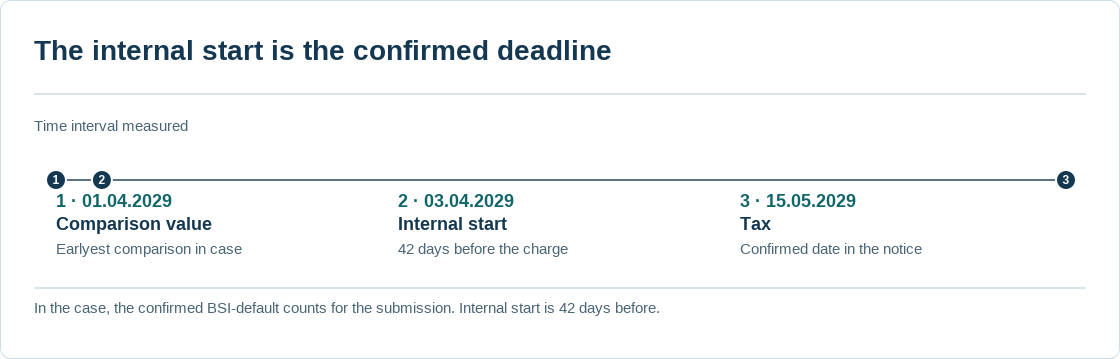

With 42 days of advance and a confirmed delivery on 15 May, the internal work starts no later than 3 April. BSI date, internal advance and legal comparison value remain separate.
Starting position, assessment and counter-test
Situation § 39 BSIG distinguishes the first, new and transferred operator constellations. The calculation helps with the planning. For the own plant the time specified by the BSI is recorded with the correct official document.
Situation
A fictitious waterworks is considered a critical installation for the first time as of 1 April 2026. The internal date is initially set to 1 April 2029. In the exercise, the BSI sets 15 May 2029 as the time of detection.
Evaluation and decision
1 April 2029 remains recognizable as the earliest comparative value. For the work plan counts the confirmed requirement 15 May 2029. Management and audit team receive the dates for completion of the scope, examination and submission
Negative test for your own operation
Remove the official document. The confirmed time of proof remains open. The work help shows the legal comparison size and the order for the date clarification.
Help for your decision
Capture the relevant operator case, the BSI date and your own preliminary. The evaluation separates the legal comparison value from the confirmed deadline.
CRITIS Detection date and test run
Capture the relevant operator case, the BSI date and your own preliminary. The evaluation separates the legal comparison value from the confirmed deadline.
Outcome Detection plan with reliable authority records, internal audit, submission date and follow-up date.
Read the instructions
Fictional example A waterworks is considered a critical installation for the first time since 1 April 2026. The earliest comparative value is 1 April 2029. In the case of exercise, BSI sets 15 May 2029.
- Operator case and starting point Distinguishing for the first time, again, transition case and follow-up cycle. Confirm date, installation and output document.
- Record official appointment Capture the assigned default with date, reference and affected scope.
- Maintaining the flow and supply Calculate the early start of work. Determine test bench, delivery receipt and open questions.
Obligation and detection matrix
Document legal decisions per institution and performance. Check each proof whether the scope, status, access and statement support the assigned obligation.
Outcome Reasoned obligations and comprehensible decisions on the use of common evidence.
Read the instructions
Fictional example N10 · Bank and ICT service providers use the same technical protocol. A bank position remains open until their own business sample. Case N12 shows the separate assignment of common systems.
- Legal decision per obligation Capture confirmed entities, activity, exact reference, decision, role and deadline.
- Check the proof under the same identifier Link position and document form. Confirm evidenced depth of information and actual retrievability.
- Release your own evaluation Keep in mind who has released the use and what proof is missing.
Legal basis for the verification task
First check for this task
§ 39 BSIG · Proof of critical installations
Determine the concrete BSI determination, classification as a new or existing operator and an appropriate exception. Plan scope of examination, handover and remedy open defects.
§ 66 BSIG · Transitional arrangements for CRITIS and registration
§ 66 links the application of certain recasts to the entry into force of the regulation referred to therein. Please provide evidence for the decision date, which version is therefore actually applicable.
§ 31 BSIG · Additional requirements for critical installations
Limit the systems that are relevant to the functioning of the affected installation. Check additional risk-appropriate precautions and the effectiveness of attack detection.

Other official references1
- § 61 BSIG · Supervision of particularly important institutions (opens in new tab)
Deutsche Anwendung · BSIG
Keep the implementation with a verifiable record chain available for each requirement. In case of ordered tests or measures, you will record the specific order scope and feedback.
Next step for your editing level
First, take the decisive observation from the case. Then, based on your open question, choose whether you want to check your own process or play a comparable case.
Set the scope of the test risk-based
The date is set. Decide on the installation, the period and the selection of suitable samples.
Starting point Reasoned service risk, set-off stock, available raw material and planned samples.
Connect relevant services, samples and planned evidence in a specific test order.
Work result A test order shows per service which conclusion is robust and what additional evidence needs.
View the guideList critical plants and the verification order
They work in parallel on tasks from the same department.
Starting point Operator and system inventory, confirmed volume records as well as existing test and reporting data.
The overview will classify further audit orders and aids.
Work result A documented system delimitation with separate detection and reporting order.
View the guide

