
Prioritise exposed vulnerabilities
A defined list of concerns with supporting documents.
IMPLEMENTATION
EVIDENCE
Prioritize weaknesses after personal concern
A general product notification is only made by version reference, function used and the effect on your own service for a reliable processing decision. Prioritisation must also take into account unknown stocks and the limits of a temporary measure.
Perform the verification task
Classify used expressions
Match maintained components and the actual operating stand with the manufacturer's advice. Also record service provider systems with a documented contract reference. Separate confirmed, excluded proven and open occurrences.
Work result A defined list of concerns with supporting documents.
Align order to service performance
Evaluate the limit of provision, business impact and existing protection for the concrete expression. Give date and responsibility. Link a preliminary measure with effect and expiration.
Work result Reasoned order of processing and temporary measures.
Check effectiveness at the actual level
Compare shared and observed status after the change. Confirm the function of the service and record unexplained remaining occurrences separately.
Work result Acceptance note with open inventory and follow-up date.
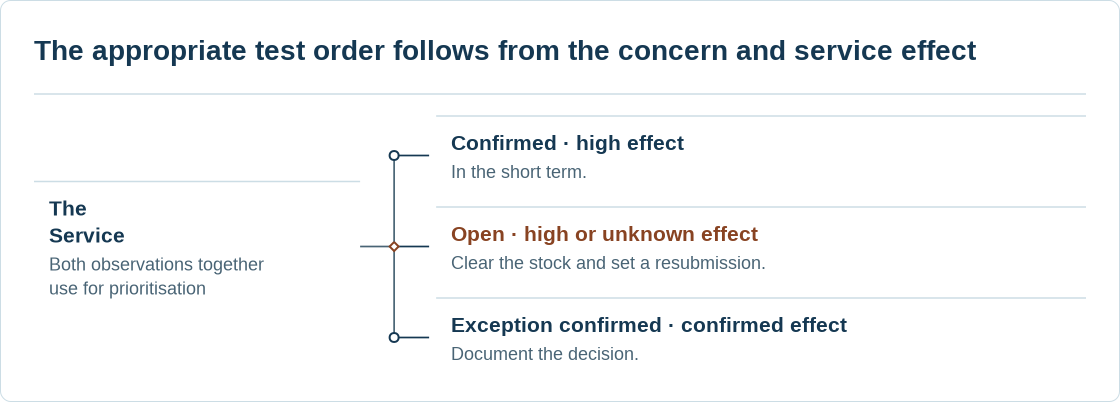
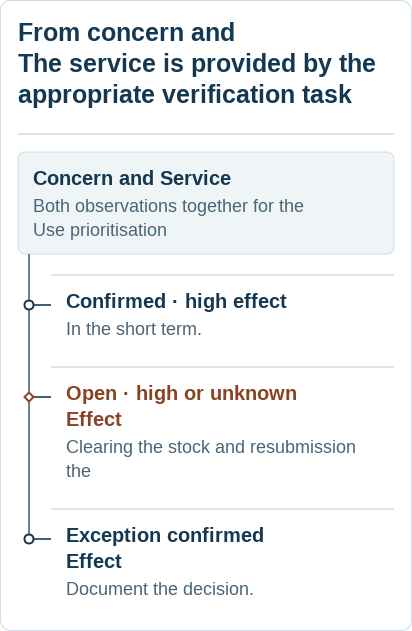
The professional prioritization combines confirmed concern and impact on the service. If there is no evidence, the competent authority opens a clarification order.
Check the decision in the example
Situation
Four servers carry one component. Two are confirmed as affected by the technical process, a third is excluded from the supported version level and the fourth is operated by the manufacturer of a service. The responsible company prioritizes the two confirmed hits and sets an appointment for clarification of the fourth.
Evaluation and decision
The decision shows two confirmed, one reasoned and an open record. The released change excludes only the retested occurrences.
Negative test for your own operation
Remove the version receipt of the excluded server. The result changes to "open" until the exact operating status is reached.
Help for your decision
Arrange the ten fields of action. Treat test criteria, measurement, detection, findings and retest in the same work position.
Measures and efficacy samples
Arrange the ten fields of action. Treat test criteria, measurement, detection, findings and retest in the same work position.
Outcome Summary of measures with observed effect and pending retests.
Read the instructions
Fictional example A back-up is achieved in 88 minutes. The sample from the department is missing. The measure remains open until the agreed result is fully documented.
- Select criterion and type of test The ten action fields bear prepared examples. Set the appropriate yes-no criterion or a measurable setpoint.
- Record impact and evidence Refer to the target and is on the same performance and the relevant time.
- Track deviation and follow-up Record correction order, re-result and receipt with the same verification identifier.
Change release and relapse test
Evaluate planned changes before release using measurable mandatory criteria, tested relapse time and proven target level.
Outcome Release decision with visible blocking findings, verified version and approved window of time.
Read the instructions
Fictional example N17 · The professional test succeeds. Relapse time is 18 minutes at 15 allowed. A documented follow-up test reaches twelve minutes.
- Set the release conditions Define the actual blocking criteria, target version and verification evidence.
- Observe relapse Measure the relapse up to the predetermined usable performance.
- Confirm decision Connect the checked stand to the designated release manager and time window.
Legal basis for the verification task
Annex 6 · (EU) 2024/2690 · Procurement, development and maintenance
Check the safety in selecting, changing, maintaining and controlled removal of a system under the relevant rule of the Annex.
§ 30 BSIG · Risk management measures
For each relevant service, combine risks, ten fields of action, evidence and effectively verified effect. § 30 para. 3 gives priority to the technical requirements of the DVO for the providers covered there.
Annex 2 · (EU) 2024/2690 · Risk management and verification
Link risk assessment, treatment, documented review and independent evaluation to the same extent.

Next step for your editing level
Choose the work path that fits your open decision. The descriptions show what you start with and which proof you then hold.
Prove security updates to the full target stock
A successful roll-out protocol only confirms processed systems. A reliable proof refers to the released target stock and includes replacement equipment, restarts and temporary exceptions.
The need for updating is confirmed. They want to compare target stock and actually updated systems.
The operation can show per system whether the target level is reached, comprehensiblely excluded or still open. A technical test confirms the effect on the performance performed.
Your decision The release takes into account installed and actually active stands as well as documented exceptions.
Work through the caseCheck accesses and system changes in operation
They work in parallel on tasks from the same department.
Starting point Select a service and a specific process to access, share or change the system.
The overview will classify further audit orders and aids.
Work result The agreed target state and the observed operating status bear the approval or an open finding.
View the guide

