
Capacity and backlog in fallback mode
Technically confirmed capacity targets.
IMPLEMENTATION
EVIDENCE
Check for minimum power and backlog operation
A first confirmation in replacement operation says little about the continuous service. Evaluate which quantity must be delivered with what quality level over a certain time and which residual load can be transferred to regular operation.
Perform the verification task
Set minimum performance and assumptions
Name incoming quantity, prioritized business operations, permissible backlog and observation period. Check bottlenecks for personnel, data access and interfaces.
Work result Technically confirmed capacity targets.
Check the hour under comparable load
Process synthetic orders under approved conditions. Measure accepted, fully processed, rejected and open. Vote for quantitative and technical results.
Work result Sheet with flow rate and quality results.
Control the backlog during transition
Arrange the still open processes to restart. Check prioritization, duplicate control and technical approval at the takeover.
Work result Transfer receipt with confirmed residual stock.
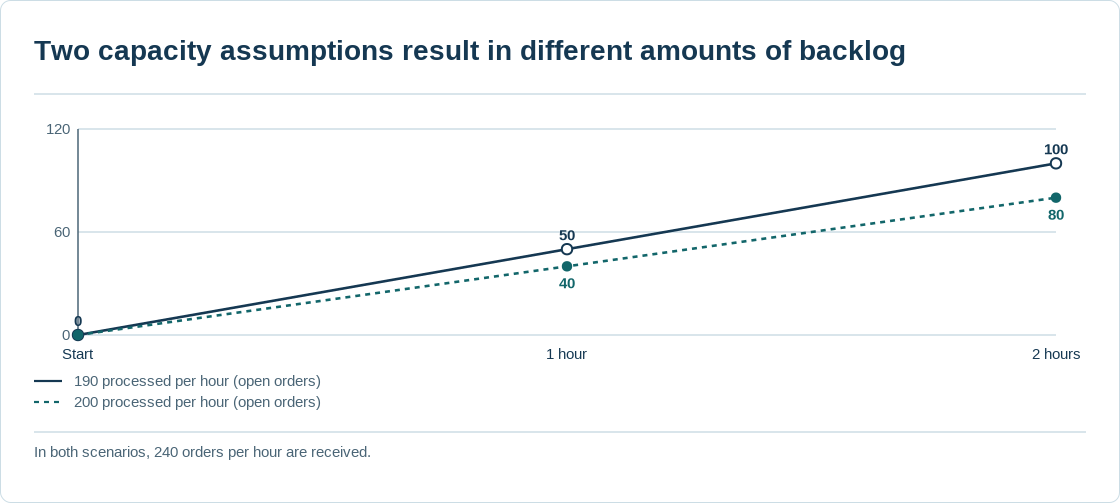
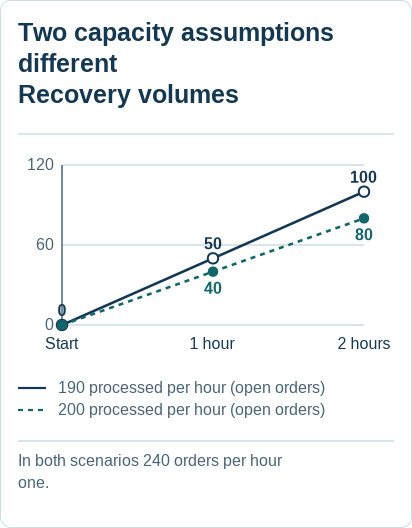
The backlog grows to 100 orders per hour for 190 processed orders and 240 inputs. 200 processed orders per hour make it 80 after two hours.
Check the decision in the example
Situation
240 fictitious orders are received per hour. The evasive operation can complete 190 without errors. The approved backlog is at a maximum of 80 orders after two hours. The assumptions remain constant over the two hours.
Evaluation and decision
After two hours 100 orders are open. Evasion operation fails to allow the backlog, although the first operations can be used. The line decides on prioritization or additional capacity.
The slope shows the backlog from inputs minus completely processed orders. After two hours, the comparison with the limit of 80 decides.
Negative test for your own operation
Increase the confirmed application to 200 orders per hour. Check the limit of 80 and test the professional completeness.
Help for your decision
Arrange operational consequences and restart targets per performance. Calculate necessary parallel and subsequent steps against the internal target
Operating effects and restart order
Arrange operational consequences and restart targets per performance. Calculate necessary parallel and subsequent steps against the internal target
Outcome Prioritized performance with comprehensible restart chain and visible target deviations.
Read the instructions
Fictional example N18 · The target of the order service is 90 minutes. The operational dependence takes 70 minutes, the subsequent handover 35 minutes.
- Coordinating objectives Set tolerable interruption, restart target and data loss.
- Count order Confirm the parallel requirements and the duration of the subsequent professional transfer.
- Sharing time and data Compare the calculated values and open evidence for the organizational decision.
Restart and restoration
Restart and data loss. Check data integrity, partition process and release separately.
Outcome Evidence of the professional resumption or a reasoned open finding.
Read the instructions
Fictional example The first run takes 105 minutes instead of 90 minutes and delivers 9.998 data sets from 10.000. In the subsequent test, the subject sample must be time and content.
- Set target values Decide on permitted time, data loss and expected records at the service.
- Record readings Determine technical usability only with a executed process as achieved.
- Check data and release The following shall be used for the purposes of this Regulation:
Legal basis for the verification task
Annex 4 · (EU) 2024/2690 · Management and crisis management
Link technical effects, restoration goals, safety test and release. Work ends with a proven business process.
§ 30 BSIG · Risk management measures
For each relevant service, combine risks, ten fields of action, evidence and effectively verified effect. § 30 para. 3 gives priority to the technical requirements of the DVO for the providers covered there.
Annex 7 · (EU) 2024/2690 · Evaluate the effectiveness of measures
Link individual test criteria to the observed result and the verified handling of a deviation.

Next step for your editing level
Choose the work path that fits your open decision. The descriptions show what you start with and which proof you then hold.
Determine operational effects and restart order
An impact analysis combines the service with comprehensible consequences of time-scale interruption. Determine professional minimum performance, accepted time frame and permissible data loss.
The observed evasive power is to be included in the target values for the entire service.
Prioritize individual services by means of wearable downtime and necessary dependencies.
Your decision A calculated restart order with time deficit and confirmed follow-up order.
Work through the caseTrying to Resume a Service
They work in parallel on tasks from the same department.
Starting point Minimum required performance, time and data objectives, reference stock and responsible department.
The overview will classify further audit orders and aids.
Work result A reasoned decision to resume with measured time value, data level and subject sample.
View the guide

