
Verify domain registration data
Data sample with field status and validation certificate.
IMPLEMENTATION
EVIDENCE
Verify domain registration data and edit requests
TLD registers and domain name registry service providers must implement the applicable rules on accuracy, availability and access to registration data. Access decisions depend, among other things, on the justification of the legitimate request and the data concerned.
Perform the verification task
Check four fields and the reels
Select an artificial domain and map the date, owner and the different managing contact point. Check the legal minimum details as well as the proof of updates.
Work result Data sample with field status and validation certificate.
Processing access decision and deadline
Test a legally justified request based on the published policy. Take into account the examination of rights, scope, receipt and response required. Consider the maximum period for reaction specified in § 50.
Work result Process with time reference, role check and confirmed release.
Data matching and protection sampling
Compare the intended data flows of registers and service providers. Use synthetic data to check whether the information contains only the released scope and receives it from the intended recipient.
Work result Version accurate information and comparison document.
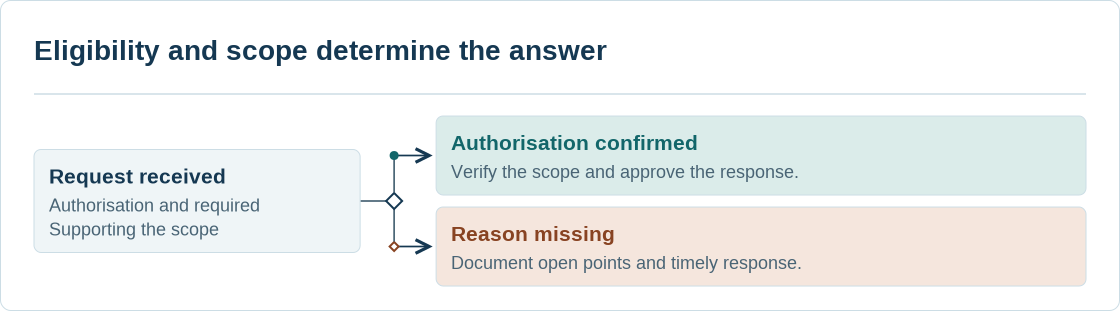
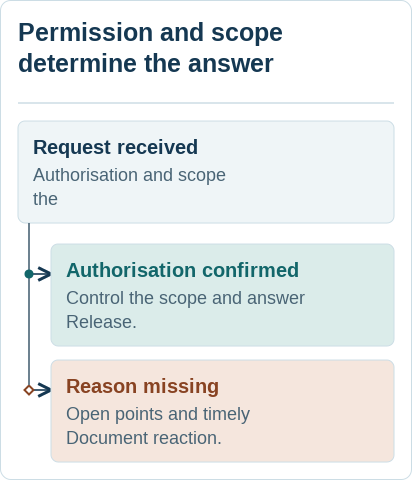
Authorisation and the necessary scope decide on the release. If the authorisation is unexplained, the competent authority shall determine the open decision and the timely response.
Starting position, assessment and counter-test
Situation TLD registers and domain name registry service providers must implement the applicable rules on accuracy, availability and access to registration data. Access decisions depend, among other things, on the justification of the legitimate request and the data concerned.
Situation
A fictitious service receives a valid request for a domain on Monday at 10:30. The public information is complete. A separate contact field contains an outdated address. The team clarifys the current situation, documents the approved range of information and delivers the released answer on Wednesday at 08:00.
Evaluation and decision
The test runs confirm the response and dispatch after 45 hours and 30 minutes. Correction of the outdated field is documented with its own change track.
Negative test for your own operation
Leave the permission or justification open in a second synthetic case. The exercise demonstrates the documented response path and the result of access control without using real personal data.
Help for your decision
Check for each service and obligation whether the proof is available, fits the status and is currently released. Track the reliable denominator.
Detection coverage and evidence gaps
Check for each service and obligation whether the proof is available, fits the status and is currently released. Track the reliable denominator.
Outcome The following table shows the results of the assessment carried out by each test group:
Read the instructions
Fictional example N22 · Six positions are expected. Four documents are current and relevant, one has expired, one is missing.
- Determine target size Provide unique identifiers for the verified obligations and demonstrate their scope.
- Matching Evidence Confirm receipt date, validity, coverage and release separately.
- Solve gaps Arrange responsibility, appointment and professional standard for any open document.
Registration and deadlines for amendments
Plan initial registration and changes including jurisdiction, time of knowledge, evidence and the correct version.
Outcome Process plan with calculated calendar reference and documented shipping status.
Read the instructions
Fictional example The special registration begins separately with an MSP. A later change of the establishment leads to a separate deadline check from the event day.
- Identifying registration The start date, § 33 or § 34 and the proof of jurisdiction.
- Change and legal status Keep the event, knowledge and current rule separate. Document the version used when it is moved.
- Verify date and dispatch Special calendar or transition case check and file the portal receipt.
Legal basis for the verification task
First check for this task
§ 49 BSIG · Database for domain registration
Check the collection, accuracy and completeness of the required registration data and document the protection and updating processes.
§ 50 BSIG · Access to domain registration data
Set the test and release route for reasoned requests. Check with fictitious data the treatment of an admissible and insufficient request.
§ 51 BSIG · Cooperation with registration data
Vote for who collects, corrects and provides registration data. Check the reconciliation of a change between the participating bodies.

Other official references1
- Art. 28 NIS2 · Data for the registration of domain names (opens in new tab)
Europäischer Rahmen · NIS-2-Richtlinie
Test accuracy, updating and information procedures using a permitted synthetic registration dataset.
Next step for your editing level
First, take the decisive observation from the case. Then, based on your open question, choose whether you want to check your own process or play a comparable case.
Evaluate DNS and TLD incidents from the service
Check the actual role as DNS provider or TLD registry and the performance specifically affected. The DVO provides some different conditions for DNS and TLD.
Data maintenance is checked. You must additionally classify an actual service malfunction.
Distinguishing full failure and response time as well as checking the appropriate data alternative.
Your decision A reasoned classification and reporting obligation per service actually affected.
Work through the caseApplying EU standards for digital providers
They work in parallel on tasks from the same department.
Starting point Description of service, proof of operation, role of provider and user and event data if applicable.
The overview will classify further audit orders and aids.
Work result Technical requirements and incident criteria are assigned to the service actually provided.
View the guide

