
Rules for digital providers
Merge the type of supplier, technical requirements and service-specific reporting criteria.
IMPLEMENTATION
EVIDENCE
Merge the type of supplier, technical requirements and incident criteria
The implementing regulation specifies requirements for explicitly designated types of providers. Evaluate whether there is a current administration, managed security, cloud, DNS or any other recorded service based on the service actually offered. Company name and general industry name are not sufficient for this decision.
Check the technical and methodological requirements of the annex for relevant providers. In case of incidents, evaluate the general alternatives and the article for the specific service. During the reporting process, determine when objective facts reveal a significant difference.
So you go ahead
Set the scope of the Regulation
Include the legal definition, services offered, contracts and actual operation. Check separately the special registration and the competent body.
Work result Documented assignment per service recorded.
Lead to technical requirements
Select a point from the attachment and connect it to a responsible test scale, supporting documents and a case sample. Use ENISA examples for implementation.
Work result Assignment of the regulation number, target and observed effect.
Evaluate alternative incidents individually
Support the general loss and impact assessment. Measure duration, relevant user base and possibly affected data for the specific service. Check Art. 4 in case of recurring events.
Work result A reasonable time and reasoned decision on the substance.
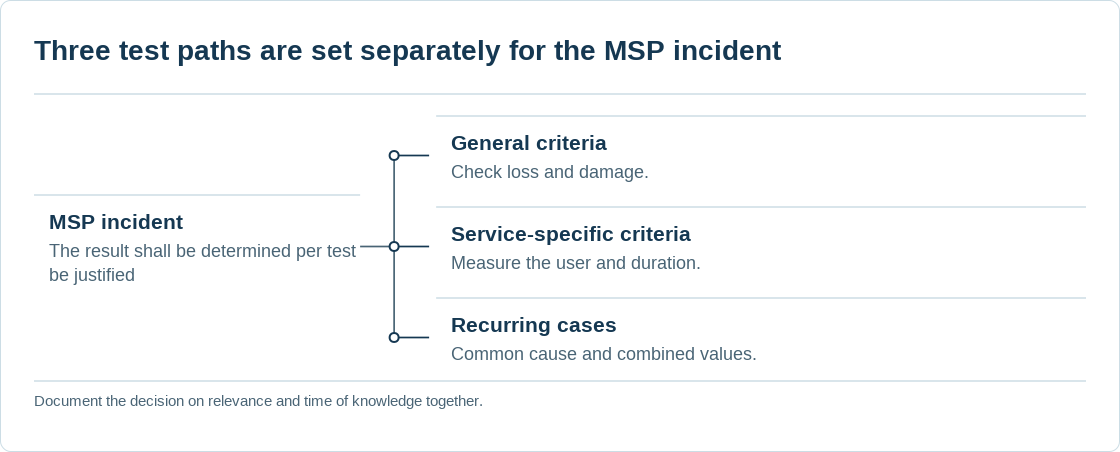
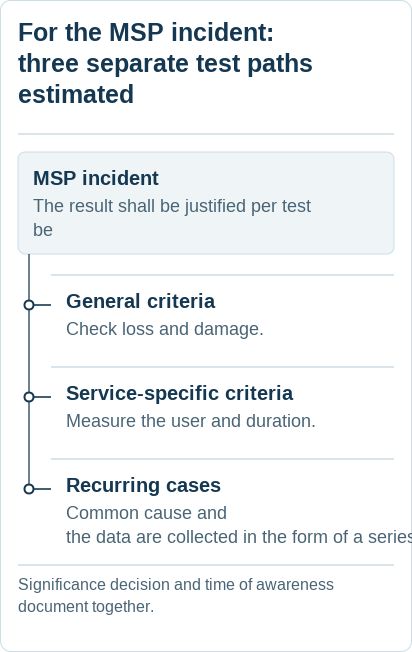
General criteria and service criteria are assessed separately, resulting in a reasoned notification decision.
Test example and counter-probe
Situation
A fictitious MSP manages devices for 20.000 EU users. A service remains limited. Affected are 1.001 users within a 61-minute time window. The partial availability exceeds both the lower user threshold and the minimum duration according to Art. 10(b) in the example.
Negative test
As a counter-test, test exactly 1.000 users and then exactly 60 minutes. A single non-fulfilled alternative allows the other criteria and if necessary an overall check according to Art. 4 to be further checked.
Work aids for your operation
Use the predictable template and check the result with the fully described example.
MSP significantity and loss threshold
Calculate selected alternatives to loss and MSP availability. Sample two additional recurring incidents.
Outcome Calculation of the tested alternatives with open questions for the substantive decision.
Read the instructions
Fictional example For 20.000 EU users, 1.001 affected persons exceed the alternative of 61 minutes according to Art. 10(b) Two similar incidents without common identifiable cause do not meet the same collective test.
- Base and effect evidence The data collected in the previous year include direct losses, EU users, partial and full loss.
- Further criteria to be assessed Evaluate all other alternatives of the DVO separately with Yes, No or Open.
- Grouping Recurring Cases examine the period, individual evaluation, cause and common sum.
Decision of incident and reporting deadlines
Support knowledge, reporting levels and recipients. Calculate the 24-hour and 72-hour limits as well as the monthly receipt.
Outcome Chronology with separate right triggers, maximum limits, shipping and reception.
Read the instructions
Fictional example A significant incident is reported around 09:30 UTC. The incident report is sent 50 hours later. The conclusion follows calendarly from the actual message. In case of an ongoing incident, the progress must be made first.
- Evidence Identify the relevant time, service concerned, competent body and facts.
- Select stages and exceptions Document regular hours profile, trust service review and individual process separately.
- Check calendar limit and shipping Technically confirm the monthly limit and special cases. Organise immediate transmission and secure all receipts.
Official references for this task
First check for this task
Art. 1 DVO (EU) 2024/2690 · Subject matter and types of suppliers covered
Direct the technical examination to the service that the institution actually performs as one of the mentioned types of provider.The assignment to the type of supplier belongs in the endorsement of validity.
Art. 2 DVO (EU) 2024/2690 · Technical and methodological requirements
Check the Annex per provider, service and risk. Where the Appendix contains a condition such as adequacy, applicability or feasibility, you can document the assessment in a comprehensible manner.
Art. 3 DVO (EU) 2024/2690 · Common criteria for relevance
Check the alternatives in paragraph 1 and the specificities of planned maintenance. Direct losses are driven by the lower limit of EUR 500.000 and 5% of total sales in the previous year.

Other official references6
- § 60 BSIG · Main office and EU representative (opens in new tab)
Deutsche Anwendung · BSIG
The assignment takes place in the legal order. First, prove where decisions on cybersecurity risk management are mostly taken. If there is no best possible solution, check the statutory catch criteria.
- Art. 4 DVO (EU) 2024/2690 · Recurring incidents (opens in new tab)
Technische Vorgaben · (EU) 2024/2690
Check at least two events that are not significant in themselves within six months. Support the same identifiable cause and the jointly fulfilled criterion of financial loss.
- Art. 10 DVO (EU) 2024/2690 · Considerability of MSP and MSSP (opens in new tab)
Technische Vorgaben · (EU) 2024/2690
Check any applicable alternative for the managed service. In case of a partial performance, identify the EU user base and the period of limitation. In addition, check the general criteria of Art. 3.
- § 34 BSIG · Special registration of digital providers (opens in new tab)
Deutsche Anwendung · BSIG
Determine the main branch office, operating states as well as the additional data of the special register. Check initial registration and changes after each individual deadline.
- Technical requirements and criteria for relevance (opens in new tab)
Durchführungsverordnung (EU) 2024/2690 · EUR-Lex
The articles and the annex specify requirements for the specifically mentioned types of suppliers.
- Technical implementation assistance to the implementing regulation (opens in new tab)
ENISA · Technical Implementation Guidance, Juni 2025
Use examples of evidence and assignments for testing. The benchmark for the binding requirement remains the relevant legal act.
What service criterion triggers the message?
Check the same event for cloud and data centre. For the Managed Service, use the separate MSP case sample.
Cloud and Data centre
Determine the role and responsibility of providers for cloud service and data centre. At the same event, check separately which criteria count for classification.
MSP incident
A provider operates several services for customers. Check in case of how duration, recurring incidents and user effects can lead to different decisions.
Check the reporting path for DNS, TLD and platforms
Evaluate DNS and TLD incidents from the service
Distinguishing full failure and response time as well as checking the appropriate data alternative.
Service-related classification with documented measurement, own legal alternative and documented reporting verification.
Work through the caseDetermine platform role and reporting scale
Evaluate online marketplace, search engine and social network of service and own DVO regulation.
Reasoned provider and incident classification per digital service with comprehensible DVO rule.
Work through the case
Edit specific tasks of digital providers
Verify domain registration data and edit requests
Data sample with field status and validation certificate.
A case report separates verified entries, publicly available data and, if necessary, free data. The process shows when the request was received and which response was sent in a controlled manner.
Work through the caseEvaluate CDN incidents through user visibility and service reference
Time window with service, region, probe type and occupied perimeter.
The incident note explains the effect on the specific CDN service, which denominator the team uses and why the chosen alternative is fulfilled, denied or still open.
Work through the caseSet the relevance and reporting clock for trust services
Service delimitation and affected user group.
The note combines the confirmed alternative, knowledgeable time, legal form, recipient and document of transmission. The readiness can classify the accelerated procedure professionally.
Work through the case
Select incident scale by supplier type
MSP incident
The fictitious HanseWerk Technik provides ongoing system management for 20.000 EU users. On November 17, part of the service is only limited to 1.001 users 61 minutes. The service was not completely out of service at any time.
They want to test the MSP threshold with concrete duration and user base.
Evaluate user impact, duration and recurring incidents in two separate tests.
Your decision What alternative is the classification of partial performance? Evaluate the two recurring events separately.
Registration
The concern is certain and data or dates must be checked.
Merge the right entity, register and confirmed notification.
Work result The competent body, released output and registration confirmation are linked to each institution.
Legal index
They want to read a concrete reference with related checkpoints.
BSIG, EU Directive and technical requirements for your own task.

