
Two CRA reports, two deadlines
Two CRA branches in a product file.
CONFORMITY
MAINTENANCE
Starting position and test order
The manufacturer of a networked control system knows a serious security incident on February 7, 2028 at 08:45 UTC. The incident message after the early warning is confirmed on February 8, at 12:00 UTC
On February 7 at 10:15 UTC the manufacturer also knows an actively exploited product vulnerability. A documented risk mitigation measure is available on February 15 at 11:00 UTC. The manufacturer models both reporting branches separately.
Compare test data and consequences
Knowledge of the incident
- Scale
- February 7, 08:45 UTC
- Observation
- Follow-up message February 8, 12:00 UTC
- Follow
- Monthly reference is the actual incident report
Knowledge of exploitation
- Scale
- February 7, 10:15 UTC
- Observation
- Measure available on February 15, 11:00 UTC
- Follow
- From that date, schedule 14 days
Financial Marks
- Scale
- Own reference per reporting category
- Observation
- 8 March and 29 February as plan marks
- Follow
- Confirm separate charges
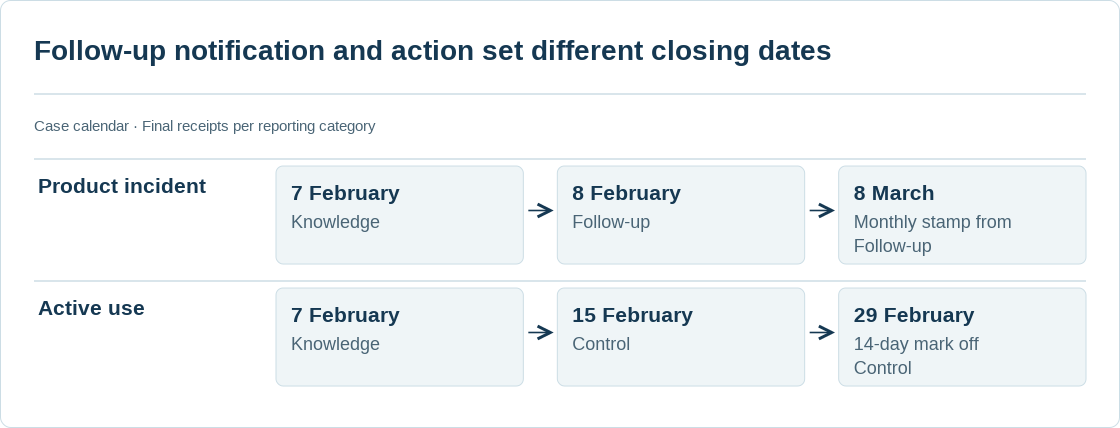
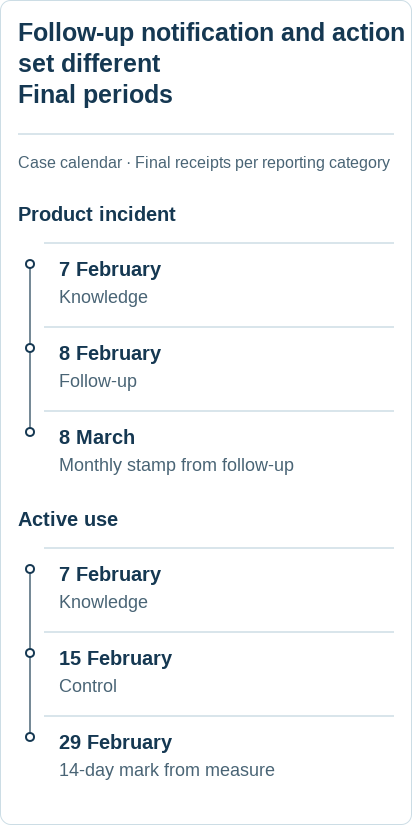
Use the actual follow-up report for the incident and, for the vulnerability, the first available measure.
Edit the test step by step
Confirm knowledge per reporting category
Keep triggering observation, justification and time base for each branch.
Testable evidence Two verified knowledge times and related raw documents.
Plan early warning and follow-up
Capture immediate processing, 24 and 72 hour computer brands and actual charges in the platform protocol.
Testable evidence Marks and documents per branch.
Choose the appropriate final reference
Link the actual incident report for the incident and, for the vulnerability, the measure actually available.
Testable evidence Independently confirmed marks with matching source.
Worked decision and negative test
Decision in case
In the model invoice the closing mark for the incident is on 8 March 2028. For the actively exploited weak point it is on 29 February 2028. The planning determines the respective triggering charge or measure
Secure the SRP confirmation and the communication status to affected users. Decisions on NIS2, DORA or EU AI Act also depend on their own roles and requirements.
Counter-sample and impact
Delete the confirmed incident report. The scheduled closing mark of the incident remains open while the closing reference for the actively exploited vulnerability is still available.
Templates and worksheets
Reporting levels and closing periods
Run the two CRA reporting branches on a consistent time basis with actual transmissions.
Outcome Computerised map marks and verifiable traces of knowledge, distribution, measures and users.
Read the instructions
Fictional example An incident receives its monthly receipt from the follow-up report. A weak spot gets its 14-day reference from the available measure.
- Identify the starting situation Record the reporting method, supported knowledge and time base per line.
- Run the test Secure early warning, follow-up and actual action with receipts.
- Secure decision and evidence Follow the completion, user information and information that is in need of clarification.
Official sources
First check for this task
Cyberresilience Regulation in text
Use the article or attachment that regulates the task to be solved.
Declarants and time limits for manufacturers
Separate the time-covers for active use and serious product incidents.
Central reporting platform for the CRA
Check the access, the reporting route and the location of the transmission document.

Other official references1
- Application data and conditions (opens in new tab)
EU-Kommission · Umsetzungsfahrplan
Keep track of the date of application and any relevant transition.
What depends on your result?
Reporting route and deadlines
Transfer the same test criteria to your own product and save the different starting data.
Check the reporting route and deadlinesReporting training
The classification and the appropriate time reference are carried out on the basis of short decisions.
Start exercise

