
Cybersecurity for energy grids
Assign operator role, safe operation management, catalog and reporting point for the specific energy service
IMPLEMENTATION
EVIDENCE
The role of the operator determines the legal path to work
Start with a concrete network or plant-related performance. Describe who is responsible for safe operation, which systems are required and who can actually carry out changes. A grid operator is registered according to § 5c para. 1 No. 1 EnWG regardless of the size category. In the case of energy plants and digital energy services, you also check the BSIG category and the grid connection as defined in paragraphs 2 and 3.
A digital energy service allows central, cross-location access to the control system or direct influence. The decisive factors are operating rights and actual functions. In addition, you can clarify other plants and activities of the same entity. For an energy plant operated as a secondary activity, the exception of § 28 para. 5 BSIG may be omitted.
From the test order to the secured result
Separate activities and system boundaries
Per performance, open up operational responsibility, asset acquisition and the systems necessary for safe operation. On a portal, check whether changes to plants can actually be triggered using a roll sample.
- Acceptance criterion
- Justify applicability using evidenced activity or intended use, role and date. Assign an owner and due date to any unresolved assumption.
- Evidence
The evidenced § 5c path per activity with system scope and, if applicable, open classification question.
Connecting catalog and responsibilities
Confirm the published catalogue version, addressee and start. Make a receipt of protection for call readiness, the obligation from the delivery contract and the documented management decision according to § 5e in the same process.
- Acceptance criterion
- Trace execution, review and approval to named roles. Check handover and deputy arrangements in the exercise.
- Evidence
Verifiable assignment of requirement, performance, responsible body and observed effect.
Prepare registration and notification separately
Track the BSI registration document and the accessibility of the contact point. Check for relevance and knowledge in accordance with § 5d para. 3. Clear portal or transition-wise reporting path using the BSI instructions.
- Acceptance criterion
- Trace the submission by time, version sent and acknowledgement. Resolve missing or changed information for each reporting stage.
- Evidence
Confirmed responsibilities and secured reporting levels for the service concerned.
Checking other activities for their own obligations
Arrange for example an additional critical water supply system or another recorded performance independently. Support which shared systems are required for this and what obligations according to § 28 para. 5 BSIG must be assessed again.
- Acceptance criterion
- Trace the decision to the agreed requirement and observed result. Assign an owner and review date to open conditions.
- Evidence
Performance-related obligations matrix with a clear definition and clarification of possible multiple payments.
Read the official provisions on classification of the energy services actually provided and link your assessment to the relevant source.

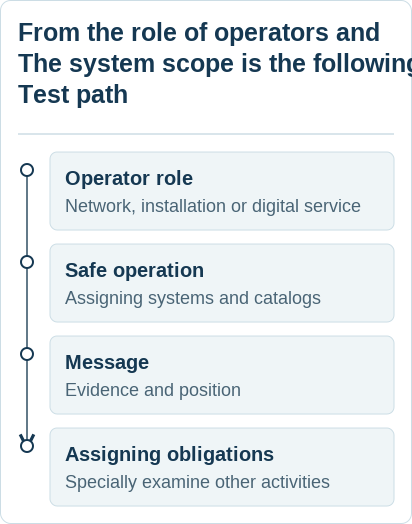
The actual role leads to the decision on obligations through the systems necessary for safe operation, the applicable catalogue and the notifier.
Small network operator with own reporting route
Situation Start with a concrete network or plant-related performance. Describe who is responsible for safe operation, which systems are required and who can actually carry out changes.
Situation
The fictitious HanseWerk Netze GmbH operates a public distribution network as an existing operator. It has 24 employees, 4 million. Euro turnover and 3 million Euro balance sheet total. Further BSIG activities and CRITIS are technically excluded in the initial case. A second product shows measured values from customer systems. The evaluation neither executes tax actions nor can it change the setting values.
Monitoring and evaluation
On 9 November 2026 at 09:15 UTC, the responsible team confirms a security incident that could severely disrupt network operations. It sends the early warning at 15:00 UTC that day and the incident notification on 10 November at 15:00 UTC. The worksheet records the outer limits of 10 November at 09:15 UTC and 12 November at 09:15 UTC, and the one-month date of 10 December. Document separately whether each report was sent without undue delay.
Reasoned decision
The network leads to the protection path according to § 5c (1) No. 1 EnWG. For this inventory constellation, registration in accordance with § 5d (4) EnWG including the legal old case date is to be proved. In fact, the display of the measured values does not fulfil the control function of a digital energy service.
Negative test
The operator will take over a water system that has already been confirmed as critical. Check the effects of § 28 para. 5 sentence 2 and 3 BSIG for additional activity and their IT. The EnWG path of the network remains comprehensible. The test order for the plant receives its own position.
- Audit record
- Comparison of the original finding and retest showing the changed condition, observed effect and closure decision.
Work result
Released allocation per energy activity, current catalog status and recalculated report calendar with source and contact point.
Working aid for your own operation
Arrange the network, plant and digital energy service of the affected operator role. Check registration, further activities and the reporting levels according to § 5d EnWG.
Energy obligations and incident timeline
Arrange the network, plant and digital energy service of the affected operator role. Check registration, further activities and the reporting levels according to § 5d EnWG.
Outcome Assignment per activity with evidence, catalogue and registration reference as well as calculated incident calendar.
Read the instructions
Fictional example N04 · A small existing network operator falls under § 5c (1) No. 1. An additional portal with a mere display is examined separately. The incident report of 10 November constitutes the monthly reference.
- Supporting the role of operators Secure actual operation, grid connection and BSIG category. In a digital energy service, the effective control function is proven.
- Keep registration and ancillary receipts Mark other activities and the special exception for an energy plant as a secondary activity. Write down the catalogue stand on the role.
- Confirm timeline and channel Calculate the detected significant incident and the actual transmitted incident report. Secure the used reporting channel.
Legal basis and official information
First check for this task
§ 5c EnWG · Scope of protection for grid, installation and digital energy service
Paragraph 1 distinguishes three roles of operators and defines the respective relation to the systems necessary for safe operation. Check which IT security catalog applies to the operator and the deadline, and include procurement in the protection planning.
§ 5d EnWG · Documentation, registration and incident reporting
Distinguishingly the documentation of the catalogue for the Federal Network Agency, registration with the BSI and the reporting stages to the reporting point according to § 32 BSIG. For existing energy supply network operators outside the BSIG categories, paragraph 4 states 6 March 2026 as a statutory event date.
§ 5e EnWG · Implementation and training by the management
Implement implementation and monitoring of the relevant catalogue and regular training in management work. Keep track of decisions with implications for your own service.

Other official references6
- IT security catalogues for energy operators (opens in new tab)
Bundesnetzagentur · Festlegung nach § 5c Abs. 2 EnWG
Check the position of the operator, the published definition and the version applicable for the reference date. The Federal Network Agency explains the continuation of the old catalogues for previous users until a new catalogue is published.
- § 3 No. 26 EnWG · Determine Digital Energy Service (opens in new tab)
Sektorales Recht · Energie, Telekommunikation, Gesundheit und Wasser
Check which system or system allows central cross-location access to control or direct influence. Describe the actual permission and operating model.
- § 28 BSIG · Particularly important and important institutions (opens in new tab)
Deutsche Anwendung · BSIG
Check legal form, actual paid activity, type of facility, size values and special cases. § 28 para. 5–8 alters the scope of obligations for certain activities or institutions.
- § 33 BSIG · General registration and changes (opens in new tab)
Deutsche Anwendung · BSIG
Document the date of classification, register proof and changes. In case of changes and critical installations, you will check the version to be applied as specified in § 66.
- Questions on digital energy services (opens in new tab)
Bundesnetzagentur · IT-Sicherheit für digitale Energiedienste
Check the registration office, catalogue status and reporting reference on the basis of official questions and legal facts.
- Register and choose the correct reporting path (opens in new tab)
BSI · Informationen für NIS-2 und MIP
The notice distinguishes NIS2 registration in the BSI portal, notifications and transitional use of MIP by certain groups.
Delimiting specialist law and critical systems in own operation
Sectoral law
Sectoral law and BSIG may be relevant to the same organisation.
Distinguishing applicable rules for financial undertakings, energy and telecommunications per service.
Work result The legal basis, decision-making, notification and appropriate evidence are visible per obligation.
Critical installations
The scope of the installation or the official time of proof shall be clarified.
Check the installation limit, transition level, reporting route and established detection date.
Work result A documented system delimitation with separate detection and reporting order.

