
NIS2, DORA and sector rules
Distinguishing applicable rules for financial undertakings, energy and telecommunications per service.
IMPLEMENTATION
EVIDENCE
What is the rule for which service?
Start with the legal entity concerned, the service and its regulatory role. § 28 BSIG contains special rules for publicly available telecommunications, energy and DORA financial companies. The standards change the scope of obligations in each case.
Arrange registration, risk management, incident reporting, management tasks and supervision separately. In case of shared evidence, the addressed institution, the legal reason and the decision point remain visible to the respective obligation.
So you go ahead
Review the activity and relevant exemption
Compare the specific performance and the affected company with § 28 para. 5 to 8, the applicable technical law and the remaining obligations.
Work result The obligation matrix with the legal basis per service.
Individually start additional activities
Determine whether the same entity offers other directly covered activities or operates relevant critical installations. Submit the system limit for these cases.
Work result Delimitation also for shared systems.
Test the reporting and supervision procedures
Check which sender reports to which location for which incident. Merge triggers and supporting documents for different reporting contexts separately.
Work result Per legal entity and activity, traceable reporting path.
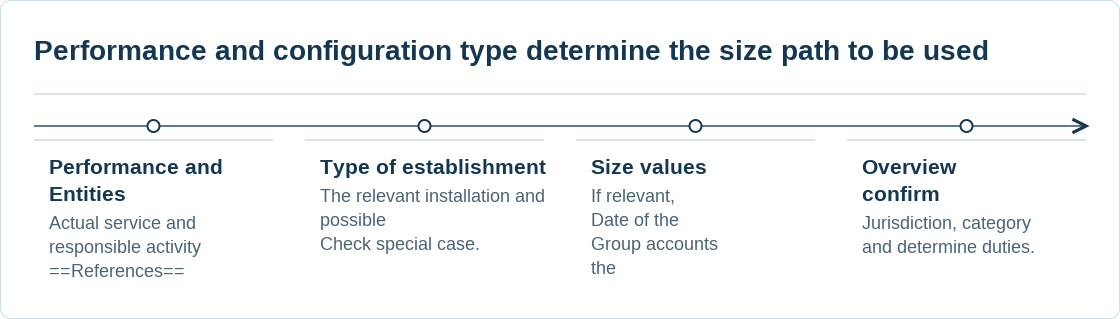
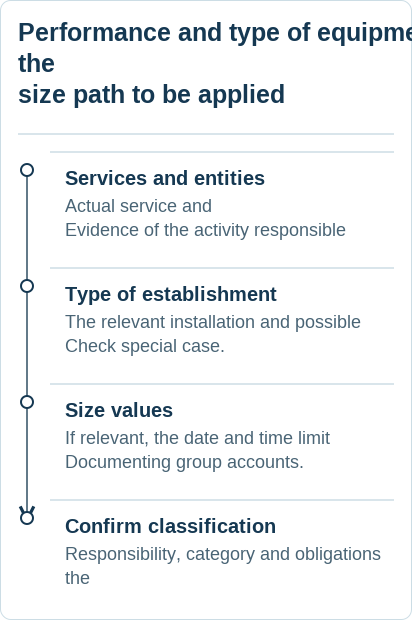
Actual performance, type of setup and special stocks determine the classification with the relevant size values.
Test example and counter-probe
Situation
A financial institution and its IT subsidiary use the same technical event receipt. The subsidiary also offers paid administration for third-party customers. Check the DORA role of the institute and then the NIS2 path of the technology company based on the service actually provided.
Negative test
Determine separately which legal reason the respective message is based on, which internal document can be used together and which registration may remain.
From the blog
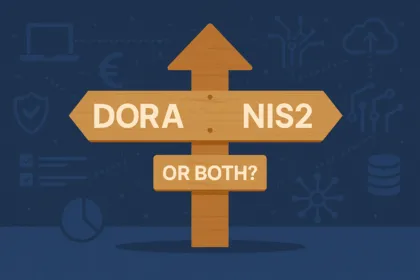
NIS2 and DORA in the same organization
The paper illustrates how companies create a common basis for work for several requirements and document decisions per role.
Work aids for your operation
Use the predictable template and check the result with the fully described example.
Affectedness and size values
Arrange activities per entity, calculate confirmed size values and record special cases and supporting documents.
Outcome The test method to be used for the calculation of the installation, size path and provisional category per activity.
Read the instructions
Fictional example HanseWerk achieves 62 annual work units with the confirmed group values. Another case with 249, 60 million. EUR turnover and exactly 43 million EUR balance sheet total remains below the main financial path.
- Legal entities and activities Enter the name, assignment, verifiable numbers and a stable reference.
- Group reference Check the partner share or full allocation and already consolidated values.
- Technically confirm decision The test shall be carried out in accordance with the following conditions:
Official references for this task
First check for this task
§ 28 BSIG · Particularly important and important institutions
Check legal form, actual paid activity, type of facility, size values and special cases. § 28 para. 5–8 alters the scope of obligations for certain activities or institutions.
Article 4 NIS2 · Union sectoral law
Check that sectoral EU rules contain at least equivalent requirements in the specific area of obligations. Keep to each obligation the relevant basis.
DORA and sectoral application
Document the application per financial company, other group company and function.

Other official references8
- § 37 BSIG · Formal exemption (opens in new tab)
Deutsche Anwendung · BSIG
In the case of an exemption notice, you shall specify the addressee, activities, expressly exempted obligations, equivalent requirements and any time limits.
- Art. 26 NIS2 · Jurisdiction and territorial link (opens in new tab)
Europäischer Rahmen · NIS-2-Richtlinie
Determine which body is responsible for each type of facility. Check the main office or the EU representative for the explicitly mentioned digital providers.
- Protection requirements for telecommunications (opens in new tab)
§ 165 TKG · Gesetze im Internet
Determine areas of protection, systems and responsibilities for the network or service.
- Notification in telecommunications law (opens in new tab)
§ 168 TKG · Gesetze im Internet
For services and networks, check the special legal reporting route and the assignment in § 28 para. 5 BSIG.
- IT security in the energy industry (opens in new tab)
§ 5c EnWG · Gesetze im Internet
Check affected plants, networks and digital energy services and keep track of the related IT security requirements.
- Documentation and reporting in the energy sector (opens in new tab)
§ 5d EnWG · Gesetze im Internet
Arrange documentation and notification per activity and prove the date of publication.
- Management obligations of the energy operators covered (opens in new tab)
§ 5e EnWG · Gesetze im Internet
Transfer the right governance basis to the governance calendar for energy activities concerned.
- Union and NIS2 sectoral law (opens in new tab)
Kommission · 2023/C 328/02
Check the equivalence and the regulations and facilities actually concerned. DORA is to be assigned separately according to Art. 1 para. 2 DORA and § 28 para. 6 BSIG.
Practically assigning specialist law
Edit the operational scope and reporting requirements for a covered energy or telecommunications service. In several activities, proof per performance is crucial.
Energy
Arrange the specific energy service, operational responsibility and the relevant safety catalogue. From this you derive the reporting path.
Telecommunications
Check whether the service is publicly accessible and which additional services are provided. Support security concept and reporting track per service.
Decide on overlaps in a specific process
Reason the individual obligation, the correct recipient and the robust scope of common documents.
Obligations and common supporting documents
Arrange the same facts to the relevant legal entities and services. Determine which proof both can use and where a separate examination is necessary.
Joint IT for energy and water
Check which functions a shared IT system for electricity and drinking water supply takes over. For both services, determine who will lose what effect.
Clearing legal entity or type of provider in individual cases
Group holding
The fictitious mother HanseWerk holds the majority of a technology company. This operates ongoing system management for companies in the group and for external customers. The Group uses a common identity system.
They want to play through the classification with concrete group data.
The fictitious HanseWerk Group checks service provider role, group values and DORA reference.
Your decision Arrange NIS2 and DORA for each entity and activity. Reason the classification and need of a NIS2 registration.
Registration
The concern is certain and data or dates must be checked.
Merge the right entity, register and confirmed notification.
Work result The competent body, released output and registration confirmation are linked to each institution.
Digital providers
The specific rule for a digital provider shall be examined.
Merge the type of supplier, technical requirements and service-specific reporting criteria.
Work result Technical requirements and incident criteria are assigned to the service actually provided.
Assign joint evidence
The starting point is the audit of the financial company.
assign common technical evidence to the relevant body and notification decision.
Work result A proof matrix per service, legal entity and obligation. Missing examinations receive their own order.

