
Is the MSP outage significant?
Evaluate user impact, duration and recurring incidents in two separate tests.
IMPLEMENTATION
EVIDENCE
Your order in managed service operation
The fictitious HanseWerk Technik provides ongoing system management for 20.000 EU users. On November 17, part of the service is only limited to 1.001 users and 61 minutes. The service was never completely out of place. The team must document the facts, the relevant alternative and the reporting route.
In addition, two events of September 8 and November 10, which were individually not significantly assessed, had the same apparent cause. The direct losses recorded amounted to 110.000 and 95.000. Total sales for the previous year amounted to EUR 4 million.
So you go ahead
Verify user base and time window
Support user base, user effect and uninterrupted time. Compare the values with both strictly exceeded limits.
Work result Applicable Art. 10 Decision.
Grouping Previous Events Separately
Check the individual assessment, cause, six-month window and the joint direct loss. Include the quarterly review.
Work result Documented case group with total losses and sources.
Keep the notification decision and counter-probe
Decide for each process, which relevant notification step is triggered. Name the facts from which the institution knew the significance.
Work result Timeline with Art. 3, Art. 4 and Art. 10 reference.
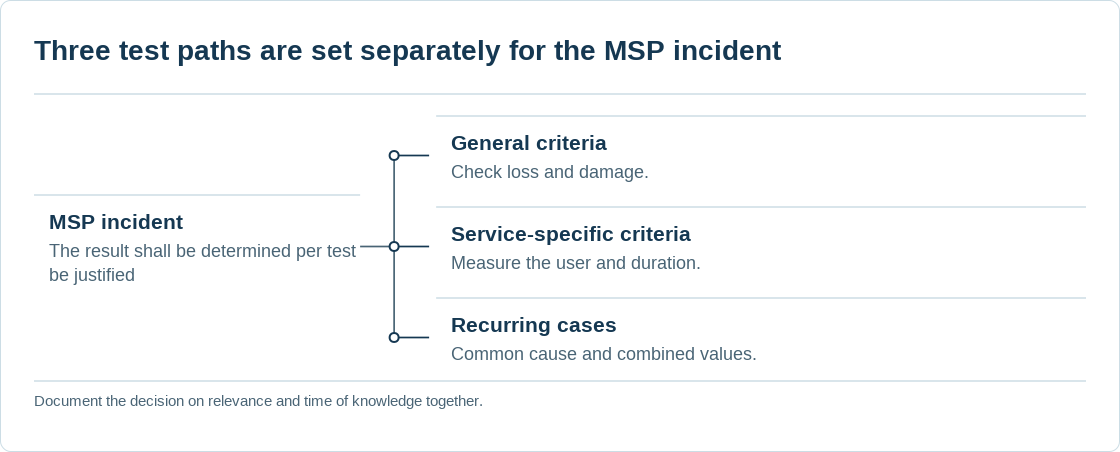
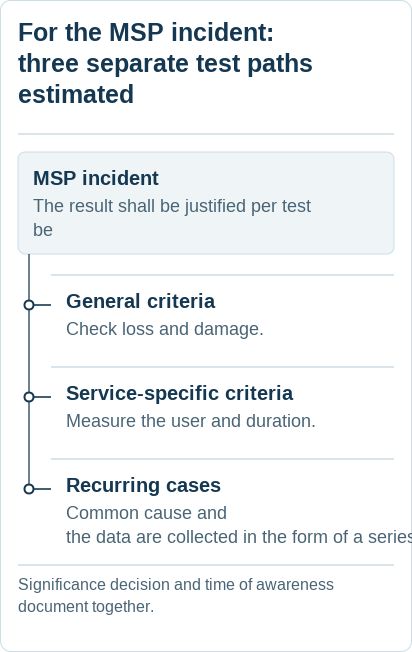
General criteria and service criteria are assessed separately, resulting in a reasoned notification decision.
Reasoned decision and counter-probe
Situation The fictitious HanseWerk Technik provides ongoing system management for 20.000 EU users. On November 17, part of the service is only limited to 1.001 users 61 minutes. The service was not completely out of service at any time.
Situation
Article 10(b) is fulfilled in the first operation because 1.001 are more than 5% of 20.000 and the limitation lasted for more than one hour. For the other two events, the loss limit is EUR 200.000. 205.000 is above this and the further conditions given in the case lead to a joint assessment.
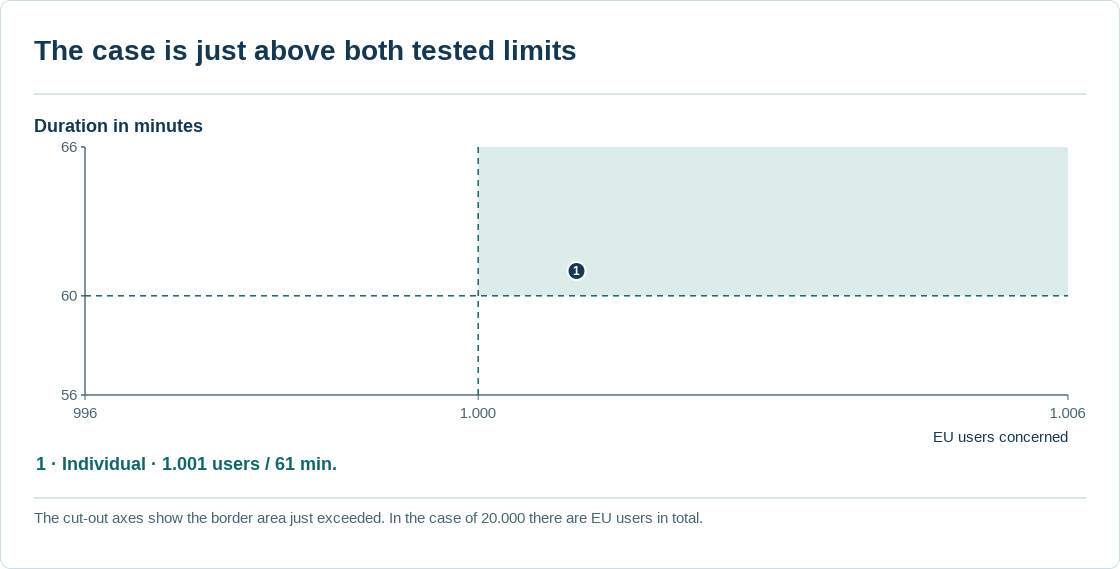
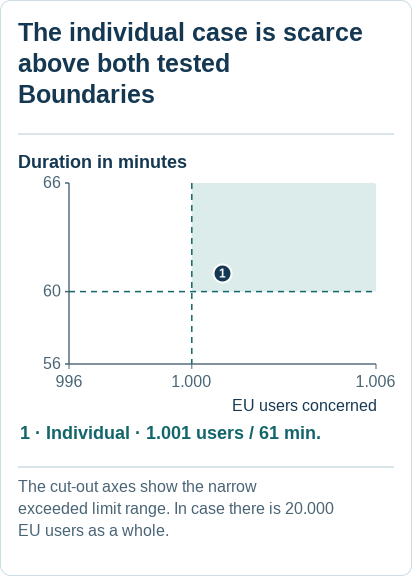
The section shows the distance to both limits in case N02. Each axis has its own evidence.
Negative test
Leave 205.000 EUR total loss for the counter-probe, but change the cause of the second event. The summary according to Art. 4 will not be shown in the example. The individual events are documented separately from this.
Work aids for your operation
Use the predictable template and check the result with the fully described example.
MSP significantity and loss threshold
Calculate selected alternatives to loss and MSP availability. Sample two additional recurring incidents.
Outcome Calculation of the tested alternatives with open questions for the substantive decision.
Read the instructions
Fictional example For 20.000 EU users, 1.001 affected persons exceed the alternative of 61 minutes according to Art. 10(b) Two similar incidents without common identifiable cause do not meet the same collective test.
- Base and effect evidence The data collected in the previous year include direct losses, EU users, partial and full loss.
- Further criteria to be assessed Evaluate all other alternatives of the DVO separately with Yes, No or Open.
- Grouping Recurring Cases examine the period, individual evaluation, cause and common sum.
Decision of incident and reporting deadlines
Support knowledge, reporting levels and recipients. Calculate the 24-hour and 72-hour limits as well as the monthly receipt.
Outcome Chronology with separate right triggers, maximum limits, shipping and reception.
Read the instructions
Fictional example A significant incident is reported around 09:30 UTC. The incident report is sent 50 hours later. The conclusion follows calendarly from the actual message. In case of an ongoing incident, the progress must be made first.
- Evidence Identify the relevant time, service concerned, competent body and facts.
- Select stages and exceptions Document regular hours profile, trust service review and individual process separately.
- Check calendar limit and shipping Technically confirm the monthly limit and special cases. Organise immediate transmission and secure all receipts.
Official references for this task
First check for this task
Art. 3 DVO (EU) 2024/2690 · Common criteria for relevance
Check the alternatives in paragraph 1 and the specificities of planned maintenance. Direct losses are driven by the lower limit of EUR 500.000 and 5% of total sales in the previous year.
Art. 4 DVO (EU) 2024/2690 · Recurring incidents
Check at least two events that are not significant in themselves within six months. Support the same identifiable cause and the jointly fulfilled criterion of financial loss.
Art. 10 DVO (EU) 2024/2690 · Considerability of MSP and MSSP
Check any applicable alternative for the managed service. In case of a partial performance, identify the EU user base and the period of limitation. In addition, check the general criteria of Art. 3.

Other official references1
- § 32 BSIG · Reporting of significant incidents (opens in new tab)
Deutsche Anwendung · BSIG
The early first report and the incident report are linked to the knowledge of the significant incident. The monthly reference follows the actual reported incident report. In case of a continuous incident, the reporting level changes.
Applying Decision for Your Digital Service
Digital providers
The specific rule for a digital provider shall be examined.
Merge the type of supplier, technical requirements and service-specific reporting criteria.
Work result Technical requirements and incident criteria are assigned to the service actually provided.
Report security incident
An event is taking place and you need to clarify the relevance and deadlines.
Track knowledge, early initial reporting, incident reporting and closure on the basis of the same event.
Legal index
They want to read a concrete reference with related checkpoints.
BSIG, EU Directive and technical requirements for your own task.

