
Report incidents under NIS2
From the confirmed time of knowledge to the proof of the last notification.
REPORTING
CLOSURE
Time of knowledge, service concerned and first order
Set the right starting point
Secure the first indication with time, time zone and performance concerned. Later in a separate line, determine when the facts available made a significant security incident understandable. This knowledge period carries both hourly periods in the regular BSIG procedure.
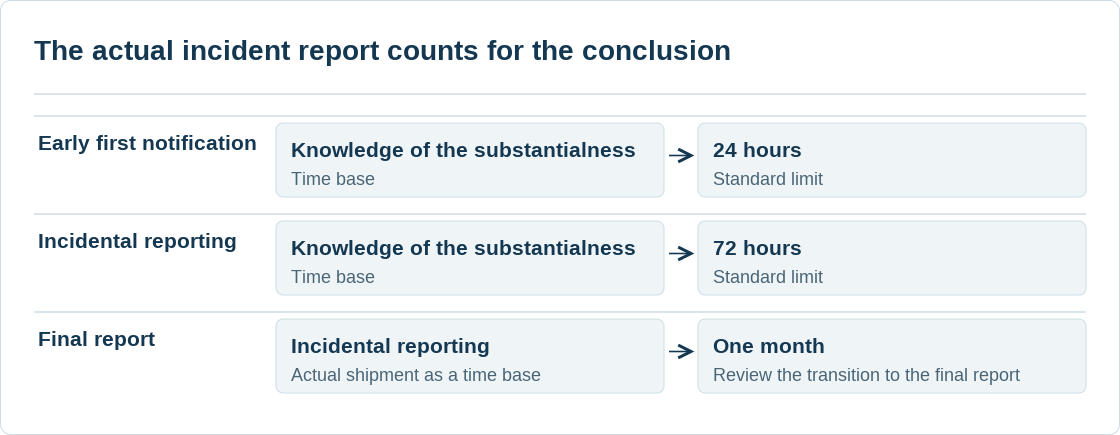
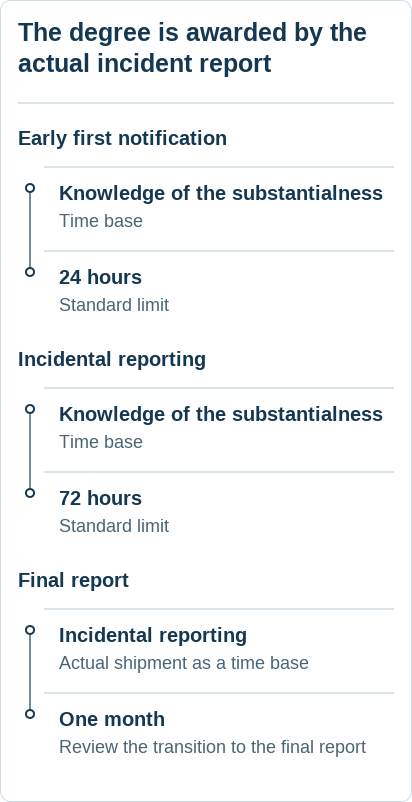
Read the first two reporting deadlines from the moment you know the significant incident. The actual date of the second reporting is decisive for the final report. Check the progress report in case of an ongoing incident.
Which reporting step fits your stand?
Reasoning incident, impact and time of knowledge
The impact or the sustainable knowledge time is still open.
You create a time note with confirmed evidence and clear open points.
Work through the caseTargeted information for users
The recipients concerned need specific information.
They shall determine the circle of recipients, the released message and the verifiable delivery.
View the guideDeriving progress report and final notification
The incident report No. 2 is already transmitted.
They check the monthly receipt as well as progress or completion.
View the guide
Four work steps from first progress to completion
Clearing the substance and jurisdiction
Check the institution concerned and the specific service. Evaluate the present effects against the relevant definition and for recorded digital services against the DVO. Capture the first viable knowledge with proven time.
Work result Decision with time basis, location and reporting.
Provide early first and incident notification
In the regular BSIG case, the maximum of 24 hours and 72 hours each start with knowledge of the significant incident. Prepare confirmed information and still open facts. Send immediately and keep the submission per step.
Work result Two separate transmission documents with actual times.
Check the status again for monthly reference
Calculate from the actual incident report No. 2. If the incident continues at the relevant date, the progress report will first be available. You submit the conclusion after the final processing.
Work result Checked status and confirmed next reporting step.
Selecting additional content and recipients
Check a requested intermediate notification, the information of affected service recipients and additional information on critical equipment independently. For this, record recipients, released version and delivery.
Work result Supplementary orders with responsible person and proof.
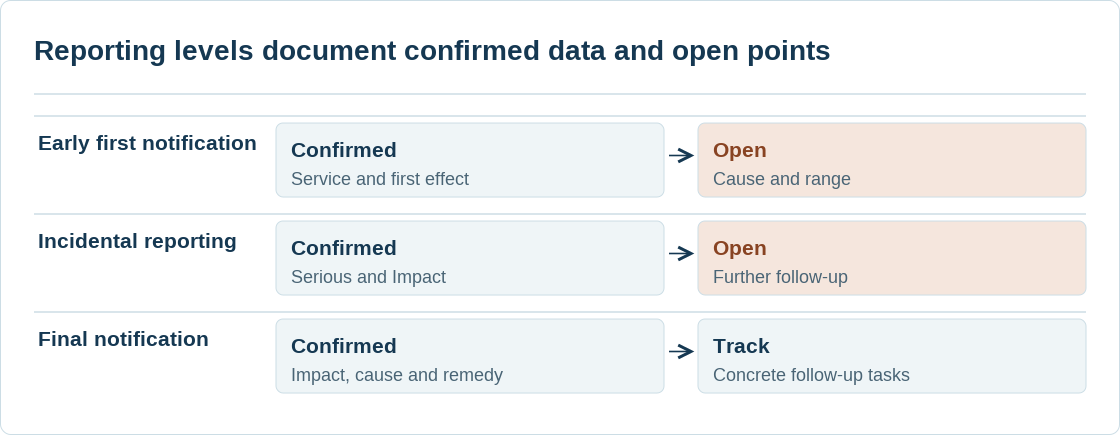
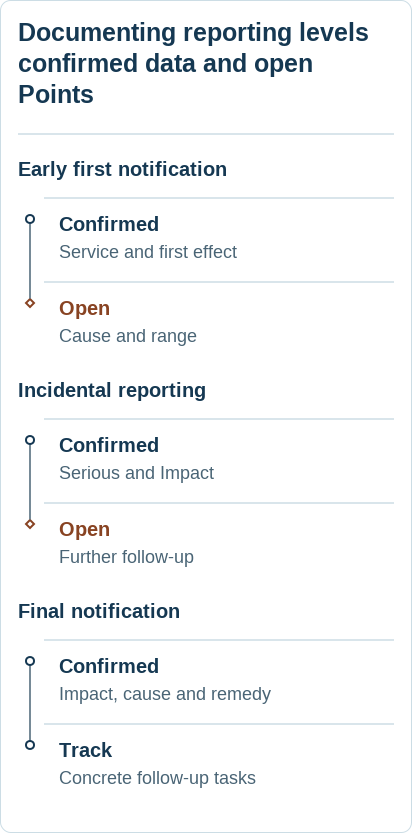
An early notification may contain confirmed effect and open cause. The following message updates the evaluation. The final report combines effects, justified cause and remedy.
Time and counter-probe test example
Calculate with the actual knowledge time
In the case of this, the facility knows the significance of November 17, 2026 at 09:30 UTC. It sends the early first report at 19:30 on the same day. The incident report follows on November 19, at 11:30 UTC. Mark all three times in the work help.
Evaluate both hourly values
The early first report follows after 10 hours. The 24-hour limit is on November 18 at 09:30 UTC. The incident report follows after 50 hours. Your 72-hour limit is on November 20 at 09:30 UTC. Also keep in mind with both charges the justification of an immediate transmission.
Deriving the monthly receipt from No. 2
The actual incident report of 19 November leads to the calculation of the month reference 19 December. Check the binding date in the concrete procedure and the processing status reached until then. In the case of the current incident, you represent progress at the relevant date.
A later delivery sample
Set the shipping from No. 2 to November 20 at 09:31 UTC. The maximum limit for this level is then exceeded by one minute. In this case, the calculation of monthly receipts is based on the actual incident report.
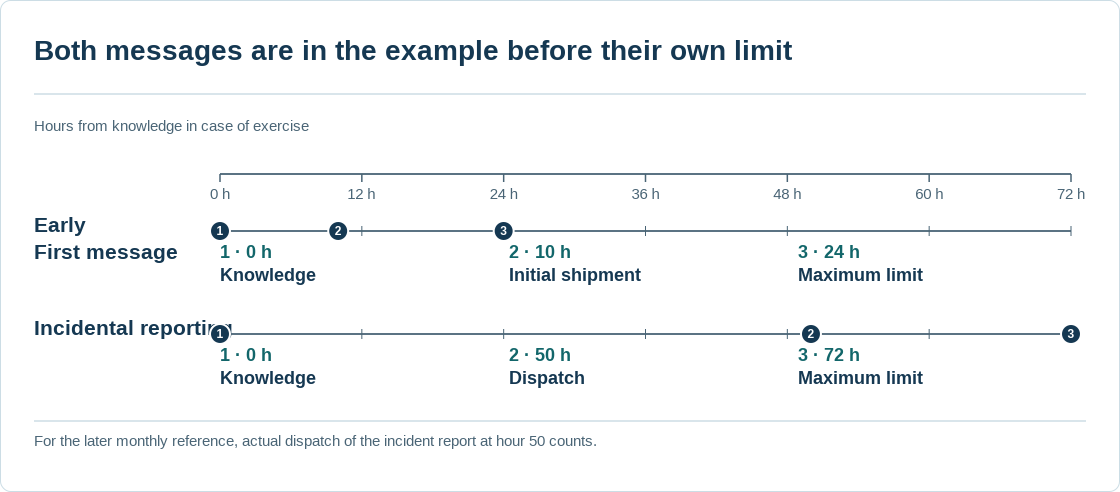
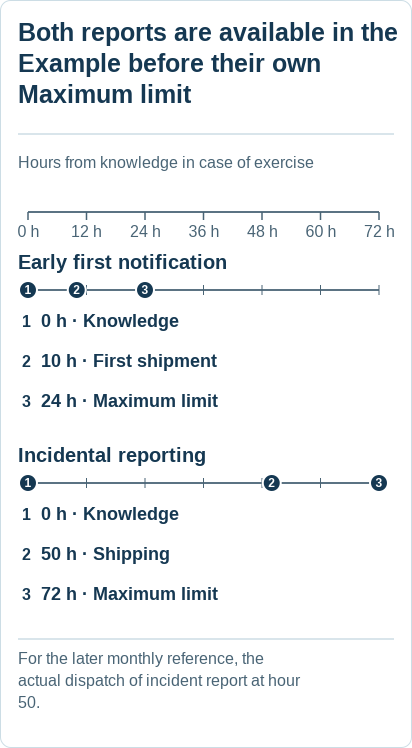
The timeline uses hours from knowledge. The early first report is at hour 10 before the 24-hour limit, the incident report at hour 50 before the 72-hour limit. The monthly reference only starts at the actual dispatch of the incident report.
Connection check for this product stand or incident
Co-ordinate notifications from manufacturers and operators
The fault concerns a BSIG device and the safety of a product. Document the two decisions independently.
View the guide
Legal basis for this task
Compare the decision from the test example with the relevant rule.
First check for this task
§ 32 BSIG · Reporting sequence from knowledge acquisition
Document when the institution has become aware of the significant security incident. Determine from this the maturity of the first two notifications and the date of the final report based on the notification.
For your exam The incident record contains information time, confirmations of receipt and notice of deadlines. It indicates when new findings were added.
§ 2 BSIG · Concepts and relevance
Arrange an observation based on the actual impact and ability to cause damage. Capture relevant terms and facts at the known time.
Register and choose the correct reporting path
The notice distinguishes NIS2 registration in the BSI portal, notifications and transitional use of MIP by certain groups.

Other official references8
- Art. 3 DVO (EU) 2024/2690 · Common criteria for relevance (opens in new tab)
Technische Vorgaben · (EU) 2024/2690
Check the alternatives in paragraph 1 and the specificities of planned maintenance. Direct losses are driven by the lower limit of EUR 500.000 and 5% of total sales in the previous year.
- § 28 BSIG · Establishment actually concerned (opens in new tab)
Gesetze im Internet
Separate the classification of the device from the classification of the incident. Capture which unit the affected service offers and on which basis it falls within the scope of application.
For your exam The endorsement of validity and the incident shall be the same as the reporting company.
- § 35 BSIG · Information to affected service recipients (opens in new tab)
Deutsche Anwendung · BSIG
Check an order for incident notification according to paragraph 1 and the sector-related communication in case of significant cyber threats according to paragraph 2. Keep balance of interests and content.
- § 36 BSIG · Feedback from the BSI (opens in new tab)
Deutsche Anwendung · BSIG
You can carry out feedback, case identification, shipping and reception times as well as queries per reporting level. Separate feedback, possible official notices and your own deadline.
- Art. 23 NIS2 · Reporting of significant security incidents (opens in new tab)
Europäischer Rahmen · NIS-2-Richtlinie
Determine the time of knowledge of the relevance and the responsible reporting route. Evaluate special periods and the applicable technical criteria per provider separately.
- Registration and notification in the BSI portal (opens in new tab)
BSI · BSI-Portal
Call on the official procedure for the appropriate legal entity. Inwardly secure proof of receipt and transmission.
- Technical requirements and criteria for relevance (opens in new tab)
Durchführungsverordnung (EU) 2024/2690 · EUR-Lex
The articles and the annex specify requirements for the specifically mentioned types of suppliers.
- Deadlines and deadlines for administrative procedures (opens in new tab)
§ 31 VwVfG · Gesetze im Internet
For a calendar period, check the specific deadline, area of responsibility and treatment of days off work.
For your own operation
Decision of incident and reporting deadlines
Support knowledge, reporting levels and recipients. Calculate the 24-hour and 72-hour limits as well as the monthly receipt.
Outcome Chronology with separate right triggers, maximum limits, shipping and reception.
Read the instructions
Fictional example A significant incident is reported around 09:30 UTC. The incident report is sent 50 hours later. The conclusion follows calendarly from the actual message. In case of an ongoing incident, the progress must be made first.
- Evidence Identify the relevant time, service concerned, competent body and facts.
- Select stages and exceptions Document regular hours profile, trust service review and individual process separately.
- Check calendar limit and shipping Technically confirm the monthly limit and special cases. Organise immediate transmission and secure all receipts.
MSP significantity and loss threshold
Calculate selected alternatives to loss and MSP availability. Sample two additional recurring incidents.
Outcome Calculation of the tested alternatives with open questions for the substantive decision.
Read the instructions
Fictional example For 20.000 EU users, 1.001 affected persons exceed the alternative of 61 minutes according to Art. 10(b) Two similar incidents without common identifiable cause do not meet the same collective test.
- Base and effect evidence The data collected in the previous year include direct losses, EU users, partial and full loss.
- Further criteria to be assessed Evaluate all other alternatives of the DVO separately with Yes, No or Open.
- Grouping Recurring Cases examine the period, individual evaluation, cause and common sum.
Choose the reporting route according to the actual performance concerned
First determine the own operator role and the performance that the fault affects. The following work pages clarify which rules apply for the service concerned and how the agency proves the transmission.
Energy
Arrange the specific energy service, operational responsibility and the relevant safety catalogue. From this you derive the reporting path.
Telecommunications
Check whether the service is publicly accessible and which additional services are provided. Support security concept and reporting track per service.
Handling a fault with several obligations
Compile the facts to the same event. Make a separate decision with recipient and time for each reportable service. The following cases show the separate reporting levels and the delimitation of common technology.
Three reporting channels
An incident occurs in the bank, telecommunications service and managed service. Determine the competent authority, the start of the deadline and your own transmission document per service.
Joint IT for energy and water
Check which functions a shared IT system for electricity and drinking water supply takes over. For both services, determine who will lose what effect.
Additional decisions for special incidents
Evaluate recurring incidents together
List of event identifiers, date and individual status.
The team can explain which events are related in the period considered, what financial loss it involves from confirmed foundations and when the common relevance was known.
Work through the casePrepare additional information for a critical installation concerned
Service and Appendix Form for notification.
The affected plant, critical service and observed or possible effect are recorded in the correct stages. The follow-up makes changes in range and duration visible.
View the guide
Prepare the next handover
Determine your own incident ID and name in writing who will take over the next reporting level. Determine confirmed facts, shipping documents and open questions with a feedback date at the same reference.
- In case of a critical installation concerned
- The investment, its critical service and actual or potential effects take up separately.
- In the case of recurring incidents
- Match individual assessments, identifiable cause, reference window and, where appropriate, direct losses.

