
Approve a change with rollback
Check critical implementation conditions, relapse test and release at the same level of change.
IMPLEMENTATION
EVIDENCE
Set the return route before release
For digital providers covered, Annex No. 6.4 of the DVO contains requirements for change management. Translate risk, dependencies and possible failure into clear release conditions. Define the conditions in which the change is aborted or withdrawn.
Name target level, permitted window, subject sample and verifiable relapse path for the change.
Release a change in the observed run
Perform the test
Mark blocking test criteria and their supporting documents. Control setpoint values, new version, relapse sample and scheduled release window. After completion, measure the observed performance again and keep track of a detectable transfer position.
Result and further processing
An executable and verifiable change or relapse decision including a subsequent test. The release point may block the start if the effect or relapse time is missed and demand the re-test.
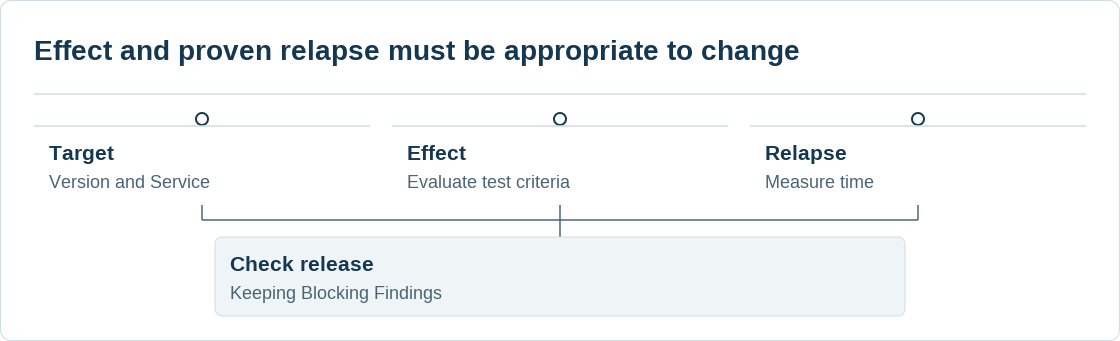
Release requires appropriate observations to change and relapse option.
Decision and counter-test
Situation For digital providers covered, Annex No. 6.4 of the DVO contains requirements for change management. Translate risk, dependencies and possible failure effects into clear release conditions.
Initial situation and observed findings
A configuration change is error-free in the test. Relapse takes 18 minutes at an internal limit of 15. The person responsible receives a documented deviation and fails to release this window. After correction and retesting, the relapse time is 12 minutes.
Negative test
Remove the proof for the modified version. Even a measured relapse time of twelve minutes will only be released when confirmed.
The own test bench
Evaluate planned changes before release using measurable mandatory criteria, tested relapse time and proven target level.
Change release and relapse test
Evaluate planned changes before release using measurable mandatory criteria, tested relapse time and proven target level.
Outcome Release decision with visible blocking findings, verified version and approved window of time.
Read the instructions
Fictional example N17 · The professional test succeeds. Relapse time is 18 minutes at 15 allowed. A documented follow-up test reaches twelve minutes.
- Set the release conditions Define the actual blocking criteria, target version and verification evidence.
- Observe relapse Measure the relapse up to the predetermined usable performance.
- Confirm decision Connect the checked stand to the designated release manager and time window.
Findings, post-test and completion
After a change, check whether the original criterion is met to a comparable extent. Track counter-test, release and date.
Outcome Reasoned financial status per finding and visible deviation from the agreed date.
Read the instructions
Fictional example N09 · The correction is documented. Only the comparable sample with counter-test and release is completed. Another criteria version and a stand without release are entered as counter-tests.
- Connect findings and first test Secure criteria, initial findings, proof and correction under the same identifier.
- Evaluate comparable sample Confirm result, counter-test, role and, if necessary, demonstrate required independence.
- Document release and appointment Collect date and release receipt. Use the valuation reference date for a comprehensible date.
Legal basis for this task
§ 30 BSIG · Risk management measures
For each relevant service, combine risks, ten fields of action, evidence and effectively verified effect. § 30 para. 3 gives priority to the technical requirements of the DVO for the providers covered there.
Annex 6 · (EU) 2024/2690 · Procurement, development and maintenance
Check the safety in selecting, changing, maintaining and controlled removal of a system under the relevant rule of the Annex.
Annex 4 · (EU) 2024/2690 · Management and crisis management
Link technical effects, restoration goals, safety test and release. Work ends with a proven business process.

Deriving the next order from the result
First, take the decisive observation from the case. Then, based on your open question, choose whether you want to check your own process or play a comparable case.
Match the setpoint configuration and observed operation
The change has been rolled out. Compare the actual status against the release.
Starting point Shared setpoint configuration, actual configuration and version state determined from the same component.
Deviating baselines with responsible decision and effective correction follow.
Work result A comparison with confirmed own risk, responsible correction and post-test on the same target.
View the guideCheck accesses and system changes in operation
A change, configuration or access must be checked during operation.
Starting point Select a service and a specific process to access, share or change the system.
Check rights, system states, cryptography and emergency communication on specific operations.
Work result The agreed target state and the observed operating status bear the approval or an open finding.
View the guide

