
One incident, three reporting paths
One event, three professional classifications and different time-limits for bank, telecommunications and managed service.
IMPLEMENTATION
EVIDENCE
Lead a common chronology and decide each performance
Clear event and affected roles
Use a common event identifier for technical observations. In addition, keep track of the reportable role, legal basis, level of knowledge and confirmed classification for each company concerned and every service concerned. For further activities of a telecommunications provider, § 28 para. 5 sentence 2 BSIG for the additionally recorded performance must be checked.
Distinguishing the timing of reports
In the DORA procedure, the calculation of the initial notification begins with knowledge of the ICT incident and with subsequent technical classification. As a rule, both limits apply. Article 5(2) of Delegated Regulation (EU) 2025/301 regulates the later classification after more than 24 hours. In the national paths, the 24 and 72 hours count from the knowledge of the significant incident. For DORA and the national paths, each basic values, work calendar and any exceptions must be documented separately.
From the test order to the secured result
The three effects of performance are defined individually
Capture public access, the service additionally managed and the banking function. Keep in mind which services and customers were affected by the disruption and when the responsible body knew this.
Work result A common event identifier with separate services and time of knowledge.
Evaluate materiality or gravity per legal basis
Check critical services and the DORA essentiality criteria for the bank. Check TK relevance according to § 168 para. 3 TKG and for the MSP the national and service-specific requirements of the DVO.
Work result Each path is based on a classification with a location, decision and relevant time of knowledge.
Calculate the time limits and transmission separately
Calculate the DORA interim period from the actual first notification sent. For NIS2 and TKG, the 72-hour limit refers to knowledge of the significant incident. Save actual transmission and receipt per operation.
Work result Three time axes with legally correct starting point and own proof reference.
Supporting update, progress and completion
For the DORA conclusion, use the intermediate message or last updated intermediate message. For the national paths, the message is number 2 of the monthly reference. If you continue to process it, check the progress report and the subsequent end of the processing.
Work result Traceable final plan for each path with documented work calendar and status.
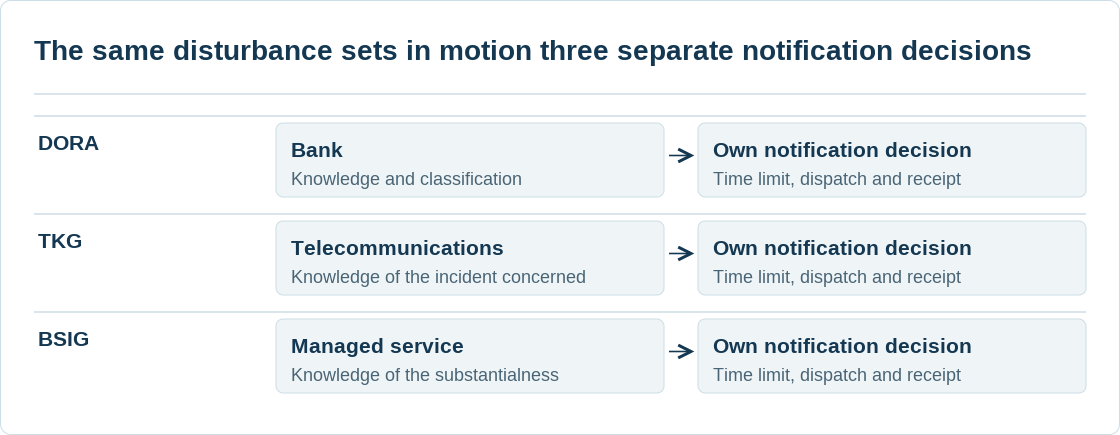
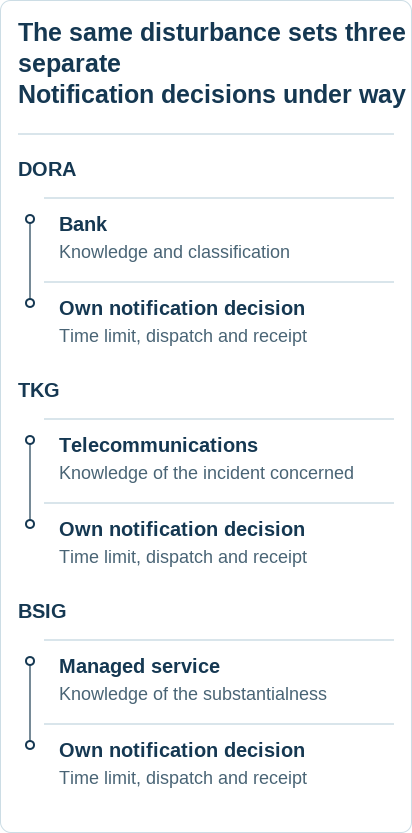
An event is assessed separately according to DORA, TKG and BSIG. Each timeline has its own starting point.
Network malfunction with three reporting decisions
Situation Use a common event identifier for technical observations. In addition, keep track of the reporting role, legal basis, level of knowledge and confirmed classification for each company concerned and every performance involved.
Situation
Under N11-E01 public Internet access and an independently operated managed service of HanseWerk Connect GmbH are affected. The role of the provider and the relevant national obligations are confirmed in the case.
A possible serious operational malfunction is confirmed in the public access. The MSP reports a significant safety incident in case of 26 minutes of confirmed full failure. For this service, the duration meets the alternative according to Art. 10 letter a DVO.
Monitoring and evaluation
The critical payment performance of Hafenbank AG is impaired. 1.200 of 10.000 customers of the service concerned and expected qualified costs of 125.000 Euro are documented. In the case of exercise, these two thresholds bear the classification as serious according to Articles 8 and 9 of Delegated Regulation (EU) 2024/1772.
Reasoned decision
The bank is familiar with the ICT incident at 18.11.2026, 08:15 UTC and classifies it at 18.11.2026, 10:45 UTC. The TKG path uses knowledge at 18.11.2026, 07:45 UTC, the MSP path at 18.11.2026, 09:20 UTC. The workbook guides the German reporting paths and the DORA path with its own transmissions. Joint technical observations are assigned to the services concerned.
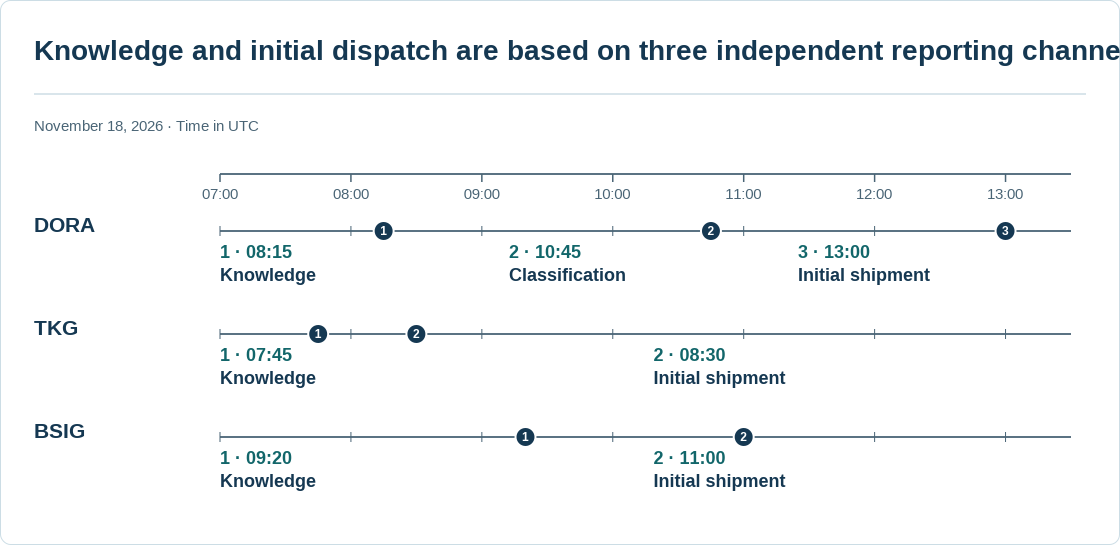
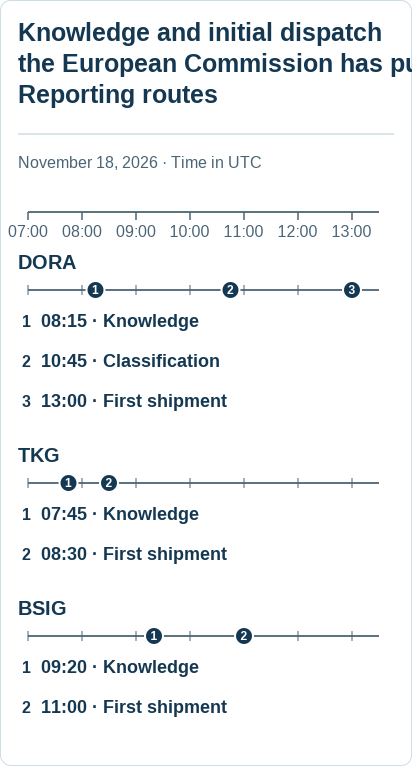
The tracks show the first events per reporting route on the same day. Follow-up messages and their deadlines are assessed separately in the workbook.
DORA
Basic period of initial notification 18.11.2026, 14:45 UTC. Interim notification within 72 hours from first shipment, here to 21.11.2026, 13:00 UTC. The last updated intermediate notification from 23.11.2026, 15:30 UTC is the monthly receipt.
TKG
Basic limits 19.11.2026, 07:45 UTC and 21.11.2026, 07:45 UTC. Follow-up from 19.11.2026, 09:10 UTC is the monthly reference.
BSIG
Basic limits 19.11.2026, 09:20 UTC and 21.11.2026, 09:20 UTC. Follow-up from 20.11.2026, 11:20 UTC is the monthly reference.
Negative test
Set the DORA classification in the counter-probe to more than 24 hours after knowledge. The four-hour limit is recalculated per DORA case. Move only the last updated DORA interim report separately. This changes the monthly reference of the bank, while the two national basic values follow from their No. 2 notifications.
Work result
A closed raw chronology and three independently verifiable reporting stands with their own legal basis and input reference.
Working aids for your own operation
Calculate the basic periods of time for the same event from the respective knowledge, classification and transmission times. Run DORA and national paths in separate sheets.
Registration deadlines for DORA, NIS2 and specialist law
Calculate the basic periods of time for the same event from the respective knowledge, classification and transmission times. Run DORA and national paths in separate sheets.
Outcome Time and receipt chains per legal entity and reporting obligation. Each reporting stage has its own time reference.
Read the instructions
Fictional example N11 · The dispatch of the DORA initial report sets the 72-hour reference for the intermediate report. In the TK and MSP thread, knowledge of the significant incident determines the 72 hours. N12 adds EnWG and critical water system.
- Confirm Concern and Classification Link the same event identifier to service, jurisdiction, knowledge and each path of confirmed classification.
- Check shipping times and steps Capture actual shipping times. Use the last relevant intermediate message or the national No. 2 message matching the path.
- Confirm calendar and transmission Check work calendar, exception and progress reference if necessary. Link the decision to the relevant reporting channel.
Obligation and detection matrix
Document legal decisions per institution and performance. Check each proof whether the scope, status, access and statement support the assigned obligation.
Outcome Reasoned obligations and comprehensible decisions on the use of common evidence.
Read the instructions
Fictional example N10 · Bank and ICT service providers use the same technical protocol. A bank position remains open until their own business sample. Case N12 shows the separate assignment of common systems.
- Legal decision per obligation Capture confirmed entities, activity, exact reference, decision, role and deadline.
- Check the proof under the same identifier Link position and document form. Confirm evidenced depth of information and actual retrievability.
- Release your own evaluation Keep in mind who has released the use and what proof is missing.
The AI and CRA signposts complement
Legal basis and official information
First check for this task
§ 32 BSIG · Reporting of significant incidents
The early first report and the incident report are linked to the knowledge of the significant incident. The monthly reference follows the actual reported incident report. In case of a continuous incident, the reporting level changes.
§ 168 TKG · Report significant security incidents in telecommunications
Determine relevance by means of paragraph 3. Use the published technical procedure for the Federal Network Agency and BSI. The monthly period follows on from the notification according to paragraph 1, sentence 1, point 2.
Content and deadlines of the reporting levels
Reporting content by level, time limit calculation, exceptions and voluntary threat reporting.

Other official references8
- Art. 10 DVO (EU) 2024/2690 · Considerability of MSP and MSSP (opens in new tab)
Technische Vorgaben · (EU) 2024/2690
Check any applicable alternative for the managed service. In case of a partial performance, identify the EU user base and the period of limitation. In addition, check the general criteria of Art. 3.
- Criteria and thresholds for ICT incidents and cyber threats (opens in new tab)
DORA · 2024/1772
Individual criteria, materiality, repeated incidents and cross-border relevance.
- § 28 BSIG · Particularly important and important institutions (opens in new tab)
Deutsche Anwendung · BSIG
Check legal form, actual paid activity, type of facility, size values and special cases. § 28 para. 5–8 alters the scope of obligations for certain activities or institutions.
- Art. 3 DVO (EU) 2024/2690 · Common criteria for relevance (opens in new tab)
Technische Vorgaben · (EU) 2024/2690
Check the alternatives in paragraph 1 and the specificities of planned maintenance. Direct losses are driven by the lower limit of EUR 500.000 and 5% of total sales in the previous year.
- Art. 23 NIS2 · Reporting of significant security incidents (opens in new tab)
Europäischer Rahmen · NIS-2-Richtlinie
Determine the time of knowledge of the relevance and the responsible reporting route. Evaluate special periods and the applicable technical criteria per provider separately.
- BaFin instructions for filling in incident reports (opens in new tab)
DORA · 2025/302
National Fillout Help. Check portal, current version and relevant notification before submission.
- Official notification templates and procedures (opens in new tab)
DORA · 2025/302
Reporting data, secure channels, updating, downgrading and possible aggregated message.
- Notification procedures for significant telecommunications incidents (opens in new tab)
Bundesnetzagentur · § 168 TKG
Open the current technical procedure with forms and the officially designated transmission channels. § 168 (1) sentence 1 No. 4 and paragraph 2 TKG is decisive for the beginning and reference point of the month period.
Further duties for the same service
Joint IT for energy and water
Arrange the systems of the energy supply network necessary for safe operation to the EnWG and the current safety catalogue.
The same technology carries grid operation and another critical system.
Check and separate distributed systems for their actual function for electricity grids and drinking water supply.
Your decision Decide for each supply, which dependency is borne and which operating status must be checked or reported.
Obligations and common supporting documents
Determine financial companies and ICT service providers as separate entities. Check Art. 1 para. 2 DORA, Art. 4 of the NIS2 Directive and the expressly stated exceptions in § 28 para. 6 BSIG.
Bank and provider want to use the same evidence.
The scope, roles and reusability of evidence between financial firms and ICT service providers.
Your decision What statement can any organization derive from the same observation? Document the remaining gap in evidence.

