
One incident, three reporting decisions
Three organisations use the same raw material.
CONFORMITY
MAINTENANCE
Starting position and test order
On May 10, 2028, a failed warning function of a networked device disrupts two regulated customers. The manufacturer knows about 09:20 UTC a confirmed serious safety incident with an impact on the safety of its product. The German water operator gains knowledge of his own significant security incident around 10:30 UTC.
A bank recognises its ICT-related incident around 10:10 UTC and considers it serious about 13:00 UTC based on its own criteria. The three documented decisions are case assumptions. They are executed by the relevant authorities.
Compare test data and consequences
Manufacturer
- Scale
- CRA knowledge on May 10 at 09:20
- Observation
- Serious product incident confirmed
- Follow
- Early warning no later than 11 May 09:20 UTC
Water operators
- Scale
- BSIG knowledge about 10:30
- Observation
- Own relevance evidenced
- Follow
- Early first notification no later than 11 May 10:30 UTC
Bank
- Scale
- Knowledge 10:10, classification 13:00
- Observation
- Four hours after classification are first reached
- Follow
- First notification no later than 10 May 17:00 UTC
An observation with three time-limit anchors
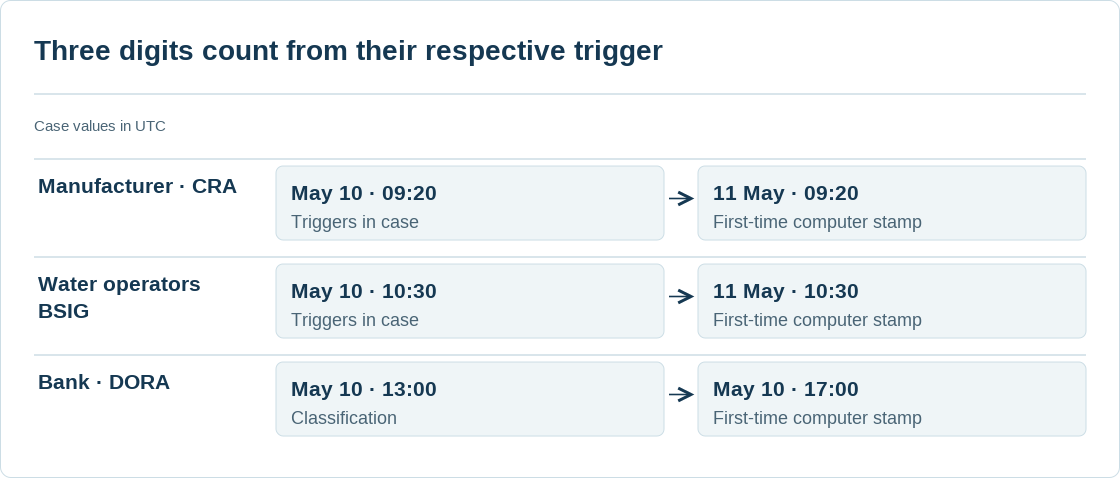
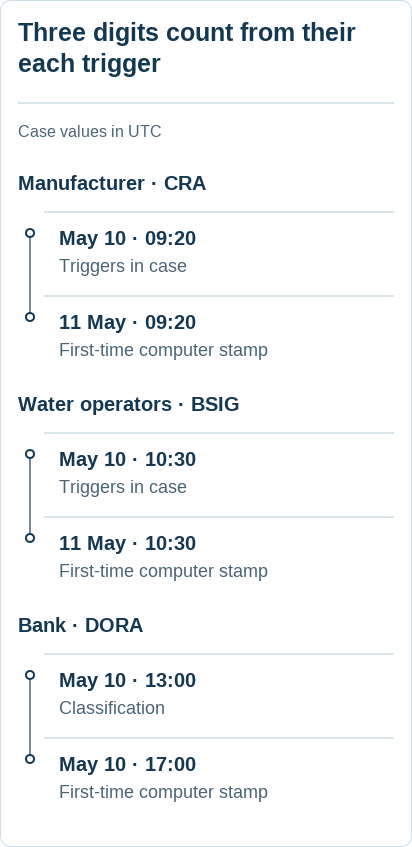
Calculate each organization with your own knowledge or confirmed classification. Actual transmissions need each organisation separately.
Edit the test step by step
Provide Versioned Common Observations
Mark the measured value, version, source and time. Distinguishingly distinguish secure and still to be confirmed information.
Testable evidence A comprehensible basis for supporting documents with a separate assignment per organisation.
Leading early decisions with their own clock
Arrange manufacturer knowledge, operator knowledge and the separate DORA times. Calculate the case-related first maximum marks.
Testable evidence Own timesheet per role with trigger, receiver and responsible delivery.
Confirm charges and subsequent update
Open separate transmission documents for each roll. Secure deviations and check the following steps of the respective rules.
Testable evidence Three independent traces with a comprehensible common event number.
Worked decision and negative test
Decision in case
In the case of practice, each organisation sets its own first maximum mark. The obligation to report quickly is already in force. The 72-hour mark for a DORA intermediate message refers to the actual first notification, while the first 72-hour marks in the CRA and BSIG examples link to their own knowledge.
The bank ensures its own classification and delivery to the competent authority. Linked original documents and comprehensible references are sufficient for the joint file. Three reports transmitted are confirmed separately.
Counter-sample and impact
Do not accept the confirmed DORA classification and keep track of the incident. The bank has an open placement order and no calculated first mark for a case considered serious. The confirmed CRA and BSIG reporting channels and their time-receipts remain valid.
Templates and worksheets
Document initial messages per organisation
Calculate the first registration marks for three confirmed decision-making paths and secure their charges.
Outcome Separate reporting files per legal entity with time, competent authority, receipt and reference to common chronology.
Read the instructions
Fictional example Manufacturers, water operators and banks know different triggers. The bank classifys its incident at 13:00 clock.
- Identify the starting situation The information provided shall be recorded on the same time basis and, where appropriate, on the same classification.
- Run the test Matching your own competent transmission and calculated plan mark.
- Secure decision and evidence Secure receipts and follow-up tasks for each reporting track.
Official sources
First check for this task
Cyberresilience Regulation in text
Use the article or attachment that regulates the task to be solved.
Declarants and time limits for manufacturers
Separate the time-covers for active use and serious product incidents.
Central reporting platform for the CRA
Check the access, the reporting route and the location of the transmission document.

Other official references3
- Reporting obligations of the entities covered (opens in new tab)
Gesetze im Internet · § 32 BSIG
Confirm knowledge, relevance, reporting levels and the appropriate reporting route of the institution.
- DORA-Reporting contents and deadlines (opens in new tab)
EUR-Lex · Delegierte Verordnung (EU) 2025/301
Compare the time of knowledge and classification with Art. 5 and the real taxes.
- DORA classification and materiality thresholds (opens in new tab)
EUR-Lex · Delegierte Verordnung (EU) 2024/1772
Support the critical service concerned and the criteria that are actually relevant.
What depends on your result?
Co-ordinate notifications from manufacturers and operators
Transfer the same test criteria to your own product and save the different starting data.
View the guideAssigning evidence between DORA and NIS2
Two regulated organisations want to use the same records and demonstrate their respective responsibilities.
View the guideSeparate reporting tracks
Complete the notification decision of an affected AI provider and continue to check with its criteria and recipients.
View the guide

